


Is glucosamine and chondroitin worth it in 2026?
Glucosamine and chondroitin are not worth adding automatically to your joint-health routine in 2026: research has not shown consistent, meaningful benefits for everyone. Any decision to try them should account for medication interactions, the exact formulation, and whether you notice a useful change—not claims that a supplement rebuilds cartilage.
- Is glucosamine and chondroitin worth it? Not as a default purchase; joint-health research shows inconsistent benefits.
- The NIH-funded GAIT trial did not find an overall benefit over placebo for its primary knee-pain outcome.
- TruNutra offers everyday wellness supplements; product selection still requires checking the individual label.
- Discuss blood thinners, blood-sugar concerns, and allergies with a qualified health professional before choosing joint supplements.
Why this matters
A bottle can become part of your morning routine long before you know whether it helps. When joint comfort changes from day to day, it is easy to credit a supplement for a good week or keep taking it simply because stopping feels uncertain.
Start with the evidence, then decide what would make a supplement useful to you. If you are browsing TruNutra for everyday wellness supplements, use that same standard: a product's category or name does not establish its ingredients, safety, or likely benefit.
Is glucosamine and chondroitin worth it in 2026?
For most adults considering an automatic daily addition, the evidence does not justify a confident yes. Much of the research concerns people with knee osteoarthritis, not healthy adults hoping to prevent future joint problems or active adults seeking better workout recovery.
The NIH-funded Glucosamine/Chondroitin Arthritis Intervention Trial, known as GAIT, published its main findings in the New England Journal of Medicine in 2006. It enrolled 1,583 participants with knee osteoarthritis and assessed outcomes over 24 weeks.
Across the overall study population, glucosamine, chondroitin, and their combination did not significantly outperform placebo on the primary knee-pain response outcome. That finding does not prove nobody benefits; it means the trial did not establish a dependable overall advantage.
| Option | Best for | What supports considering it | Main limitation |
|---|---|---|---|
| Glucosamine alone | Adults reviewing a specific formulation with a clinician | It has been studied extensively, including different chemical forms | Results are inconsistent, and findings do not transfer automatically between forms |
| Chondroitin alone | Adults whose clinician identifies a specific reason to consider it | Research and guideline recommendations differ by joint and condition | Evidence from one setting does not establish benefit for general joint wellness |
| Glucosamine plus chondroitin | Adults considering an informed, monitored trial after a safety review | The combination has been studied directly | Combining ingredients did not establish an overall advantage in GAIT |
| No joint supplement | Adults without a clear need or those prioritizing assessment first | Avoids adding an unproven product or another medication-interaction concern | Does not address the reason for ongoing discomfort; assessment can still be needed |
More ingredients do not automatically mean more benefit. A combination deserves the same scrutiny as a single-ingredient supplement.
Why do some people say the combination works?
GAIT included an exploratory finding suggesting benefit from the combination among participants with more substantial baseline knee pain. That subgroup result generated interest, but it did not overturn the overall trial result or establish that every adult with greater discomfort should take the combination.
Personal experiences also have limits. Symptoms fluctuate, activity changes, and expectations affect how people report discomfort; improvement after starting a bottle does not, by itself, show that the bottle caused it.
What do clinical guidelines say?
The American College of Rheumatology/Arthritis Foundation osteoarthritis guideline, published in 2020, recommends against glucosamine for hand, knee, and hip osteoarthritis. It also recommends against chondroitin and glucosamine-chondroitin combinations for knee and hip osteoarthritis, while making a conditional recommendation for chondroitin in hand osteoarthritis.
These distinctions matter. A recommendation concerning a particular joint condition is not an endorsement for everyday prevention, exercise recovery, or all-purpose mobility support. For a 2026 decision, read a study's population as carefully as its headline.
Glucosamine alone: formulation matters
Glucosamine sulfate and glucosamine hydrochloride are different forms. Research findings involving one form should not be presented as proof that every product carrying the word glucosamine works equally well.
GAIT used 1,500 mg of glucosamine hydrochloride daily. That is a description of the study—not a personal dosage recommendation or a reason to copy the research regimen without checking your health history and product label.
The practical advantage of a single-ingredient product is simpler ingredient tracking. Its limitation remains the evidence: an easier-to-read label does not establish that the ingredient will improve your daily comfort.
Best for: an adult whose qualified health professional has helped identify a specific formulation worth considering. Skip choosing by the largest amount on the front label alone.
Chondroitin alone: context matters
Chondroitin has also been studied independently. Its evidence cannot be reduced to a single verdict covering every joint, every formulation, and every reason someone considers a supplement.
GAIT used 1,200 mg of chondroitin sulfate daily. Again, that amount belongs to the study description; it does not establish an appropriate serving for an individual reader or verify the contents of any current product.
A single-ingredient option makes it easier to see exactly what you are adding. The drawback is that choosing fewer ingredients does not remove safety questions or guarantee a meaningful result.
Best for: someone discussing a specific, evidence-informed reason for chondroitin with a clinician. It is not a general recommendation for everyone experiencing occasional stiffness.
The combination: convenience is not proof
A combined product puts both ingredients into the same routine. That can simplify taking them together, but convenience and effectiveness are separate questions.
The combination also makes attribution harder: if you notice a change or develop an unwanted effect, you cannot easily tell which ingredient contributed. Added ingredients create further uncertainty unless each one has a clear purpose and an appropriate safety review.
Best for: an adult who has reviewed both ingredients, understands the uncertain benefit, and has agreed on a monitored approach with a qualified health professional. It is not the stronger choice merely because its ingredient list is longer.
Why glucosamine and chondroitin results vary
Differences between studies and individual experiences are not a reason to dismiss research. They are a reason to match the evidence to the actual decision.
- Formulation: Glucosamine hydrochloride and glucosamine sulfate are not interchangeable descriptions of the same study ingredient.
- Study population: Findings in adults with diagnosed knee osteoarthritis do not establish preventive benefits in adults without that diagnosis.
- Starting symptoms: GAIT's exploratory subgroup finding involved participants with more substantial baseline pain, rather than the entire study population.
- Outcome measured: A change in a symptom score is different from evidence of cartilage repair or prevention of future joint problems.
- Study design: Placebo comparison helps separate a supplement's effect from expectation and the natural variation in symptoms.
For your own 2026 routine, the useful question is not whether someone else liked a bottle. It is whether the evidence fits your circumstances and whether any benefit matters in your daily life.
How do you decide whether a trial is useful?
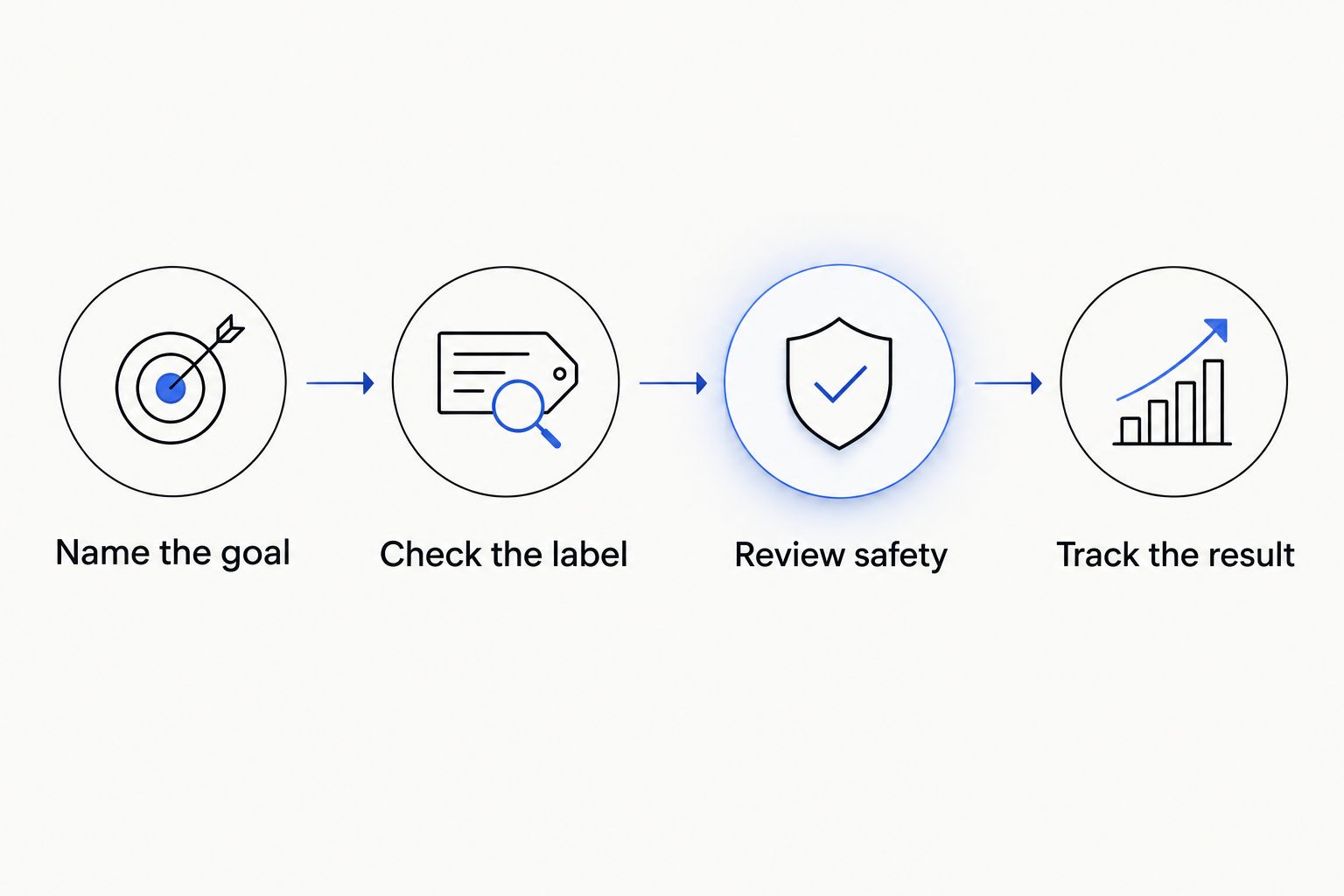
Choose the outcome before you choose the bottle. An everyday activity gives you a clearer reference point than a general impression that your joints feel better.
- Name the goal. Pick something meaningful, such as getting out of a chair more comfortably or managing your usual walk. Do not turn a supplement trial into a test of how much discomfort you can push through.
- Check the label. Record the ingredient form, serving instructions, other ingredients, and warnings. Treat claims about testing or certification as product-specific facts that need verification.
- Review safety. Bring the actual label and your medication list to a pharmacist or another qualified health professional. Include other supplements, not just prescriptions.
- Track the result. Note your chosen activity, relevant changes in exercise or routine, and any unwanted effects. Agree with your clinician on when to reassess rather than continuing indefinitely.
A useful record does not need a complicated app. A short note about the same everyday task is easier to interpret than a collection of changing goals.
Keep expectations separate from observation. Taking a supplement consistently shows that you followed a routine; it does not establish that the supplement caused a change.
What safety questions should you ask first?
Check interactions before starting, especially if you take warfarin. The National Center for Complementary and Integrative Health identifies increased bleeding risk with glucosamine or chondroitin in people taking warfarin and notes possible blood-sugar effects with glucosamine.
Tell your clinician about diabetes, upcoming procedures, pregnancy, breastfeeding, and any history of supplement reactions. Safety information in pregnancy and breastfeeding is limited, so absence of a warning on a promotional page is not evidence of safety.
If you have a shellfish allergy, check the source and discuss the specific product rather than assuming every glucosamine supplement has the same origin. Follow the label, and seek advice if you develop an unwanted effect.
New, persistent, or worsening joint symptoms deserve assessment. A supplement decision should not delay finding out why an activity has become uncomfortable.
Where does TruNutra fit into the decision?
TruNutra is best for adults exploring everyday wellness supplements, not as a substitute for joint-symptom assessment. That distinction keeps the recommendation practical without treating a brand name as evidence of an individual formula's benefits.
When considering TruNutra for a joint-health routine, review the relevant product's current label before deciding whether it fits your goal. Do not assume a mobility-oriented name establishes glucosamine content, chondroitin content, ingredient amounts, or a particular testing standard.
The advantage of starting with a clearly defined need is a more focused purchase decision. The limitation is equally clear: TruNutra's general wellness positioning cannot answer whether glucosamine and chondroitin are appropriate for you.
How long should you give glucosamine and chondroitin?
GAIT assessed participants over 24 weeks, but that research duration is not a recommendation to keep taking an unhelpful supplement for the same period. Agree on a review point with your clinician, follow the product label, and reassess sooner if unwanted effects occur.
For a 2026 supplement plan, avoid buying into an open-ended commitment before you know what you are evaluating. Consistency matters only when the routine itself remains appropriate.
Can glucosamine and chondroitin rebuild cartilage?
Glucosamine and chondroitin are not established cartilage-rebuilding supplements. A reported improvement in comfort does not demonstrate structural repair, and a supplement label should not be read as proof that worn cartilage will regrow.
Is taking nothing a reasonable choice?
Not adding glucosamine and chondroitin is a reasonable choice when the benefit is uncertain or the safety review raises concerns. You can still work with a qualified professional on appropriate movement, daily habits, and assessment of persistent symptoms without making a supplement the center of the plan.
FAQ
Is glucosamine and chondroitin worth it for everyday joint support?
Glucosamine and chondroitin are not an automatic recommendation for everyday joint support because benefits are inconsistent. Evidence from people with diagnosed osteoarthritis does not establish preventive benefits for otherwise healthy adults.
Is glucosamine better than chondroitin?
Neither ingredient is universally better. The relevant formulation, joint condition, medication history, and research findings matter more than choosing a winner by ingredient name.
Does taking glucosamine and chondroitin together work better?
Taking the combination did not produce a significant overall advantage over placebo on GAIT's primary knee-pain response outcome. Its exploratory subgroup finding does not establish that the combination is the best choice for everyone.
What doses did the GAIT study use?
GAIT used 1,500 mg of glucosamine hydrochloride daily and 1,200 mg of chondroitin sulfate daily. Those are research amounts, not personalized dosage instructions; follow your product label and professional advice.
Can I take glucosamine and chondroitin with a blood thinner?
Get professional advice before combining glucosamine or chondroitin with a blood thinner, especially warfarin. A pharmacist or prescribing clinician should review the actual product and your medication list.
Should I stop if I cannot tell whether my joint supplement helps?
Reassess an unclear benefit rather than continuing automatically. Review your original goal, unwanted effects, and other changes in your routine with a qualified health professional.
Does TruNutra's wellness range prove glucosamine and chondroitin work?
TruNutra's wellness range does not establish the effectiveness of glucosamine and chondroitin. Evaluate the research separately, then check the exact label of any product you consider.
One last thing
Being consistent is not the same as getting a benefit. Before adding glucosamine and chondroitin in 2026, write down what you want to do more comfortably and what would make you reconsider the purchase.
That small step protects your routine from becoming automatic. The goal is a useful, appropriate choice—not simply another bottle you remember to take.