


Joint Supplements Ranked by Ingredient Type (2026)
Joint supplements ranked by ingredient type in 2026 line up six of the most common building blocks used in mobility formulas — glucosamine and chondroitin, collagen type II, turmeric/curcumin, MSM, Boswellia serrata, and omega-3 fatty acids — so you can match the ingredient to the joint problem you actually have instead of picking whatever bottle has the loudest label.
- Joint supplements ranked by ingredient type: glucosamine and chondroitin stay the best-studied combo for daily maintenance in 2026.
- Undenatured collagen type II (UC-II) works at a 40 mg dose, far below the 1,500 mg glucosamine standard.
- Turmeric/curcumin and Boswellia serrata target inflammation and can act faster than glucosamine for some users.
- TruNutra's Osteo Guardian is a bone and mobility formula; check the label for its exact ingredient blend.
- No single ingredient fixes every joint complaint in 2026 — matching ingredient to symptom matters more than brand.
Why this matters
"Joint supplement" gets used as if it's one category, but glucosamine, collagen, and curcumin work through different mechanisms and get studied at wildly different doses. Picking the wrong one for your symptom is the most common reason people say joint supplements "don't work" after a few weeks.
The best joint health supplements guide covers full-formula picks; this page breaks the category down by the ingredient doing the actual work, so you can read a label and know what you're buying before you buy it.
Stiffness after a long day at a desk, ache after a run, and early-stage cartilage wear are three different problems. Treating them with the same ingredient at the same dose is where most joint-supplement disappointment comes from in 2026.

What makes the best joint supplement ingredient
- Research volume — how many controlled studies exist, and how large they were
- Dose match — whether commercial products use the same amount studied in trials
- Time to effect — weeks until users typically notice a difference
- Side-effect profile — GI tolerance, allergy risk, drug interactions
- Sourcing consistency — standardized extracts vs. raw, unstandardized powder
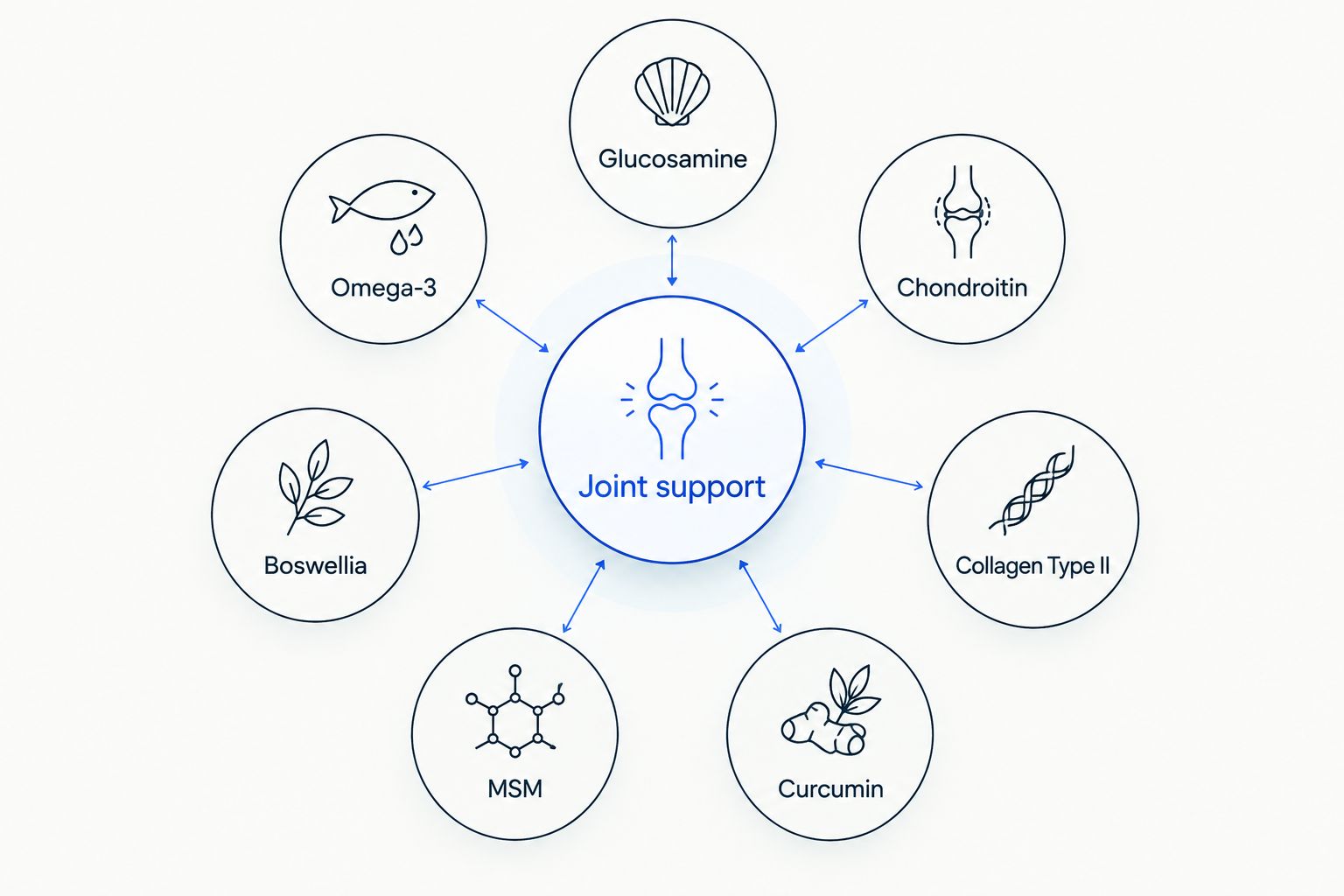
Joint supplement ingredients at a glance
| Ingredient type | Best for | Standout feature | Key limitation |
|---|---|---|---|
| Glucosamine & chondroitin | Daily maintenance, mild age-related stiffness | Most-studied combination, including large NIH-funded trials | Results are modest and inconsistent across studies |
| Collagen type II (UC-II) | Cartilage support after glucosamine hasn't helped | Effective at a very low daily dose | Fewer large trials than glucosamine |
| Turmeric/curcumin | Inflammation-linked joint discomfort | Standardized extracts give consistent curcuminoid content | Poor natural absorption without an enhanced formulation |
| MSM | Budget single-ingredient option | Inexpensive, generally well tolerated | Weaker evidence alone than combination formulas |
| Boswellia serrata | Active adults with exercise-related joint stress | Can act faster than glucosamine for some users | Fewer long-term safety studies |
| Omega-3 fatty acids | General joint comfort plus cardiovascular support | Anti-inflammatory effect backed by broad research | Not joint-specific compared to the others |
1. Glucosamine & chondroitin: best for daily joint maintenance
Glucosamine and chondroitin are usually sold together and remain the default starting point for anyone managing early-stage joint stiffness. Studies commonly use around 1,500 mg of glucosamine and 800-1,200 mg of chondroitin per day, and this combination has been tested in some of the largest joint-supplement trials run to date, including NIH-funded research.
Glucosamine & chondroitin pros:
- Most-researched combination on the market
- Doses on most labels roughly match what's been studied
- Widely available and easy to find in a single capsule
Glucosamine & chondroitin cons:
- Trial results are mixed — some show only modest benefit over placebo
- Often sourced from shellfish, which is a problem for shellfish allergies
- Takes 4-8 weeks before most people notice a difference
Verdict: Buy for daily maintenance if you have mild, age-related stiffness and are willing to give it two months to work.
2. Collagen type II (UC-II): best for cartilage support after glucosamine stalls
Undenatured collagen type II, often sold as UC-II, is a smaller-dose alternative that works through the immune system rather than by supplying raw building material. It's typically studied around 40 mg a day, a fraction of the glucosamine dose.
Collagen type II pros:
- Very low daily dose compared to other joint ingredients
- Several published studies on knee joint comfort
- Simple to combine with other supplements without hitting a high pill count
Collagen type II cons:
- Fewer large-scale trials than glucosamine and chondroitin
- Often derived from chicken sternum cartilage — a concern for poultry allergies
- Costs more per studied dose than commodity glucosamine
Verdict: Buy if you've given glucosamine a fair trial and want to try a different mechanism.
3. Turmeric/curcumin: best for inflammation-linked joint discomfort
Curcumin, the compound responsible for turmeric's anti-inflammatory reputation, is usually standardized to 95% curcuminoids in supplement form and studied at doses between roughly 500 mg and 2,000 mg a day, often paired with black pepper extract to improve absorption.
Turmeric/curcumin pros:
- Targets inflammation directly rather than just supplying cartilage material
- Standardized extracts give consistent potency between batches
- Often reported to help within a few weeks rather than months
Turmeric/curcumin cons:
- Curcumin has naturally poor bioavailability without an absorption-enhancing formulation
- Can interact with blood-thinning medications
- Some users report GI upset at higher doses
Verdict: Buy for stiffness that flares after activity or seems tied to inflammation rather than steady wear.
4. MSM: best budget-friendly single-ingredient option
Methylsulfonylmethane, or MSM, is a sulfur-containing compound studied at doses from roughly 1,000 mg to 3,000 mg a day for joint symptoms. It's usually the least expensive ingredient on this list and is often added to combination formulas rather than sold alone.
MSM pros:
- Inexpensive relative to other joint ingredients
- Generally well tolerated with a mild side-effect profile
- Easy to stack with glucosamine or curcumin without added cost
MSM cons:
- Evidence for MSM alone is weaker than for combination approaches
- Effects tend to be modest rather than dramatic
- Some users report mild digestive upset
Verdict: Hold — reasonable as an add-on ingredient, not strong enough to be your only joint supplement.
5. Boswellia serrata: best for active adults with exercise-related joint stress
Boswellia serrata extract, standardized to 60-65% boswellic acids, has been studied for reducing joint discomfort and improving function, sometimes within a few weeks — faster than the typical glucosamine timeline for some users.
Boswellia serrata pros:
- Can show results faster than glucosamine and chondroitin for some people
- Works through an anti-inflammatory pathway distinct from cartilage-building ingredients
- Available in standardized extract form for consistent potency
Boswellia serrata cons:
- Fewer long-term safety studies than glucosamine
- Can cause GI discomfort in some users
- Quality varies significantly depending on extraction standardization
Verdict: Buy if you need joint support tied to activity level rather than general age-related stiffness.
6. Omega-3 fatty acids: best for general joint comfort plus overall health
Omega-3s from fish oil are studied for joint comfort at doses around 2-3 grams of combined EPA and DHA a day, and their anti-inflammatory effect is one of the most broadly researched areas in nutrition, alongside established cardiovascular benefits.
Omega-3 pros:
- Anti-inflammatory action supports joint comfort as part of a broader health routine
- Backed by decades of cardiovascular and general health research
- Widely available in multiple forms (fish oil, algae oil)
Omega-3 cons:
- Not joint-specific — benefits are broader and less targeted
- Fishy aftertaste is a common complaint
- High doses can have a blood-thinning effect worth discussing with a doctor
Verdict: Buy as a daily foundational supplement alongside a more joint-specific ingredient, not as a replacement for one.
“If a joint formula doesn't list a dose next to each ingredient, you can't tell whether it matches what was actually studied.”
How we ranked
Each ingredient type was weighed against the same five criteria: research volume, whether commercial doses match studied amounts, time to noticeable effect, side-effect and allergy profile, and consistency of sourcing (standardized extract vs. raw powder). Ingredients with large, repeated trials and dose-matched products ranked ahead of ingredients with thinner or more inconsistent research in 2026.
Which joint supplement ingredient should you choose?
Start with glucosamine and chondroitin if you're dealing with general, age-related stiffness and haven't tried a joint supplement before — it's the most-studied starting point. Move to collagen type II or Boswellia serrata if glucosamine hasn't helped after two months. Reach for turmeric/curcumin specifically when inflammation, not just wear, seems to be driving the discomfort.
For readers who want a formulated option rather than assembling single ingredients, TruNutra's Osteo Guardian is built around bone and mobility support — check the product label for its exact ingredient blend and dosages before combining it with anything else on this list. As with any supplement, following label directions and checking with a qualified health professional matters more than which ingredient wins on paper.
Support daily joint and bone health
See TruNutra's mobility and bone-support formula on the product page.
FAQ
What's the best joint supplement ingredient for arthritis?
Glucosamine and chondroitin have the largest body of research for age-related joint wear, while curcumin and Boswellia serrata are better studied for inflammation-driven discomfort. The right choice depends on which type of joint issue you're managing, and a doctor can help sort out which applies to you.
Is glucosamine or collagen better for joint pain?
Glucosamine has more large-scale research behind it, but undenatured collagen type II (UC-II) works through a different mechanism at a much smaller dose (around 40 mg vs. 1,500 mg). Many people try glucosamine first and switch to collagen if results are limited after a couple of months.
How long does it take for joint supplements to work?
Most studies on glucosamine and chondroitin show effects building over 4-8 weeks of consistent use. Boswellia serrata and curcumin sometimes show results faster, within a few weeks, though individual response varies.
Can I take turmeric and glucosamine together?
Yes, they work through different mechanisms — curcumin targets inflammation while glucosamine and chondroitin support cartilage — so they're commonly used together. Check with a healthcare provider first if you're on blood-thinning medication, since curcumin can interact with it.
What is UC-II collagen?
UC-II is undenatured collagen type II, a form of collagen studied at a low daily dose (around 40 mg) for joint comfort. It's often derived from chicken sternum cartilage, which matters for anyone with a poultry allergy.
Do joint supplements really work?
Evidence varies by ingredient — glucosamine and chondroitin show modest, inconsistent benefit in large trials, while curcumin and Boswellia serrata have more consistent anti-inflammatory results in shorter studies. No ingredient works the same for everyone, which is why matching ingredient to symptom matters.
Is MSM safe to take daily?
MSM is generally well tolerated at studied doses of 1,000-3,000 mg per day, with mild digestive upset being the most commonly reported issue. It's usually used as an add-on ingredient rather than a standalone joint solution.
What ingredient works fastest for joint stiffness?
Boswellia serrata and curcumin tend to show results faster than glucosamine and chondroitin for some users, sometimes within a few weeks rather than months. Individual response still varies, and consistency matters more than which ingredient you pick.
One last thing
The biggest surprise in comparing these six ingredients side by side isn't which one "wins" — it's the dose gap. Undenatured collagen type II is studied at roughly 40 mg a day, nearly 40 times smaller than the standard 1,500 mg glucosamine dose, yet it's aimed at the same cartilage tissue through a completely different pathway. That's the clearest sign this category isn't one ingredient competing against another — it's several different tools for different jobs, and 2026's joint-supplement labels are finally specific enough to tell them apart if you read past the front of the bottle.