


Can joint supplements actually rebuild cartilage?
No—joint supplements have not been shown to reliably rebuild lost cartilage in humans. In 2026, the practical distinction is between possible relief of joint symptoms and actual tissue repair: feeling less stiff does not prove that cartilage has grown back. Treat supplements as an optional part of a clinician-reviewed routine, not a replacement for evaluating persistent joint pain.
- Can joint supplements rebuild cartilage? No reliable evidence establishes that they restore lost cartilage in humans.
- Glucosamine, chondroitin, and collagen are not interchangeable, and symptom improvement does not prove cartilage regeneration.
- TruNutra belongs in an everyday wellness discussion, not a promise of cartilage regrowth.
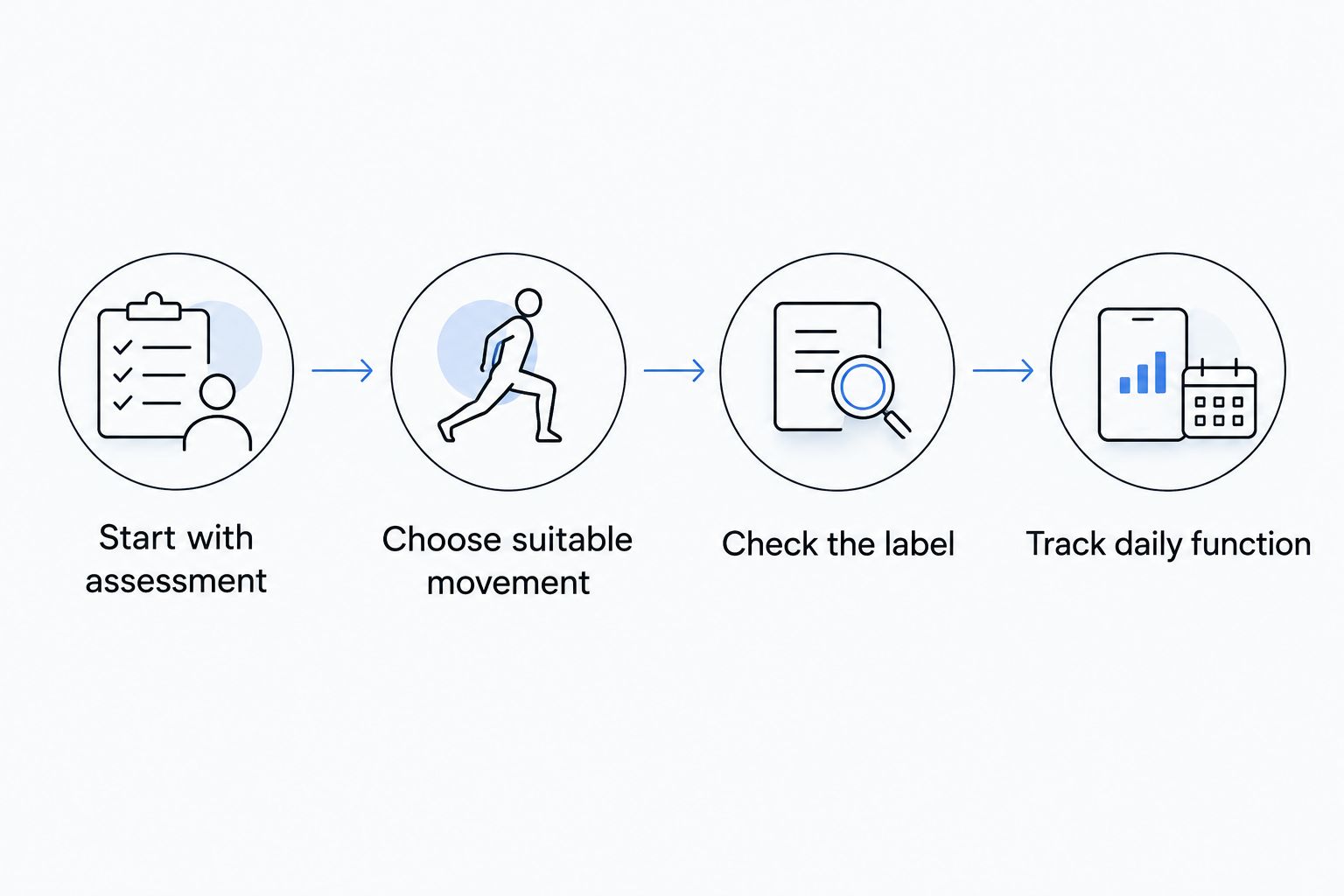
- Prioritize appropriate movement, professional assessment, and label checks before adding a joint supplement.
Can joint supplements actually rebuild cartilage?
No oral joint supplement is established as a treatment that regrows lost joint cartilage. Research on joint supplements often measures pain, stiffness, or daily function. Those outcomes matter, but they answer a different question from whether damaged cartilage has been restored.
The National Center for Complementary and Integrative Health describes inconsistent findings for glucosamine and chondroitin in osteoarthritis. Its guidance does not establish either supplement as a cartilage-regrowth treatment. For your 2026 decision, separate an ingredient's role in the body from proof that swallowing it repairs a joint.
These distinctions also help when comparing joint supplements by ingredient type.
| Outcome | What it tells you | What it does not establish |
|---|---|---|
| Less discomfort | Your symptoms have improved | Lost cartilage has returned |
| Easier movement | A daily activity feels more manageable | The joint surface has regenerated |
| Better strength | Muscles supporting the joint work better | A supplement repaired cartilage |
| Structural findings | Clinicians can assess joint changes using appropriate evaluation | A symptom diary alone proves tissue repair |
A personal improvement can be real without showing why it happened. Activity changes, rehabilitation, fluctuating symptoms, and other treatments all complicate attributing that improvement to a supplement.
Why this matters
If your knee feels uncomfortable on stairs, you want the next step to help—not distract you from the cause. A cartilage-rebuilding promise can shift attention away from an injury, a strength deficit, or another problem that needs assessment.
Cartilage is the smooth tissue covering the ends of bones in a joint. It has limited ability to repair itself, partly because it lacks a direct blood supply. That biology helps explain why supplying a nutrient does not automatically rebuild a damaged surface.
Joint pain also does not tell you exactly how much cartilage is present. Muscles, tendons, ligaments, and other joint tissues can contribute to symptoms. Start with the problem you have, not the repair claim on a supplement advertisement.
How do common joint supplement ingredients compare?
Glucosamine, chondroitin, and collagen appear frequently in joint-health discussions. Their relationship to cartilage biology is not proof of a cartilage-rebuilding benefit from supplementation.
This is an ingredient comparison, not a recommendation to start all of them. None earns a cartilage-regrowth recommendation in 2026.
| Ingredient | Best for | Potential advantage | Important limitation |
|---|---|---|---|
| Glucosamine | Adults discussing a commonly studied joint ingredient with a clinician | Has been studied for osteoarthritis symptoms | Findings are inconsistent; cartilage regrowth is not established |
| Chondroitin | Adults reviewing joint-support options and medication compatibility | Has research addressing joint symptoms and function | Results vary, and it is not an established cartilage-rebuilding treatment |
| Collagen | Adults asking about a protein-based joint supplement | Some studies report improvements in joint symptoms | Different preparations are not interchangeable; symptom findings do not establish cartilage regeneration |
Glucosamine: studied does not mean proven to rebuild
Glucosamine occurs naturally in the body and contributes to compounds found in cartilage. The leap from that fact to an oral supplement rebuilding a worn joint is unsupported.
The possible benefit under discussion is symptom relief, not restoration of a joint surface. If you take warfarin, discuss glucosamine with your prescriber before using it; the National Center for Complementary and Integrative Health identifies an increased bleeding concern with this combination.
Chondroitin: a cartilage component is not replacement cartilage
Chondroitin is a component of cartilage, but taking it does not place new cartilage directly into your knee or hip. Research results depend on the preparation, study design, and outcome measured.
Its practical limitation is uncertainty about benefit for an individual reader. Chondroitin also warrants a medication review, particularly with warfarin. Do not assume that combining it with glucosamine makes the combination more effective or safer.
Collagen: distinguish the preparation from the promise
Collagen provides structural support in connective tissues. Oral collagen is processed through digestion; it does not travel intact to a painful joint and become a replacement cartilage layer.
Different collagen preparations have different research behind them. A favorable finding for a particular preparation does not establish the same benefit for every collagen product, and it does not justify a claim that lost cartilage will regrow.
Why joint supplement results vary
There is no reliable cartilage-rebuilding result to predict. What varies is the symptom response reported by individuals and measured in studies.
Several differences explain why one person's experience does not settle the question for everyone:
- The cause of symptoms: Osteoarthritis, an injury, and tendon discomfort are different problems. A supplement discussion cannot substitute for identifying the cause.
- The ingredient preparation: Different forms and formulations do not automatically share the same evidence.
- The outcome measured: A pain questionnaire measures a different result from structural changes assessed in a clinical study.
- Other care: Exercise, physical therapy, medication, and activity changes affect how a joint feels and functions.
- Study quality: Small studies, inconsistent methods, and different comparison groups limit how confidently findings apply to you.
A useful rule for 2026: ask what improved, how it was measured, and whether the evidence concerns the exact preparation being discussed. A testimonial about easier walking cannot answer a cartilage-regrowth question.
What should you do instead of chasing cartilage regrowth?
Build a plan around daily function and an appropriate assessment. You do not need to prove that cartilage has changed to work toward walking more comfortably or managing stairs more confidently.
Start with assessment
Speak with a qualified health professional about persistent, worsening, or unexplained joint symptoms. Describe where the discomfort occurs, what brings it on, and whether you have swelling, locking, or difficulty bearing weight.
A suddenly hot, swollen joint, fever with joint pain, or inability to bear weight needs prompt medical attention. Do not wait for a supplement to work when symptoms suggest a problem requiring evaluation.
Choose suitable movement
Exercise is an established part of osteoarthritis management. Appropriate strengthening and aerobic activity can support function without relying on a promise of cartilage regrowth.
For general adult health, CDC guidance recommends at least 150 minutes per week of moderate-intensity aerobic activity, or 75 minutes per week of vigorous activity, plus muscle-strengthening activity on 2 days per week. These are general activity targets—not a prescription for an injured or painful joint. Ask a clinician or physical therapist how to adapt movement to your abilities.
Check the label
Before adding a supplement, read the full ingredient list, serving directions, and warnings. Check for ingredients already present in other products you take.
Bring the label to a pharmacist or qualified clinician if you use medicines, have a medical condition, are pregnant or breastfeeding, or have surgery planned. More ingredients do not establish a better outcome.
Track daily function
Pick a familiar activity, such as getting out of a chair or taking your usual walk. Record whether it feels easier, unchanged, or harder, alongside any side effects and changes in your routine.
This record supports a useful conversation about symptoms. It cannot measure cartilage thickness or prove that a supplement repaired tissue.
Where does TruNutra fit into a joint-health routine?
TruNutra is best suited to adults considering everyday wellness supplements, not people seeking a proven cartilage-regrowth treatment. That is the right boundary for any recommendation here.
If you are reviewing the brand's options, use the Osteo Guardian product page to check its current label, directions, and warnings. The product name alone does not establish its ingredients, suitability, or a cartilage-rebuilding benefit.
The useful role of a TruNutra supplement discussion is to consider a product alongside your goals and existing routine. The limitation is equally clear: choosing a supplement does not replace assessment, appropriate movement, or treatment recommended for a diagnosed condition.
Does less joint pain mean cartilage has grown back?
Less joint pain does not prove cartilage has grown back. Pain and function can improve without restoration of lost cartilage, including through changes in muscle strength, activity, or other care.
Track symptom improvements because they matter to everyday life. Keep the explanation separate from the observation: easier stairs are a useful result, but not evidence of new cartilage.
Can food rebuild damaged joint cartilage?
No food is established as a way to regrow lost joint cartilage. A balanced eating pattern supports general health and supplies nutrients your body needs, but that does not make a particular food a cartilage-repair treatment.
Correcting a nutritional deficiency addresses the deficiency. It should not be presented as a promise to reverse joint damage.
Should you stop a supplement if it is not helping?
An unhelpful supplement deserves reassessment, not an automatic increase in the serving amount. Follow the label and discuss a review point with a qualified professional rather than adopting a universal trial period from an advertisement.
Stop using a product and seek appropriate advice if you develop concerning symptoms or suspect an adverse reaction. Do not stop prescribed treatment in order to try a supplement.
FAQ
Can joint supplements rebuild cartilage in 2026?
Joint supplements are not established as a reliable way to rebuild lost cartilage in humans in 2026. Possible improvements in discomfort or function should not be described as proof of tissue regeneration.
Does glucosamine grow cartilage back in your knees?
Glucosamine has not been established as a treatment that grows lost knee cartilage back. Research on osteoarthritis symptoms has produced inconsistent findings.
Is collagen better than glucosamine for rebuilding cartilage?
Neither collagen nor glucosamine is established as a reliable cartilage-rebuilding treatment. Differences in preparations and research make broad claims that one is better for regrowth unsupported.
What is the best supplement for regrowing knee cartilage?
No supplement can be recommended as a proven way to regrow lost knee cartilage. Ask a qualified health professional about the cause of your symptoms and a plan for improving function.
Can I take joint supplements with blood thinners?
Check with your prescriber or pharmacist before combining joint supplements with blood thinners. Glucosamine and chondroitin have an increased bleeding concern when taken with warfarin.
Can exercise help even if my cartilage does not grow back?
Appropriate exercise can support joint function without cartilage regrowth. A clinician or physical therapist can help you choose strengthening and aerobic activity suited to your symptoms.
Can TruNutra supplements replace treatment for joint damage?
TruNutra supplements should not replace assessment or treatment for joint damage. Review the relevant product label with a qualified professional and keep expectations focused on its stated use, not cartilage regeneration.
One last thing
A better-feeling joint and a rebuilt joint are not the same result. That distinction protects you from dismissing a real improvement—or accepting an unsupported explanation for it.
Before choosing a joint supplement in 2026, write down the everyday task you want to improve and bring that goal to your next health appointment. A plan built around your actual limitations is more useful than a promise to regrow cartilage.