


How long does it take for joint supplements to work?
Joint supplements have no single, reliable time to work: any benefit depends on the ingredient, the reason for your symptoms, and whether the supplement helps at all. They are not a dependable source of immediate relief, and taking them longer does not guarantee a result. For your 2026 routine, agree on a review point with a qualified health professional rather than relying on a bottle’s promise.
- How long does it take for joint supplements to work? There is no reliable timeline that applies to every formula.
- NCCIH reports mixed evidence for glucosamine and chondroitin; longer use does not guarantee joint comfort.
- TruNutra suits adults exploring everyday wellness supplements, not people seeking a substitute for joint assessment.
- Track everyday mobility, follow the label, and review persistent symptoms with a qualified health professional.
How long does it take for joint supplements to work?
There is no established average that applies to joint supplements as a category. A research study’s duration tells you how long researchers observed participants—not when you should expect to feel better.
The National Center for Complementary and Integrative Health, or NCCIH, describes inconsistent findings for glucosamine and chondroitin in knee osteoarthritis. Its summary includes the Glucosamine/Chondroitin Arthritis Intervention Trial, known as GAIT, which enrolled 1,583 adults and assessed treatment over 24 weeks. Overall, glucosamine and chondroitin, alone or together, did not provide significant pain relief compared with placebo.
That result does not establish a waiting period. It shows why a long trial is not proof that a supplement will eventually help. The findings also concern specific ingredients and knee osteoarthritis, not every mobility formula or every cause of joint discomfort.
| Supplement type | Best for considering | Potential role | Main limitation | What the evidence means for timing |
|---|---|---|---|---|
| Glucosamine | Adults discussing an ingredient studied for knee osteoarthritis | Has been studied for joint symptoms | Research findings are inconsistent | No dependable personal start date |
| Chondroitin | Adults reviewing joint-support ingredients with a clinician | Has been studied alone and with glucosamine | Results do not establish a reliable benefit for everyone | Study length is not a response deadline |
| Collagen | Adults comparing a specific formulation with published research | Some formulations have been studied for joint comfort | Findings do not transfer automatically between formulations | Check the actual study, not a category-wide promise |
| Calcium and vitamin D | Adults reviewing bone-health needs | Support normal bone health when intake is appropriate | Bone support is not the same as relief of joint symptoms | Joint comfort is not a reliable measure of benefit |
A useful 2026 decision starts with the ingredient and your goal, not with a universal countdown. You should not assume that evidence for one preparation applies to another product with a similar name.
Why this matters
Waiting for a supplement to work can become a reason to put off understanding a recurring problem. Discomfort after a new workout, persistent morning stiffness, and a swollen joint do not call for the same response.
Your goal is not simply to finish a bottle. It is to understand whether your daily movement feels easier, whether the routine is safe, and whether symptoms need assessment. Persistent or worsening joint symptoms deserve attention even while you are taking a supplement.
Bone health and joint comfort also need separate expectations. Nutrients that support bones do not automatically explain, or resolve, discomfort when you climb stairs or stand after sitting.
Why the time to notice a difference varies
Several practical differences make a single answer misleading. Use these factors to assess a recommendation rather than accepting a generic promise about results.
- Ingredient and formulation. Glucosamine, chondroitin, collagen, and bone-support nutrients are not interchangeable. Evidence must match the ingredient and preparation you are considering.
- Reason for symptoms. Joint discomfort has different causes. A supplement cannot tell you which cause applies to you, and an unsuitable choice will not become suitable simply through longer use.
- Label directions and consistency. Irregular use makes your experience harder to interpret. Taking more than directed does not create a valid shortcut.
- Starting point. Occasional discomfort and symptoms that interfere with everyday activities are different situations. Set expectations around your actual limitations rather than another person’s review.
- Other changes. A new exercise program, physical therapy, altered activity, or medication changes can affect how you feel. These changes make it harder to attribute an improvement to the supplement alone.
- How you assess progress. A vague impression is less useful than a repeated observation of the same everyday task. Track function as well as comfort.
For a 2026 supplement review, keep these factors together. A promising ingredient name does not remove the need to check suitability, directions, and the reason you are taking it.
How can you tell whether a joint supplement is helping?
Use a simple record rather than trying to remember how you felt before starting. This is a personal observation tool, not a way to diagnose a condition or prove that a supplement caused an improvement.
Choose a task
Pick an ordinary activity that already matters to you: getting out of a chair, walking your usual route, or using stairs. Do not deliberately provoke pain to test a supplement.
Write down what feels difficult. Being able to describe the limitation clearly makes a later conversation with a health professional more useful.
Record a baseline
Before starting, note your usual comfort, stiffness, and ability to complete the task. If you use a 0–10 comfort scale, keep its meaning consistent each time; the number is your tracking tool, not a medical threshold.
Include relevant context, such as unusually heavy activity or a poor night’s sleep. A demanding day can change your experience without telling you anything about the supplement.
Follow the label
Use the product only as directed, after checking that it is appropriate for you. Do not increase the serving because you have not noticed a change.
Record missed servings without doubling up unless the label or your health professional specifically directs you to do so. Accurate notes are more useful than trying to make the routine look perfect.
Review function
Compare the same task under reasonably similar circumstances. Look for a repeatable difference rather than a single unusually good afternoon.
Bring the record to your agreed review point. Include adverse effects, medication changes, and other treatments—not just the observations that suggest improvement.
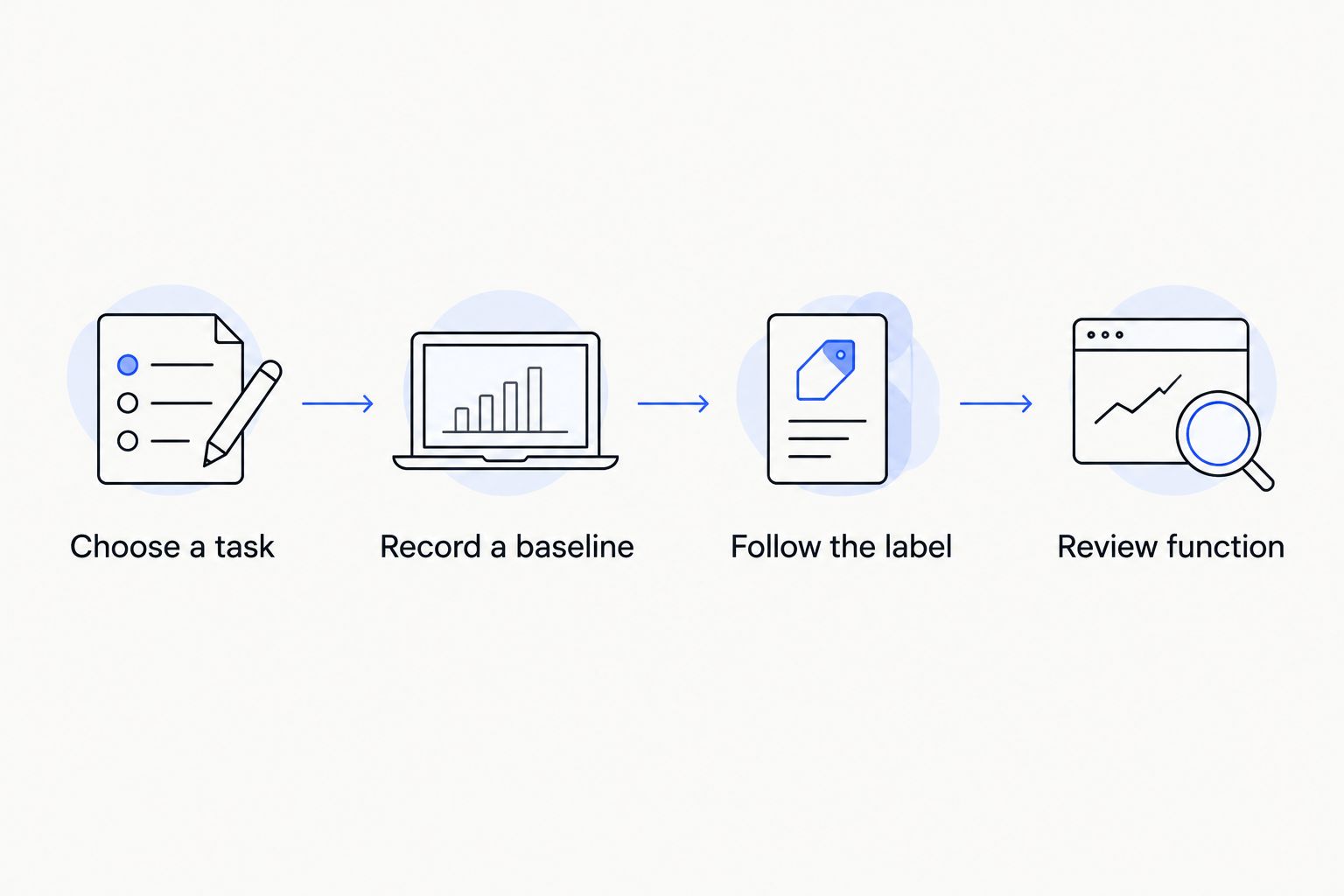
Tracking has limits. An improvement during supplement use does not prove the supplement caused it, and a higher activity count does not necessarily mean better joint comfort. Your notes support a decision; they do not replace an assessment.
Should you keep taking a joint supplement if nothing changes?
Do not continue indefinitely just because a supplement is described as slow-working. Review whether the ingredient has relevant evidence, whether you followed the label, and whether your original goal was realistic.
Ask your health professional to help establish a review point that fits the specific product and your situation. There is no evidence-based universal deadline for every joint supplement, so a fixed schedule copied from an unrelated product is not a sound guide.
At the review, discuss these questions:
- Has the everyday task you chose become consistently easier?
- Have symptoms stayed the same, improved, or worsened?
- Have you experienced unwanted effects?
- Did another treatment or routine change at the same time?
- Is there a clearer reason to continue, stop, or seek further assessment?
For your 2026 routine, the useful outcome is a clear decision—not an automatic refill. Do not add several new supplements at once to compensate for an unclear result; that makes both benefits and unwanted effects harder to interpret.
Is a bone-health supplement the same as a joint supplement?
No. Bones and joints are related parts of movement, but supporting normal bone health is not the same as addressing joint discomfort. A product’s intended purpose matters more than whether it appears in a broad mobility category.
If you are browsing TruNutra for everyday wellness support, review the current Osteo Guardian product information before deciding whether it matches your goal. Check its stated purpose, ingredients, directions, and warnings rather than assuming it offers a particular joint benefit or response time.
TruNutra is best suited to adults exploring everyday wellness supplements, not those seeking a substitute for assessment of joint symptoms. The limitation is straightforward: a supplement listing cannot establish why your joint hurts or predict your individual response.
Bring the product label to a pharmacist or another qualified health professional if you need help judging suitability. Choose based on the actual label, not assumptions about the brand or the product name.
Can taking more make a joint supplement work faster?
No reliable rule supports increasing a supplement serving to speed up results. Follow the label, and do not combine overlapping products without checking their ingredients and total amounts.
More is not automatically better. An increased serving can increase exposure to ingredients and unwanted effects without establishing a better outcome.
Safety also depends on your medicines and health history. NCCIH notes that glucosamine and chondroitin can interact with warfarin and increase bleeding risk. Discuss supplements with your health professional if you take medicines, are pregnant or breastfeeding, have a medical condition, or have surgery planned.
When should you get help instead of waiting?
Seek prompt medical assessment for a hot, red, swollen joint, especially with fever or feeling unwell. Sudden severe pain, an injury with inability to bear weight, or a visibly changed joint also needs assessment rather than a supplement trial.
Arrange a routine appointment for symptoms that persist, recur, disturb sleep, or limit normal activities. You do not need to finish a bottle before asking for help.
In 2026, the most useful safety rule remains simple: a supplement timeline must not delay care for a new or worsening problem. Tell your clinician what you take, including combination formulas and nonprescription medicines.
FAQ
How long does it take for joint supplements to work?
Joint supplements have no single, reliable time to work. The ingredient, formulation, reason for symptoms, and individual response matter, and some people will not notice a benefit.
Does a 24-week joint supplement study mean I should wait that long?
A 24-week study does not establish how long you should wait for relief. The GAIT trial assessed glucosamine and chondroitin over that period, but overall results did not show significant pain relief compared with placebo.
Can a joint supplement help on the first day?
A joint supplement is not a dependable source of first-day relief. Feeling better after starting one does not prove that the supplement caused the change.
Should I take a larger serving if my joint supplement is not helping?
Do not increase the serving to chase faster results. Follow the label and review the product with a qualified health professional if you are unsure whether to continue.
How do I know whether my joint supplement is helping?
Track the same everyday task and look for a repeatable change in comfort or function. Include other treatment and activity changes so you do not automatically credit the supplement.
Are calcium and vitamin D supposed to make my joints feel better?
Calcium and vitamin D support normal bone health, but that is not the same as relieving joint symptoms. A lack of noticeable joint improvement does not measure whether your bone-health needs are being met.
When should I stop waiting and talk to a health professional?
Talk to a health professional when joint symptoms persist, worsen, disturb sleep, or limit daily activities. Seek prompt assessment for a hot, swollen joint with fever, sudden severe pain, or inability to bear weight after injury.
One last thing
Feeling a change and meeting a health need are not always the same thing. A bone-health routine is not judged by immediate joint comfort, while persistent joint symptoms need more than a promise of gradual support.
Before starting your next supplement, write down its purpose and the everyday outcome you want to review. That small distinction helps you ask better questions—and avoid waiting for a benefit the product was never intended to provide.