


Is ashwagandha safe during pregnancy?
Do not take ashwagandha during pregnancy. The National Center for Complementary and Integrative Health (NCCIH) advises pregnant people to avoid it, and there is no established pregnancy-safe dose. If you already took it, stop taking further doses and contact your prenatal care team; an exposure alone does not establish that harm occurred.
- Is ashwagandha safe during pregnancy? No—NCCIH advises avoiding it, and no pregnancy-safe dose is established.
- Stop further doses after an accidental exposure and contact your prenatal care team with the product label.
- TruNutra Ashwagandha is an adult wellness supplement, not a pregnancy recommendation.
- Pregnancy and breastfeeding need separate safety reviews; do not replace ashwagandha with another supplement without guidance.
Is ashwagandha safe during pregnancy?
Ashwagandha is not recommended during pregnancy. NCCIH's Ashwagandha: Usefulness and Safety guidance explicitly advises avoiding it while pregnant. That recommendation applies even when your goal is ordinary stress support or a more settled bedtime routine.
For a pregnancy decision in 2026, use pregnancy-specific safety guidance rather than general adult wellness advice. A supplement being familiar, botanical, or sold without a prescription does not establish that it is appropriate during pregnancy.
Our guide to taking ashwagandha every day addresses a different question. General adult use should never be read as pregnancy clearance.
The distinction matters: advice to avoid an ingredient does not prove that every exposure causes harm. It means you should not start or continue using it during pregnancy, and an accidental exposure deserves an individualized review rather than a prediction from an online article.
Why this matters
Pregnancy changes the question from whether a supplement supports an everyday wellness goal to whether it is appropriate for you and your developing baby. Evidence from nonpregnant adults cannot answer that question on its own.
You deserve support for stress and disrupted sleep. But a product promoted for those goals is not automatically a suitable way to get that support during pregnancy. The practical next move is to tell your prenatal care team what is bothering you and ask for a pregnancy-appropriate plan.
Keep the wellness goal; reconsider the ingredient. Avoiding ashwagandha does not mean ignoring your sleep, stress, or daily comfort.
What does the safety guidance actually say?
NCCIH advises avoiding ashwagandha during pregnancy and not using it while breastfeeding. The NIH Office of Dietary Supplements' Ashwagandha: Health Professional Fact Sheet also discusses pregnancy safety concerns, including the potential to cause spontaneous abortion.
That concern should not be rewritten as a certainty that a particular capsule will cause a miscarriage. These sources provide a reason to avoid use; they do not let you calculate an individual pregnancy outcome from a product label.
For your 2026 supplement review, separate these statements:
| Safety statement | What it means for you | What it does not mean |
|---|---|---|
| Avoid ashwagandha during pregnancy | Do not start or continue it while pregnant | Every accidental exposure necessarily causes harm |
| No pregnancy-safe dose is established | Do not choose a smaller dose as a workaround | A general adult serving establishes pregnancy safety |
| Breastfeeding guidance also advises against use | Review supplements again after delivery | Giving birth automatically makes ashwagandha appropriate |
The clearest conclusion is also the most useful: avoid ashwagandha during pregnancy, and get personal advice if you have already taken it. No product comparison or customer review changes that recommendation.
What should you do if you already took ashwagandha?
Stop taking additional ashwagandha and contact your obstetrician, midwife, or other prenatal care professional. Bring the actual label rather than relying on the product's name, because a stress or sleep blend can contain several ingredients.
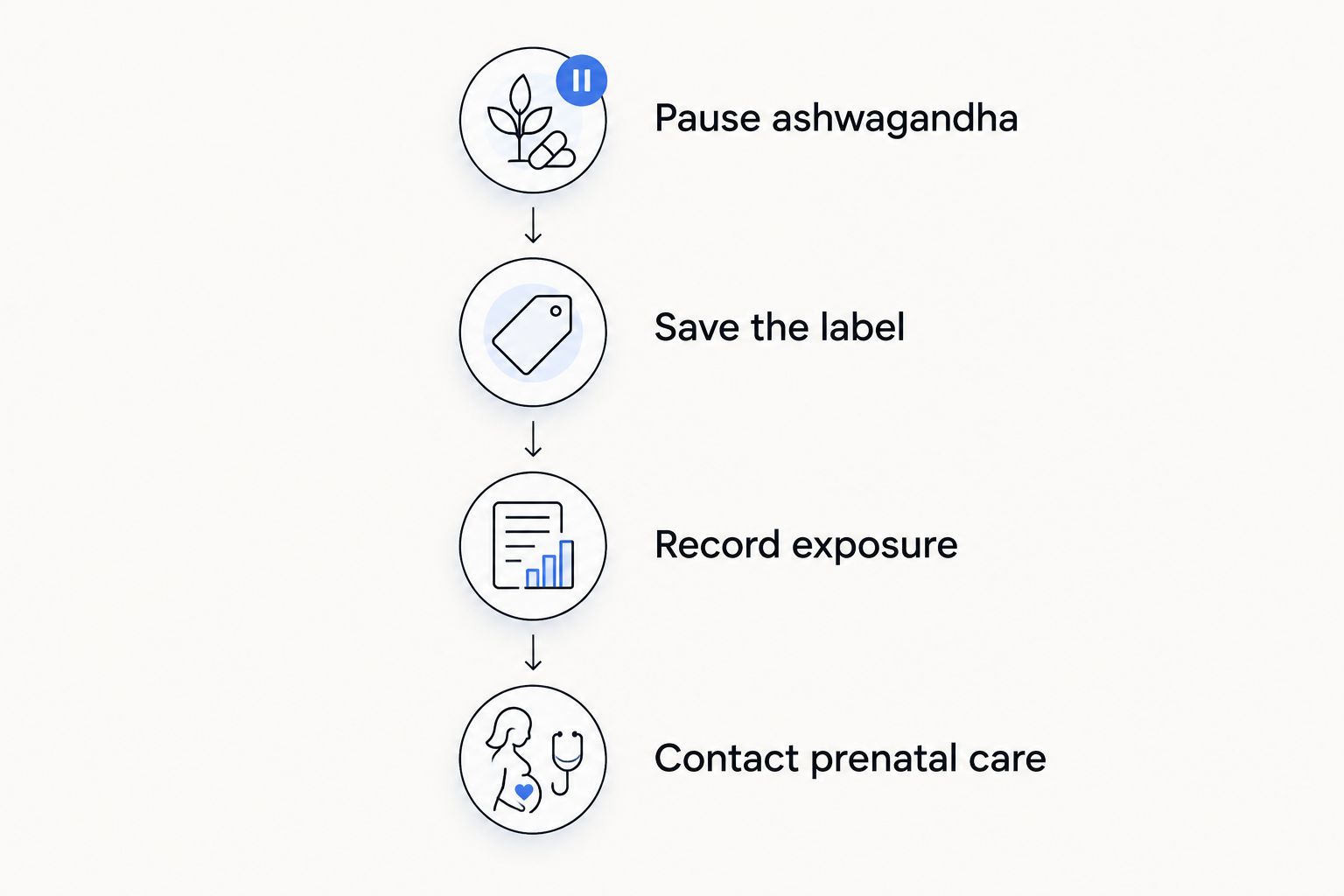
Use this sequence to make that conversation easier:
- Pause ashwagandha. Set aside the supplement so it does not remain part of your automatic morning or bedtime routine. Do not stop prescribed medicines without guidance from the prescriber.
- Save the label. Photograph the Supplement Facts panel, ingredient list, serving directions, and any warnings. Keep the container available for questions.
- Record exposure. Write down how much you took, when you took it, and whether you used it repeatedly. If you cannot remember exactly, say that rather than guessing.
- Contact prenatal care. Share the label, your pregnancy stage, other supplements and medicines, and any symptoms. Ask what follow-up is appropriate for your circumstances.
Do not interpret an accidental dose as proof that something is wrong. Equally, do not assume that feeling well establishes safety. Your prenatal care team can assess the exposure in context.
If you have vaginal bleeding, severe abdominal pain, fainting, or another urgent symptom, seek prompt medical attention. Do not wait for a supplement discussion to address an urgent pregnancy concern.
Why does individual advice vary if everyone should avoid it?
The recommendation to avoid ashwagandha stays the same. What varies is the assessment after an exposure and the support you need instead.
Your clinician will need details that a general article cannot evaluate:
- Pregnancy stage: Tell your care team how far along you are or whether pregnancy is only suspected.
- Amount taken: Bring the labeled serving information and explain the amount you actually used.
- Exposure pattern: A single use and repeated use are different histories to report, not a basis for guessing risk yourself.
- Other ingredients: A blended product requires a review of the whole formula, not just ashwagandha.
- Medicines and health history: Share prescribed medicines, over-the-counter products, other supplements, and relevant health conditions.
- Current symptoms: Describe what you are experiencing without assuming the supplement caused it.
These details help your care team decide what to do next. They do not create an exception that makes a particular ashwagandha product pregnancy-safe.
Does a lower dose or different form make ashwagandha safe?
No pregnancy-safe dose is established. Taking less than the label suggests is not a validated pregnancy safety strategy, and spacing doses apart does not resolve the underlying concern.
The same caution applies to capsules, powders, gummies, and herbal drinks containing ashwagandha. A different delivery format is not evidence that the ingredient is appropriate during pregnancy.
In 2026, do not use a serving suggestion intended for general adult use as a pregnancy recommendation. Serving directions explain how a product is intended to be used; they do not establish safety for every life stage.
Likewise, a quality or testing claim answers a different question from pregnancy suitability. Even verified testing does not, by itself, demonstrate that an ingredient is safe for you to take while pregnant.
What can you do for stress or sleep instead?
Start with the problem you want help with, not with a replacement bottle. Tell your prenatal care team whether you are struggling to wind down, waking frequently, or feeling overwhelmed during the day.
For an everyday routine, discuss a consistent bedtime, a quieter wind-down period, and comfortable activity that your prenatal care team has approved. These are practical topics for a care plan, not promises that a routine will resolve every concern.
| Approach | Best for | Practical benefit | Limitation |
|---|---|---|---|
| A consistent wind-down routine | Adults who want a predictable bedtime transition | Creates a repeatable period for settling down | Does not replace assessment of persistent sleep difficulties |
| Prenatal-approved movement | Adults who want activity within their pregnancy care plan | Keeps movement connected to individualized advice | Appropriate activity depends on your circumstances |
| A prenatal care conversation | Adults with persistent stress or sleep concerns | Connects symptoms with a pregnancy-specific plan | Requires sharing your symptoms and current products |
| A clinician-reviewed supplement | Adults whose care team identifies a specific need | Allows review of ingredients and the reason for use | Another supplement is not automatically a suitable substitute |
Ask for help when stress or sleep difficulties interfere with daily life. You do not need to manage them alone, and you do not need to experiment with several products before raising the issue.
A prenatal vitamin is also not a substitute for a stress or sleep supplement. Use supplements for the purpose your clinician recommends, and check before adding anything to an existing routine.
Where does TruNutra Ashwagandha fit?
TruNutra Ashwagandha is described as a botanical supplement for adults who prefer straightforward product information and a simple daily routine. That adult wellness positioning is not a pregnancy safety claim.
TruNutra Ashwagandha is for adults considering a daily botanical routine, not for use during pregnancy. For pregnant readers, the measured recommendation is to avoid it rather than choose a different dose or assume another formula is suitable.
The useful feature here is straightforward product information; the limitation is that general adult positioning does not establish pregnancy suitability. If you already use a TruNutra supplement, bring its current label to your prenatal appointment before continuing or replacing it.
Can I take ashwagandha while trying to conceive?
Avoid starting ashwagandha without a preconception review. You can be pregnant before you recognize it, so tell your clinician if you are trying to conceive and ask which supplements belong in your routine.
Bring the same complete product list you would bring to a prenatal visit. Do not assume that a supplement suitable before pregnancy remains suitable once pregnancy is possible.
Is ashwagandha safe while breastfeeding?
NCCIH advises not using ashwagandha while breastfeeding. Delivery does not automatically make a pregnancy-avoided ingredient appropriate for nursing.
For your 2026 postpartum routine, review supplements again with a qualified health professional. Your feeding plans, medicines, and health needs belong in that conversation rather than in a general adult supplement comparison.
Can I restart ashwagandha after pregnancy?
Restarting requires a fresh safety review, especially if you are breastfeeding. Do not simply resume the routine you used before pregnancy.
Ask your clinician or pharmacist to review your current medicines, supplements, and reasons for wanting ashwagandha. An earlier decision about adult use does not replace advice for your current circumstances.
FAQ
Is ashwagandha safe during pregnancy in 2026?
No—NCCIH advises avoiding ashwagandha during pregnancy, and no pregnancy-safe dose is established. Do not start or continue it while pregnant; ask your prenatal care team about support for the concern you wanted to address.
What if I took ashwagandha before I knew I was pregnant?
Stop further ashwagandha doses and contact your prenatal care team with the product label and exposure details. An accidental exposure alone does not establish that harm occurred.
Can I take a small amount of ashwagandha while pregnant?
No pregnancy-safe dose is established, so a smaller amount is not a validated workaround. Avoid ashwagandha rather than adjusting an adult serving yourself.
Does ashwagandha definitely cause miscarriage?
An ashwagandha exposure does not establish that a miscarriage will occur. NIH safety guidance identifies pregnancy concerns and advises avoidance; your care team should assess an individual exposure.
Are ashwagandha gummies or tea safer than capsules during pregnancy?
A gummy, tea, or powder containing ashwagandha is not established as a pregnancy-safe alternative to capsules. The recommendation concerns the ingredient, not only the format.
Can I replace ashwagandha with another stress supplement?
Do not replace ashwagandha with another stress supplement without a pregnancy-specific review. Share the full ingredient list with your prenatal care team rather than relying on the product's wellness claims.
Can I take TruNutra Ashwagandha while breastfeeding?
NCCIH advises not using ashwagandha while breastfeeding, which also applies when considering TruNutra Ashwagandha. Ask your health professional about an appropriate postpartum routine.
One last thing
Check the ingredient list, not just the front of the bottle. Ashwagandha can appear in a blend marketed for stress or sleep without being the most prominent word on the package; its botanical name is Withania somnifera.
For your next supplement review in 2026, photograph every label you currently use and keep those pictures together. A complete list gives your prenatal care team a clearer starting point than trying to remember each bottle during an appointment.
This article provides general education, not an individual pregnancy assessment. Your prenatal care team is the right source for advice about your exposure, symptoms, and next steps.
Related guides
These general wellness guides are not pregnancy-use recommendations: