


Is ashwagandha safe to take every day?
Daily ashwagandha use can be appropriate for some adults over the short term, but it is not safe for everyone, and long-term safety is not established. The National Center for Complementary and Integrative Health (NCCIH) describes use for up to 3 months as potentially safe; pregnancy, certain health conditions, medication interactions, and reported liver injury require extra caution. In 2026, the practical answer is to check your health history and product label before starting, then reassess rather than taking it indefinitely.
- Is ashwagandha safe to take every day? Short-term use can suit some adults; long-term safety remains uncertain.
- NCCIH describes use for up to 3 months as potentially safe, not a guarantee for every person.
- Avoid ashwagandha during pregnancy; check medication interactions and thyroid, liver, or autoimmune concerns before use.
- TruNutra Ashwagandha offers straightforward product information; a clear label does not replace an individual safety review.
Is ashwagandha safe to take every day?
Daily use is a conditional choice, not a blanket recommendation. Your health history, other supplements, medications, and the exact formula matter more than whether a bottle says it fits a daily routine. When browsing TruNutra, use the product label—not a general wellness description—to guide your questions.
For this 2026 guide, the main safety references are NCCIH’s Ashwagandha fact sheet and the National Institutes of Health Office of Dietary Supplements (ODS) health-professional fact sheet on ashwagandha. These sources address short-term research, reported side effects, and precautions; they do not establish that every commercial formula is safe for lifelong use.
| Daily-use choice | Best for | Practical advantage | Limitation or next step |
|---|---|---|---|
| Consider short-term use after a safety review | Adults without identified contraindications who want to discuss stress or sleep support | Gives you a defined period to assess tolerability and usefulness | Short-term evidence does not establish long-term safety |
| Get professional advice before starting | Adults taking medicines or managing thyroid, autoimmune, or other health conditions | Checks risks that a product label alone cannot resolve | Requires a review of your actual medicines and health history |
| Avoid starting | People who are pregnant or breastfeeding | Follows NCCIH’s precautions for these groups | Choose another approach with a qualified health professional |
| Focus on daily habits without adding a supplement | Adults who prefer to avoid supplement exposure | Avoids supplement-related side effects and interactions | Persistent stress or sleep problems still deserve attention |
The table compares decisions, not competing extracts. A supplement that suits someone else is not automatically suitable for you.
Why this matters
A daily habit can continue long after the reason for starting has changed. You might begin during a stressful stretch, then keep taking the same capsule because it sits beside your breakfast mug. That convenience is useful only while the product still fits your health needs.
The safety question also differs from the benefit question. Research suggesting that some ashwagandha preparations help with stress or sleep does not prove that every preparation works, that more is better, or that continued use adds benefit.
For your 2026 routine, keep the goal specific: an easier wind-down, less everyday stress, or a question to discuss with your clinician. Avoid turning a supplement into a substitute for evaluating ongoing symptoms.
Short-term daily use: up to 3 months is not a guarantee
NCCIH’s up-to-3-month safety statement is a research boundary, not a recommended course for everyone. It does not mean that every adult should take ashwagandha for that long, or that side effects cannot happen earlier.
Studies generally examine particular preparations in selected participants. A study’s findings therefore do not automatically apply to a different extract, a combination formula, or someone taking several medicines. Read the evidence as support for a limited question, not permission for unrestricted daily use.
If you and a qualified health professional decide to try it, agree on what you are assessing and when to review it. Do not keep taking a product solely because you have finished one bottle without noticing an obvious problem.
Long-term daily use: safety is not established
There is no established safe duration for indefinite daily ashwagandha use. NCCIH states that information is insufficient to draw conclusions about long-term safety.
That distinction matters if you are planning recurring purchases or building a permanent supplement stack in 2026. A convenient routine does not extend the evidence behind it. Revisit the decision when your medications, health conditions, or reasons for taking it change.
Taking occasional breaks does not resolve that uncertainty. There is no universally established cycling schedule that makes prolonged use safe, so do not treat a break-and-restart routine as a protective rule.
Why daily ashwagandha safety varies
The main safety factors are personal and product-specific. Use these points to prepare for a pharmacist or clinician conversation:
- Pregnancy and breastfeeding: NCCIH advises avoiding ashwagandha during pregnancy and not using it while breastfeeding.
- Thyroid and autoimmune conditions: NCCIH does not recommend ashwagandha for people with these conditions. Get condition-specific advice rather than self-selecting a formula.
- Medicines: Potential interactions include medicines for diabetes or blood pressure, thyroid hormone, immunosuppressants, sedatives, and anticonvulsants.
- Liver health: Liver injury has been reported in association with ashwagandha. A history of liver problems deserves professional review before use.
- Formula and serving: Extracts and combination products differ. The amount listed on one bottle is not automatically interchangeable with another.
- Upcoming surgery: NCCIH does not recommend ashwagandha for people about to have surgery. Tell your surgical team about every supplement you take.
Do not stop or adjust prescribed medicines to make room for a supplement. The safer next move is to bring the full list to a qualified health professional.
How do you check whether daily use fits your routine?
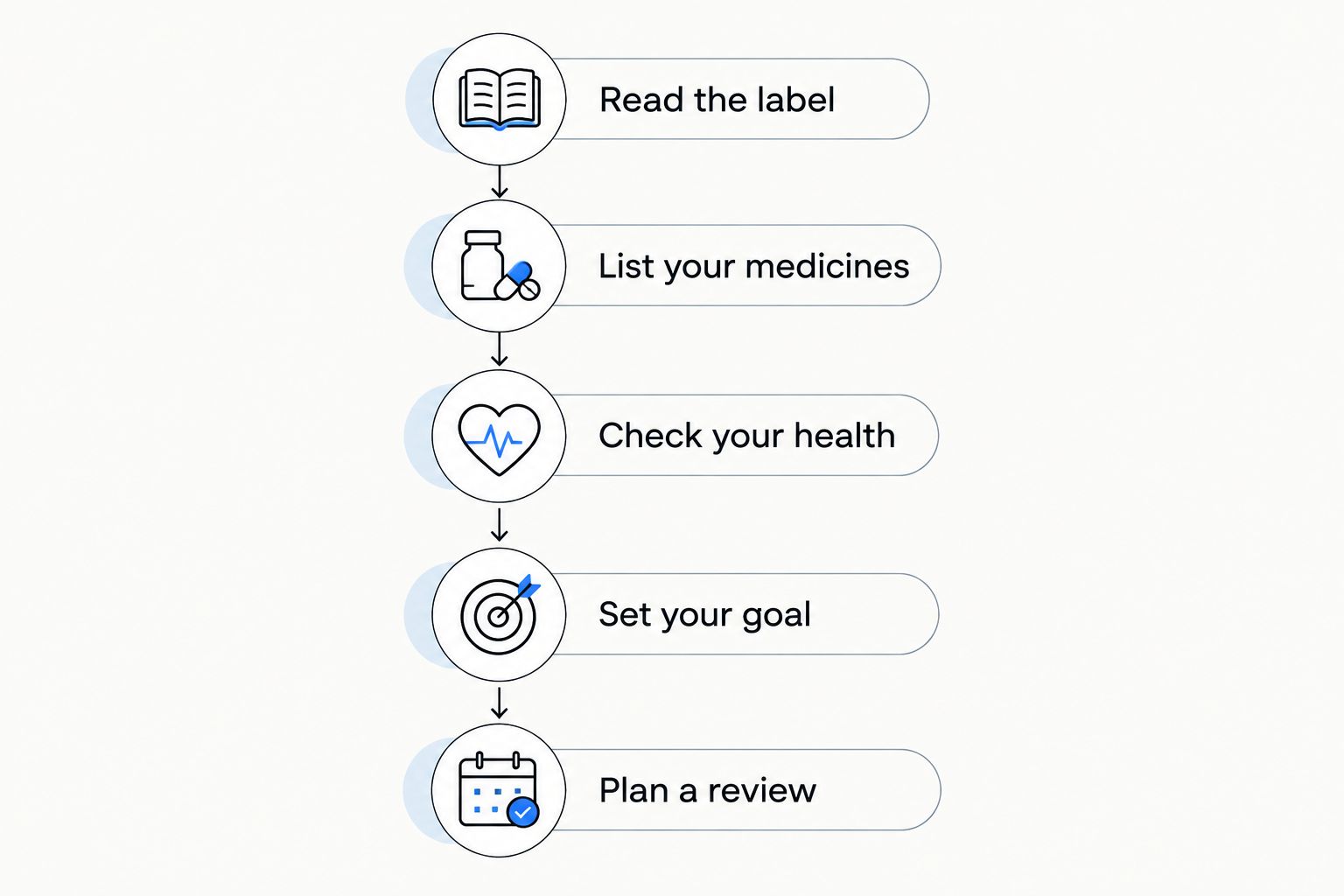
A safety check should come before a reminder on your phone. Use this sequence before adding ashwagandha to your 2026 routine, and repeat it when your health or medicines change.
- Read the label. Check the serving directions, ingredient list, warnings, and whether the product combines ashwagandha with other ingredients. Follow the actual label rather than advice for a different formula.
- List your medicines. Include prescriptions, over-the-counter medicines, and other supplements. Bring the list to a pharmacist or clinician so the interaction review covers everything you take.
- Check your health. Discuss pregnancy, breastfeeding, thyroid or autoimmune conditions, liver history, and planned surgery. A previous uneventful experience does not answer a new health question.
- Set your goal. Describe what you want to improve in everyday terms. A specific goal makes it easier to decide whether the supplement adds anything useful.
- Plan a review. Agree on when to reassess benefit, side effects, and continued use. Do not assume that an empty bottle means you should automatically buy another.
These steps separate two decisions: whether to start and whether to continue. Both deserve attention, especially when a short-term experiment becomes a daily habit.
What side effects should you watch for?
NCCIH lists drowsiness, stomach upset, diarrhea, and vomiting among possible side effects. If a new symptom appears after starting ashwagandha, do not assume it is a normal adjustment you need to push through.
Stop taking it and seek medical advice if you develop concerning symptoms. Yellowing of the skin or eyes, dark urine, or unusual fatigue can signal a liver problem and need prompt evaluation. Seek urgent care for severe symptoms rather than waiting for your planned supplement review.
Drowsiness also matters during ordinary activities. Avoid driving or operating machinery if you feel sleepy or less alert, and ask about combining ashwagandha with medicines that cause sedation. Taking it at bedtime does not remove an interaction risk.
If symptoms develop, keep the container and ingredient information available for the health professional reviewing them. That is more useful than describing the product only as a stress supplement.
Is taking ashwagandha at night safer than taking it in the morning?
Taking ashwagandha at night does not make it safer for someone with a contraindication or medication interaction. Timing changes the routine, not the underlying safety question.
Follow the product’s directions, and discuss drowsiness or stomach symptoms with a qualified health professional. Avoid adding an extra serving because you missed one earlier or because you want a stronger bedtime effect.
A consistent bedtime routine still matters. The American Academy of Sleep Medicine and Sleep Research Society recommend 7 or more hours of sleep per night for adults, with individual needs varying; a supplement should not replace sufficient opportunity to sleep.
Do you need to cycle ashwagandha to use it safely?
There is no established universal cycling schedule that makes daily ashwagandha use safe. Advice to take it on certain days or pause between bottles should not be treated as a substitute for safety evidence.
A planned review is different from a cycle. A review asks whether the supplement remains suitable and useful; a cycle simply changes when you take it. Discuss continued use instead of assuming that scheduled breaks solve long-term uncertainty.
How much ashwagandha should you take each day?
There is no single daily amount that is appropriate for every ashwagandha product and every adult. Different preparations have different compositions, so comparing only the milligrams on the front of a bottle can be misleading.
Follow the relevant product label and get individual advice when needed. Do not copy a research dose onto an unrelated formula or add multiple products containing ashwagandha without checking the combined ingredients.
Bring the label to your consultation. The useful question is whether that exact preparation and serving fit your situation—not whether a larger number sounds more effective.
Where TruNutra Ashwagandha fits
TruNutra Ashwagandha is best for adults who want straightforward product information for a simple supplement routine. Its product description identifies it as a clearly labeled botanical supplement, which gives you a practical starting point for reviewing the label.
That recommendation is about choosing information you can evaluate, not declaring the product safe for every reader. The same pregnancy, medication, health-history, and long-term-use considerations apply. Check the current label before deciding whether it belongs in your routine.
A daily supplement also has limits. It cannot replace medical evaluation for ongoing symptoms, and a clear label does not prove that a product will deliver your intended benefit. Keep the recommendation measured: choose only after checking suitability, then reassess usefulness.
Build the routine around more than a capsule
For 2026, make the supplement decision one part of your day rather than the center of it. Keep regular sleep opportunities, notice how caffeine affects your evening, and make room for movement you can sustain. These habits remain relevant whether you choose ashwagandha or not.
The US Department of Health and Human Services recommends at least 150 minutes of moderate-intensity aerobic activity per week for adults, alongside muscle-strengthening activity. Adapt activity to your abilities and health needs; the guideline is a general health target, not evidence that exercise and ashwagandha have equivalent effects.
Keep a brief record of your goal and any symptoms if you start a supplement. Note medication changes too. A simple record supports a useful review without turning daily wellness into a complicated tracking project.
FAQ
Is ashwagandha safe to take every day for a year?
Safety for a full year of daily use is not established. NCCIH describes use for up to 3 months as potentially safe, but that does not establish safety for prolonged use or for every adult.
Can I take ashwagandha every day if I take prescription medicine?
Check with a pharmacist or qualified health professional before combining daily ashwagandha with prescription medicine. Potential interactions include thyroid hormone, sedatives, anticonvulsants, immunosuppressants, and medicines for diabetes or blood pressure.
Who should avoid taking ashwagandha?
Avoid ashwagandha during pregnancy and do not use it while breastfeeding. NCCIH also does not recommend it for people with thyroid or autoimmune disorders or those about to have surgery.
Can ashwagandha cause liver problems?
Liver injury has been reported in association with ashwagandha use. Stop taking it and seek prompt medical advice for yellowing skin or eyes, dark urine, or other concerning symptoms.
Is it safer to take ashwagandha before bed?
Bedtime use does not remove contraindications or medication interactions. Follow the label, and discuss drowsiness or combinations with sedating medicines before making it a nightly habit.
Should I take a break from ashwagandha every month?
No universal monthly break schedule has been established to make ashwagandha use safe. Review whether continued use is suitable rather than relying on cycling to resolve long-term uncertainty.
Can I take more ashwagandha when I feel especially stressed?
Do not exceed the product label’s directions because you feel more stressed. Ask a qualified health professional about persistent stress and whether your current supplement remains appropriate.
One last thing
The most useful daily reminder includes a reminder to reassess. Put your review date beside the note to take your supplement, so consistency does not quietly become indefinite use.
Before another bottle, ask whether your goal, health, or medicines have changed. Continuing should be a fresh decision—not simply the easiest one.