


Can you take ashwagandha with antidepressants?
Do not add ashwagandha to an antidepressant unless your prescriber or pharmacist has reviewed the combination. In 2026, there is no established, generally safe dose or timing schedule for taking them together; the decision depends on your medication, the supplement label, and your health history. Ashwagandha can cause drowsiness and has other safety concerns, so keeping your prescribed treatment stable comes first.
- Can you take ashwagandha with antidepressants? Get a prescriber or pharmacist review before combining them.
- Ashwagandha can cause drowsiness; antidepressant side effects and other sedating substances belong in the same medication review.
- TruNutra Ashwagandha is a botanical option to discuss, not a replacement for prescribed mental health treatment.
- Separating doses does not establish safety, and no universal combination dose is established.
Why this matters
When stress still follows you home or sleep feels unsettled, adding a supplement can seem like a small change. But an everyday wellness product still belongs on your medication list. Your clinician needs to know what you take before deciding whether adding it is appropriate.
The National Center for Complementary and Integrative Health, or NCCIH, identifies drowsiness, digestive effects, thyroid concerns, and reported liver injury among ashwagandha's safety considerations. Its guidance does not establish that ashwagandha is safe with every antidepressant. For a separate discussion of ongoing use, read is ashwagandha safe to take every day.
For your 2026 routine, a medication review matters more than a supplement's popularity. Feeling comfortable with an ingredient is not the same as confirming that it fits your treatment.
Can you take ashwagandha with antidepressants?
There is no blanket yes. A prescriber or pharmacist needs to assess the exact antidepressant, the complete supplement formula, and your other medicines before you start. Evidence about ashwagandha used alone does not establish the safety of combining it with a prescription drug.
Use this sequence rather than choosing a dose from an online discussion:
- Identify your medicine. Write down the antidepressant's name, dose, and schedule. Include recent changes and any side effects you already notice.
- Bring the supplement label. Share the Supplement Facts panel, ingredient list, and directions—not just the front of the bottle.
- List everything else you take. Include prescription medicines, over-the-counter sleep aids, other supplements, alcohol, and cannabis.
- Explain your goal. Say whether you want help with everyday stress, winding down, or another concern. Persistent symptoms deserve a treatment discussion rather than an automatic supplement addition.
- Agree on a plan. Ask whether to avoid the supplement, what to monitor if your clinician approves it, and when to follow up.
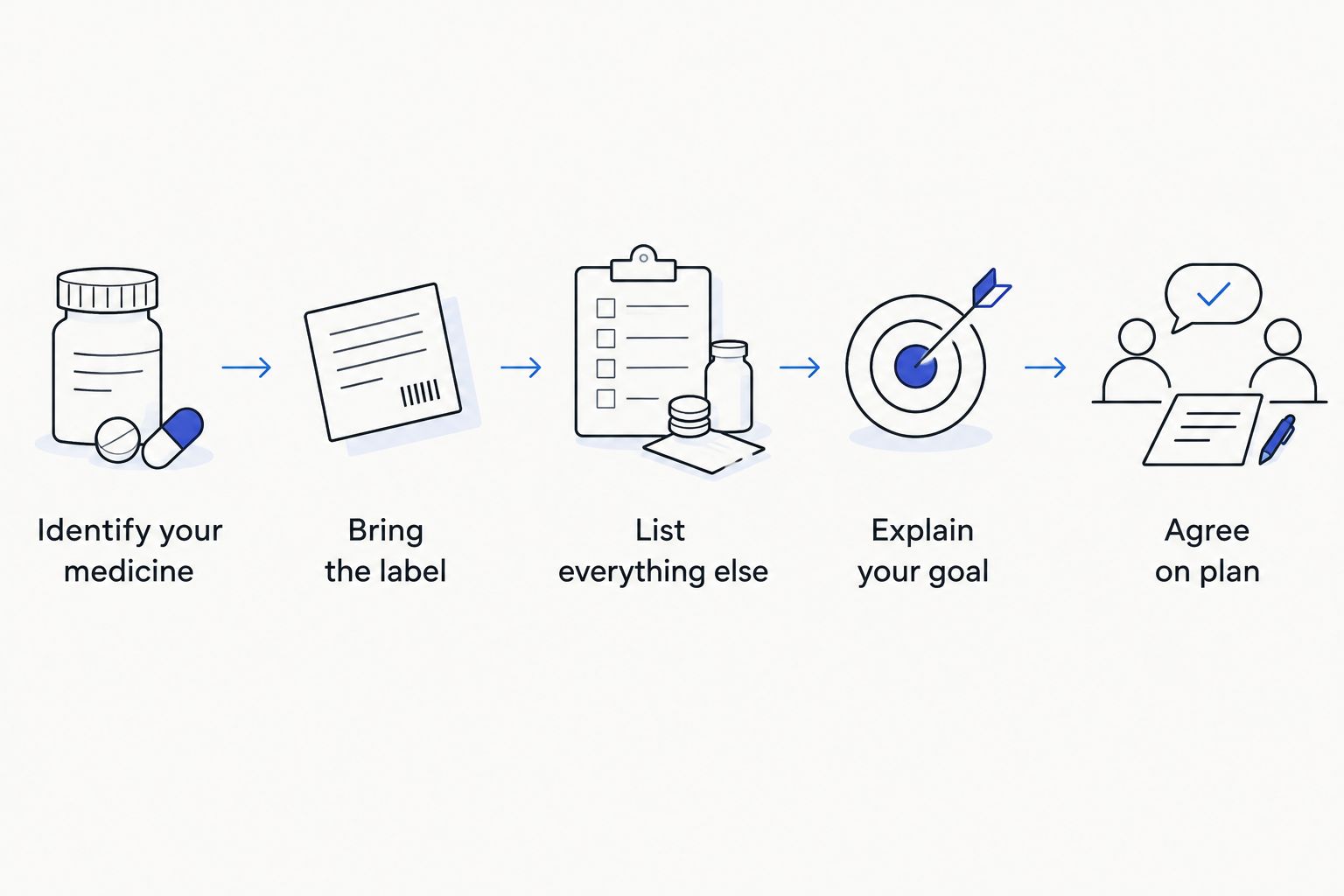
A useful conversation is specific: explain the symptom you want to address and ask whether the proposed product fits your existing treatment. Ask the clinician to separate known risks from unanswered questions. That distinction prevents an uncertain combination from being presented as either proven safe or automatically dangerous.
Which approach fits your situation?
These are treatment decisions, not interchangeable wellness options. The safest starting point is to continue your prescribed plan while asking for advice.
| Approach | Best for | Benefit | Limitation or concern |
|---|---|---|---|
| Continue prescribed treatment without adding ashwagandha | Adults awaiting a medication review | Avoids introducing a new supplement while the combination is assessed | Does not by itself address unresolved stress or sleep concerns |
| Consider ashwagandha after a clinician review | Adults whose clinician considers the specific combination appropriate | Allows a decision based on the actual medicine, label, and health history | Approval does not guarantee benefit or eliminate adverse effects |
| Replace an antidepressant with ashwagandha | Not recommended as a self-directed choice | No established substitute benefit for prescribed treatment | Risks disrupting treatment; antidepressant changes require prescriber guidance |
Do not stop, skip, or reduce an antidepressant to make room for ashwagandha. If you want to change your medication, discuss a supervised plan with your prescriber.
Why the safety decision varies
An ashwagandha decision in 2026 should follow your actual circumstances, not a general supplement ranking. These factors belong in the review:
- Your antidepressant and existing side effects. Antidepressants differ. If your medicine already leaves you sleepy or dizzy, another product that causes drowsiness needs particular attention.
- Other sedating substances. Sleep medicines, sedating antihistamines, alcohol, and other substances can affect alertness. Share them even if you use them only occasionally.
- The full supplement formula. A single-ingredient product and a blend are different reviews. Every additional ingredient needs consideration; the ashwagandha name alone is not enough.
- Thyroid or autoimmune conditions. NCCIH advises against ashwagandha for people with these conditions. Thyroid medicines and immunosuppressants also belong in the interaction review.
- Liver history and digestive tolerance. Liver injury has been reported with ashwagandha, and stomach upset, diarrhea, and vomiting are recognized adverse effects.
- Pregnancy, breastfeeding, or planned surgery. NCCIH advises avoiding ashwagandha during pregnancy and breastfeeding and does not recommend it for people about to have surgery.
These factors do not mean that every antidepressant has a documented interaction with ashwagandha. They explain why a general reassurance cannot substitute for individual advice. A missing interaction warning is not proof that a combination has been studied and found safe.
Does the type of antidepressant change the answer?
Yes, the exact antidepressant matters, but its drug class does not provide automatic clearance. Selective serotonin reuptake inhibitors, serotonin-norepinephrine reuptake inhibitors, and other antidepressants have different effects and prescribing precautions. Your pharmacist should assess the specific medicine rather than treating all antidepressants as one group.
Do not assume that a medicine is compatible simply because someone taking another drug had no problems. Their supplement, dose, health history, and other medicines can differ from yours. An online account also cannot establish what caused—or did not cause—a symptom.
If your antidepressant was recently started or adjusted, tell your prescriber before adding anything. Introducing a supplement during a medication change makes new symptoms harder to interpret. The practical question is whether this is an appropriate time to introduce another variable.
Can you take ashwagandha and an antidepressant at different times?
Separating them does not establish safety. A morning antidepressant and an evening supplement are still part of the same medication routine, and their effects are not necessarily confined to the moment you swallow them.
There is no universal spacing interval that makes this combination safe. Follow a timing plan only if your prescriber or pharmacist recommends one for your specific medicines. Do not treat spacing as a workaround for an interaction concern.
The same applies to starting with a smaller amount. Taking less does not resolve every safety issue, especially when the concern involves your health history or another ingredient. Ask about suitability before asking about timing.
Is there a safe ashwagandha dose with antidepressants?
No universally established dose makes ashwagandha safe with antidepressants. The serving suggested on a supplement label is not evidence that the product has been evaluated alongside your prescription.
NCCIH describes short-term ashwagandha use of up to 3 months as potentially safe for some people, while stating that long-term safety is not established. That general safety statement does not approve a 3-month course alongside an antidepressant. It also does not establish that daily use is appropriate for you.
If your clinician approves a particular product, follow the label and the clinician's instructions. Ask how long to use it, what would count as a meaningful benefit, and what should prompt stopping it. Avoid increasing the serving because the result feels slower or less noticeable than expected.
What to do if you already took both
Taking both does not, by itself, prove that you have been harmed. Do not take another ashwagandha serving until you have spoken with a pharmacist or prescriber, and continue your prescribed antidepressant unless a qualified clinician directs otherwise. Have both labels and the timing of each dose ready.
Tell the clinician about any new symptoms, including unusual sleepiness, dizziness, stomach upset, agitation, or changes in sleep. Avoid driving if you feel impaired. Do not use alcohol or another sleep product to counter an uncomfortable reaction.
Severe confusion, a seizure, trouble breathing, or inability to stay awake needs emergency care; in the United States, call 911. New yellowing of the skin or eyes, dark urine, or significant abdominal pain also requires prompt medical assessment because these can signal liver problems.
If you have suicidal thoughts or feel unsafe, seek immediate support rather than trying another supplement. In the United States, call or text 988 for the Suicide & Crisis Lifeline; call 911 for an immediate medical emergency. These numbers address urgent needs, not routine supplement questions.
How to address stress without adding another supplement
While you wait for a medication review, keep your routine simple. Maintain your prescribed treatment, give yourself a consistent wind-down period, and bring persistent stress or sleep problems to your clinician. You do not need to add a product to make that conversation worthwhile.
Practicing mindfulness techniques for anxiety keeps the focus on attention and coping skills rather than introducing another ingestible ingredient. Briefly noticing your breathing or your surroundings is a different kind of choice from combining a botanical with a prescription. It does not replace treatment, and you can stop an exercise that feels uncomfortable.
For your 2026 plan, describe daily-life problems plainly: struggling to switch off after work, waking unrefreshed, or feeling overwhelmed during ordinary tasks. That gives your clinician a clearer starting point than asking for a stronger supplement. The goal is support that fits your treatment, not a larger supplement stack.
Where TruNutra Ashwagandha fits
TruNutra Ashwagandha is an option for adults seeking a clearly labeled botanical supplement after a medication review. The supplied product information describes it as an adult supplement for a simple daily routine; it does not establish compatibility with antidepressants.
The benefit of considering TruNutra Ashwagandha here is a specific product to discuss rather than an undefined ingredient recommendation. The limitation is equally important: neither the brand name nor the routine-focused description supplies an interaction assessment. Bring the complete current label to your pharmacist before deciding.
For TruNutra dietary supplements, professional-grade positioning is not a substitute for medicine-specific advice. This guide does not verify a serving, extract specification, certification, or testing claim for this product. Treat the product as a discussion option—not as clearance to combine it with your prescription.
Evidence behind this answer
The safety framework for this 2026 guide comes from NCCIH's Ashwagandha: Usefulness and Safety, which covers adverse effects, cautions, interactions, and the limits of long-term evidence. FDA guidance on mixing medications and dietary supplements supports discussing supplement use with a health professional. The emergency contact information follows United States emergency services and SAMHSA's 988 Suicide & Crisis Lifeline guidance.
These sources support caution and individual review. They do not establish a safe antidepressant-and-ashwagandha dose, a protective spacing schedule, or a guarantee of benefit. This article provides general education, not an individualized treatment plan.
FAQ
Can I take ashwagandha with an SSRI?
Do not add ashwagandha to an SSRI without a prescriber or pharmacist review. The exact medicine, supplement ingredients, other substances, and your health history determine the advice.
Does ashwagandha cause serotonin syndrome with antidepressants?
This guide does not establish that ashwagandha causes serotonin syndrome when combined with antidepressants. Do not infer safety from that uncertainty; severe agitation, confusion, fever, or muscle rigidity requires urgent medical assessment regardless of the suspected cause.
Can I take my antidepressant in the morning and ashwagandha at night?
Taking them at different times does not establish safety. There is no universal spacing schedule that removes the need for a medication review.
Can ashwagandha replace my antidepressant?
Ashwagandha is not an established replacement for prescribed antidepressant treatment. Do not stop or reduce your medicine without a plan from your prescriber.
What should I do if I already took ashwagandha with my antidepressant?
Contact your pharmacist or prescriber before taking another ashwagandha serving, and report any new symptoms. Call 911 for severe confusion, seizures, trouble breathing, or inability to stay awake.
Is TruNutra Ashwagandha safe with my medication?
TruNutra Ashwagandha needs the same medicine-specific review as any other botanical supplement. Its supplied description does not establish compatibility with your antidepressant.
How long is ashwagandha considered safe to take?
Up to 3 months is the short-term period described in NCCIH's general safety guidance for some people. That statement does not establish safety with antidepressants, and long-term safety remains uncertain.
One last thing
Bring the back of the bottle, not just the product name. The ingredient list and directions give your pharmacist something concrete to assess; a general question about an herb leaves important details unresolved. In 2026, that small preparation step is more useful than collecting more online opinions.