


How long does it take for ashwagandha to work?
Ashwagandha has no proven start time that applies to everyone; think in weeks, not hours, when considering it in 2026. Research follow-up periods show when investigators assessed results, not when you will first feel a change. A useful decision combines realistic expectations, the product label, and a safety check—not a promise that a capsule will work by a particular day.
- How long does it take for ashwagandha to work? Research timelines describe weeks of use, not guaranteed onset.
- NIH summarizes stress studies lasting 6–8 weeks; those durations do not establish your personal response time.
- TruNutra suits adults seeking straightforward supplement information for a daily wellness routine.
- Track everyday stress and sleep consistently, and follow the label rather than increasing your dose.
- Check with a qualified health professional about medications, pregnancy, thyroid conditions, and other safety concerns.
Why this matters
A difficult afternoon or a restless night can make an immediate solution appealing. Ashwagandha research does not support a dependable same-day promise. Feeling sleepy after taking a supplement is also not proof that it is providing the benefit you wanted.
For your 2026 routine, separate three questions: Is the supplement appropriate for you? What outcome are you watching? When will you review whether to continue? Those questions are more useful than looking for an exact countdown.
If you already use a wearable, this guide to tracking stress-relief progress with a WHOOP recovery score offers related reading. Keep your own observations in view: a recovery score does not prove that a supplement caused a change.
How long does it take for ashwagandha to work?
There is no established average number of days until ashwagandha starts working. The National Institutes of Health Office of Dietary Supplements summarizes stress studies conducted over 6–8 weeks. That is an evidence-assessment window, not a guarantee of noticeable benefits within that window.
The same NIH evidence summary discusses sleep research and reports that benefits were more apparent in studies lasting at least 8 weeks. That finding does not mean everyone needs exactly that long, or that everyone will benefit. The studies used particular preparations and enrolled particular groups of adults.
For a 2026 decision, use these distinctions:
| Research context | Reported study timeline | What it tells you | What it does not tell you |
|---|---|---|---|
| Everyday stress support | 6–8 weeks in studies summarized by NIH | Researchers assessed outcomes after repeated use | The day you will first notice a change |
| Sleep support | At least 8 weeks in studies with more apparent benefits summarized by NIH | Duration mattered in the research findings | That ashwagandha is a same-night sleep aid |
| Safety information | Short-term use, up to 3 months, discussed by NCCIH | Available safety information is mainly short term | That longer use is established as safe |
Sources: NIH Office of Dietary Supplements, Ashwagandha: Health Professional Fact Sheet, covering stress and sleep research; National Center for Complementary and Integrative Health, Ashwagandha: Usefulness and Safety, covering precautions and short-term safety. None of these durations is a personal dosing instruction.
Everyday stress support: studies lasting 6–8 weeks
Best for: Adults discussing a supplement for everyday stress with a qualified health professional—not people seeking an immediate rescue effect.
The 6–8 weeks described in the NIH stress evidence summary reflect study duration. Researchers compared outcomes over a defined period; they did not establish a universal day when everyone began feeling calmer. Some findings were favorable, but the evidence does not remove differences between products or individuals.
The practical advantage is that you can assess a repeated routine rather than chase an instant sensation. The limitation is just as important: an ordinary change in workload, rest, or personal circumstances can change how stressed you feel. A better week does not establish cause and effect.
Choose an everyday observation before starting. You might watch how easily you unwind after work or whether you feel less wound up during familiar situations. Keep the description consistent so you are not switching the definition of success halfway through.
Recommendation: use the research window to understand the evidence, not to promise yourself a result. If stress interferes with daily life, get professional support rather than relying on a supplement trial to address it.
Sleep support: evidence assessed over at least 8 weeks
Best for: Adults asking about ongoing sleep support, after checking whether a supplement fits their health situation.
The NIH sleep evidence summary reports more apparent benefits in studies lasting at least 8 weeks. This describes a pattern in the research, not a required waiting period. It also does not establish ashwagandha as an immediate bedtime solution.
The potential advantage is support evaluated across repeated nights rather than a single evening. The limitations include differences in the preparations studied and the people enrolled. Results from one study do not establish what a different bottle will do for you.
Watch an outcome you can describe plainly: how rested you feel on waking, how easily you settle at bedtime, or how often your sleep feels interrupted. Record schedule changes alongside those observations. A quieter week and a steadier bedtime can complicate your interpretation of any supplement effect.
Recommendation: do not treat drowsiness as proof of better sleep. Persistent sleep difficulties deserve a discussion with a qualified health professional, especially when they affect your alertness or daily functioning.
Why the timing varies
There is no reliable formula that converts a label into an exact onset date. The following factors explain why study timelines and personal expectations need to stay separate:
- Preparation: Research uses particular extracts or preparations. A result for one preparation does not automatically apply to every ashwagandha supplement.
- Amount studied: Research amounts differ. A higher amount on a label does not establish a faster result, and study amounts are not instructions for you.
- Outcome measured: Everyday stress ratings and sleep outcomes answer different questions. Improvement in one does not establish improvement in the other.
- Study population: Findings apply most directly to the adults studied. They do not predict every reader's experience.
- Assessment schedule: A study that measures an outcome after several weeks does not necessarily reveal the first day a change occurred.
These are limits on prediction, not reasons to experiment with your dose. Follow the product label and obtain individualized advice when appropriate. Taking more to speed things up replaces an uncertain timeline with an unnecessary safety concern.
How to build a routine you can actually evaluate
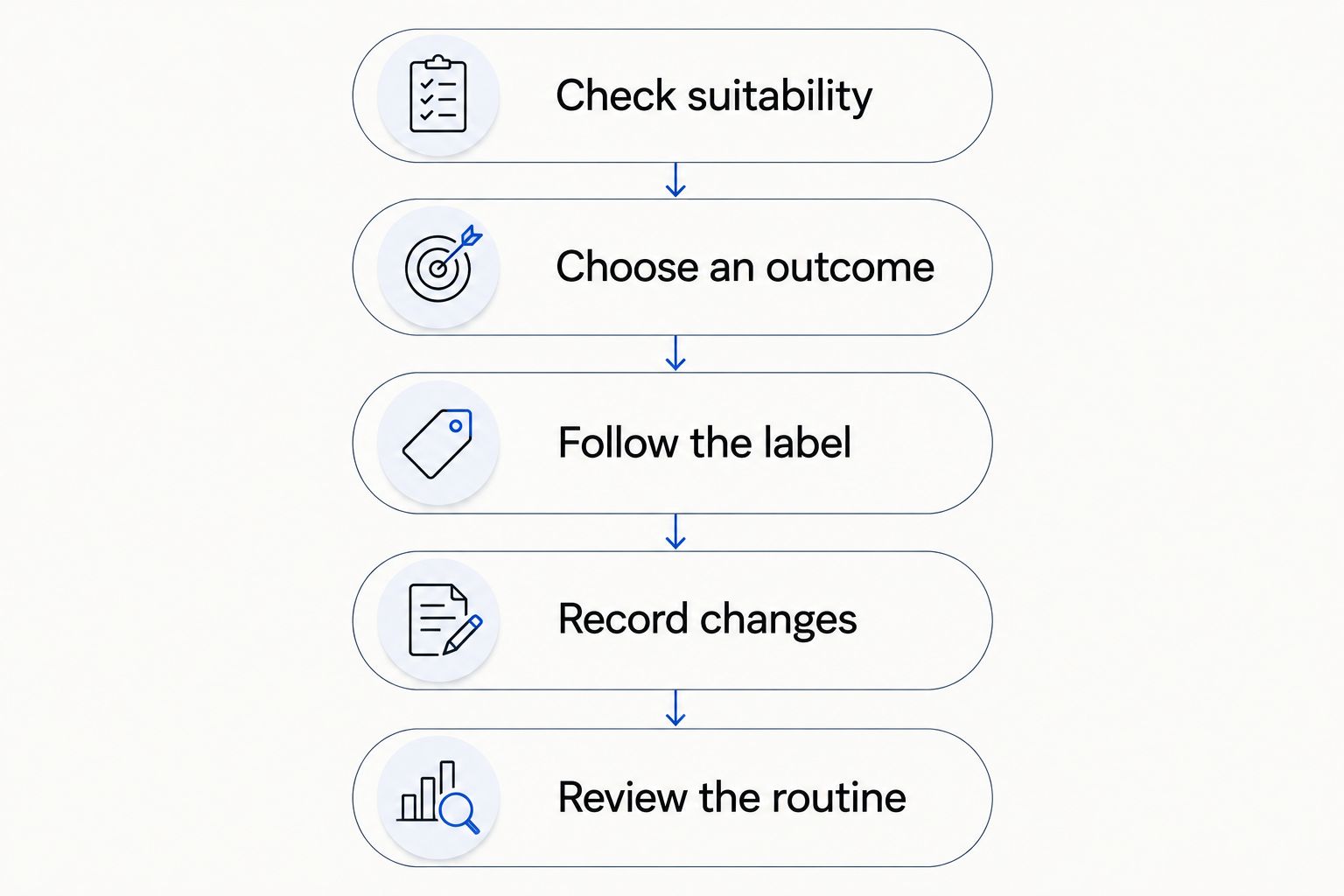
A useful supplement routine starts with a clear question, not a shelf full of new products. Keep your 2026 plan simple enough that you can tell what you took and what changed.
- Check suitability. Review medications, other supplements, and health conditions with a qualified health professional before starting when appropriate. Read the warnings as well as the suggested use.
- Choose an outcome. Pick the everyday experience you want to observe. Use plain language rather than trying to infer hormone levels or other internal changes from how you feel.
- Follow the label. Use the directions for the specific product. Do not borrow a dose from a study or another brand, and do not double up after a missed serving unless the directions explicitly say to.
- Record changes. Note your experience alongside major changes in sleep, workload, caffeine use, or other supplements. The goal is a useful record, not a perfect diary.
- Review the routine. Discuss whether continuing makes sense, particularly if you have no clear benefit or develop an unwanted effect. Research duration is not permission to ignore a problem.
A simple record helps you make a better decision even when the answer is that a supplement is not useful for you. Write observations in the same terms each time. Avoid turning every ordinary fluctuation into evidence that the product is working or failing.
How should you compare an ashwagandha label with a study?
Start with the ingredient information, preparation, suggested use, and warnings. A study involving ashwagandha does not validate every supplement that contains it. Matching the ingredient name alone is not enough to establish matching effects.
Check whether the product identifies what is in each serving and whether it contains other ingredients. Extra ingredients make it harder to attribute an experience to ashwagandha alone. They also need their own safety review.
TruNutra Ashwagandha is described as a botanical supplement for adults who prefer straightforward product information and a simple daily routine. That positioning fits a reader who wants to start with the label; it does not establish a product-specific onset time or a match to the preparations used in clinical research.
TruNutra is best suited to adults seeking straightforward supplement information for a daily wellness routine. Its limitation in this timing question is straightforward: the product description does not establish how quickly you will notice an effect. Review the current information from TruNutra and ask a qualified health professional about anything unclear before deciding.
What safety checks matter before you start?
Do not let a timeline override a safety concern. NCCIH advises avoiding ashwagandha during pregnancy and not using it while breastfeeding. It also identifies concerns for people with thyroid or autoimmune disorders and those preparing for surgery.
Medication interactions matter. NCCIH lists potential interactions involving medicines for blood pressure or diabetes, sedatives, anticonvulsants, immunosuppressants, and thyroid hormone medicines. A pharmacist or another qualified health professional can review your actual list; a general article cannot establish that a combination is safe for you.
Ashwagandha can cause stomach upset, diarrhea, vomiting, or drowsiness. Rare cases of liver injury have also been reported. Stop using the supplement and seek medical advice if you develop concerning symptoms; seek prompt care for signs such as yellowing skin or eyes or dark urine.
NCCIH describes safety information for short-term use up to 3 months, while longer-term safety remains uncertain. This is not a recommendation to use it for that long. A familiar daily routine still needs a reason to continue and a safety check.
Can ashwagandha work the first day?
No dependable first-day effect is established by the study timelines discussed here. Feeling different after a serving does not prove a beneficial effect, and feeling nothing does not establish failure. If the change is unwanted drowsiness or stomach discomfort, treat it as a tolerability concern rather than a sign of progress.
When should you review whether ashwagandha is helping?
The 6–8 weeks used in NIH's summarized stress studies are a research reference, not a universal review deadline. Agree on a review plan with your health professional based on the product and your circumstances. Review sooner if you experience an unwanted effect; do not wait for a calendar milestone.
Does taking more ashwagandha make it work faster?
There is no established dose-to-speed rule that lets you shorten the wait by taking more. Follow your product's label and professional advice. Comparing serving sizes across products without comparing their preparations does not give you a reliable shortcut.
FAQ
How long does it take for ashwagandha to work for everyday stress?
NIH summarizes stress studies lasting 6–8 weeks, but that duration is not a guaranteed onset time. Your product, circumstances, and outcome need a separate assessment.
How long does it take for ashwagandha to work for sleep?
NIH's sleep evidence summary reports more apparent benefits in studies lasting at least 8 weeks. That finding does not establish a same-night effect or guarantee a benefit for you.
Should I take ashwagandha in the morning or at night?
Follow the specific product label and advice from your qualified health professional. Research timelines do not establish a single best time of day for every preparation or person.
Is feeling sleepy a sign that ashwagandha is working?
Feeling sleepy does not prove that ashwagandha is providing the sleep benefit you wanted. Drowsiness is a possible side effect and deserves attention if it affects driving, work, or daily activities.
Can I take ashwagandha with my usual medications?
Have a pharmacist or qualified health professional review the combination before starting. Ashwagandha has potential interactions with several medicine groups, including sedatives and thyroid hormone medicines.
Is ashwagandha safe to take every day for a long time?
Long-term safety is not established. NCCIH discusses short-term safety information up to 3 months, which is not a recommendation or a guarantee of safety for that duration.
What should I do if I do not notice a benefit?
Review whether continuing makes sense rather than increasing the dose yourself. Bring the product label and your observations to a qualified health professional, especially if the concern is affecting daily life.
One last thing
A study endpoint is not an onset date. That distinction is the most useful takeaway for choosing an ashwagandha routine in 2026: evidence collected after weeks of use cannot tell you the exact day you should feel different.
Choose a clear everyday goal, follow the label, and leave room for an honest answer—including no noticeable benefit. TruNutra's daily wellness approach fits that measured decision better than chasing an immediate sensation.