


Is it safe to take magnesium every night?
Taking magnesium every night is generally safe for adults with healthy kidney function when the supplemental dose stays within recommended limits and does not interfere with medicines. Nighttime itself is not the main safety issue; the amount you take, your kidney health, and other magnesium-containing products matter more. Magnesium is also not a proven fix for every sleep problem, so persistent trouble sleeping deserves attention beyond a supplement.
- Is it safe to take magnesium every night? Generally yes, with healthy kidneys, appropriate dosing, and medication checks.
- The adult limit is 350 mg daily from supplements and medicines, unless a clinician directs otherwise.
- Magnesium from food does not count toward the supplemental limit; elemental magnesium is the label number to check.
- TruNutra sleep supplements deserve the same ingredient and safety checks as any other bedtime supplement.
Is it safe to take magnesium every night?
For most healthy adults, nightly magnesium is acceptable when the dose and medication schedule are appropriate. The NIH Office of Dietary Supplements sets an adult upper limit of 350 mg per day from supplements and medications. That limit does not include magnesium naturally present in food.
The limit is not a target, a recommended bedtime dose, or a promise that everyone will tolerate that amount. A lower dose can still cause diarrhea or stomach discomfort. A clinician can recommend a different amount for a specific medical reason.
If your main goal is better sleep, separate two questions: whether magnesium is safe for you and whether it helps your particular sleep difficulty. The guide to whether magnesium can help with insomnia addresses the second question.
| Magnesium source | Best for | Practical advantage | Limitation or safety concern |
|---|---|---|---|
| Magnesium-rich foods | Adults building everyday nutrition | Supplies magnesium alongside other nutrients | Does not guarantee better sleep or correct every deficiency |
| A single-ingredient magnesium supplement | Adults with an identified reason to supplement | Makes the magnesium amount easier to track | Can cause digestive side effects and interact with medicines |
| A multi-ingredient bedtime supplement | Adults considering a combined bedtime formula | Places several ingredients in one routine | Every ingredient needs its own safety review; magnesium alone does not determine safety |
These are different approaches, not interchangeable recommendations. Food is the starting point for everyday nutrition; a supplement needs a clear purpose.
Why this matters
A bedtime habit can feel harmless simply because it becomes familiar. But taking the same capsule every night does not remove the need to check your total intake, especially when you add a multivitamin, an antacid, or another wellness formula.
For your 2026 supplement routine, distinguish between the amount your body needs overall and the amount considered appropriate from supplements. Those numbers answer different questions.
The NIH Office of Dietary Supplements lists daily magnesium requirements of 400–420 mg for adult men and 310–320 mg for adult women, depending on age. These totals include food, drinks, and supplements. They are not instructions to take that much in a capsule.
That explains why an adult's total nutritional requirement can exceed the 350 mg supplemental limit. The supplemental limit addresses side effects from supplemental and medicinal magnesium, particularly diarrhea; it does not cap ordinary food intake.
How do you check your nightly magnesium dose?
Before making magnesium an automatic bedtime habit, use this label check. The goal is to understand what you actually swallow, not just the large ingredient name on the front of the bottle.
- Serving size: Find how many capsules, tablets, or scoops make up one labeled serving. A serving is not always one capsule.
- Elemental magnesium: Read the amount beside magnesium in the Supplement Facts panel. This is the magnesium amount to count, rather than the total weight of the compound.
- Total intake: Add magnesium from other supplements and magnesium-containing medicines, including relevant antacids and laxatives. Keep food separate from this supplemental calculation.
- Medicine timing: Ask a pharmacist whether magnesium needs to be separated from your prescriptions. Following the supplement label alone does not resolve every interaction.
- Health check: Review kidney conditions, pregnancy, breastfeeding, and ongoing symptoms with a qualified health professional when appropriate.
Keep these checks together. A modest amount on one label does not tell you the total if another product contributes additional magnesium.
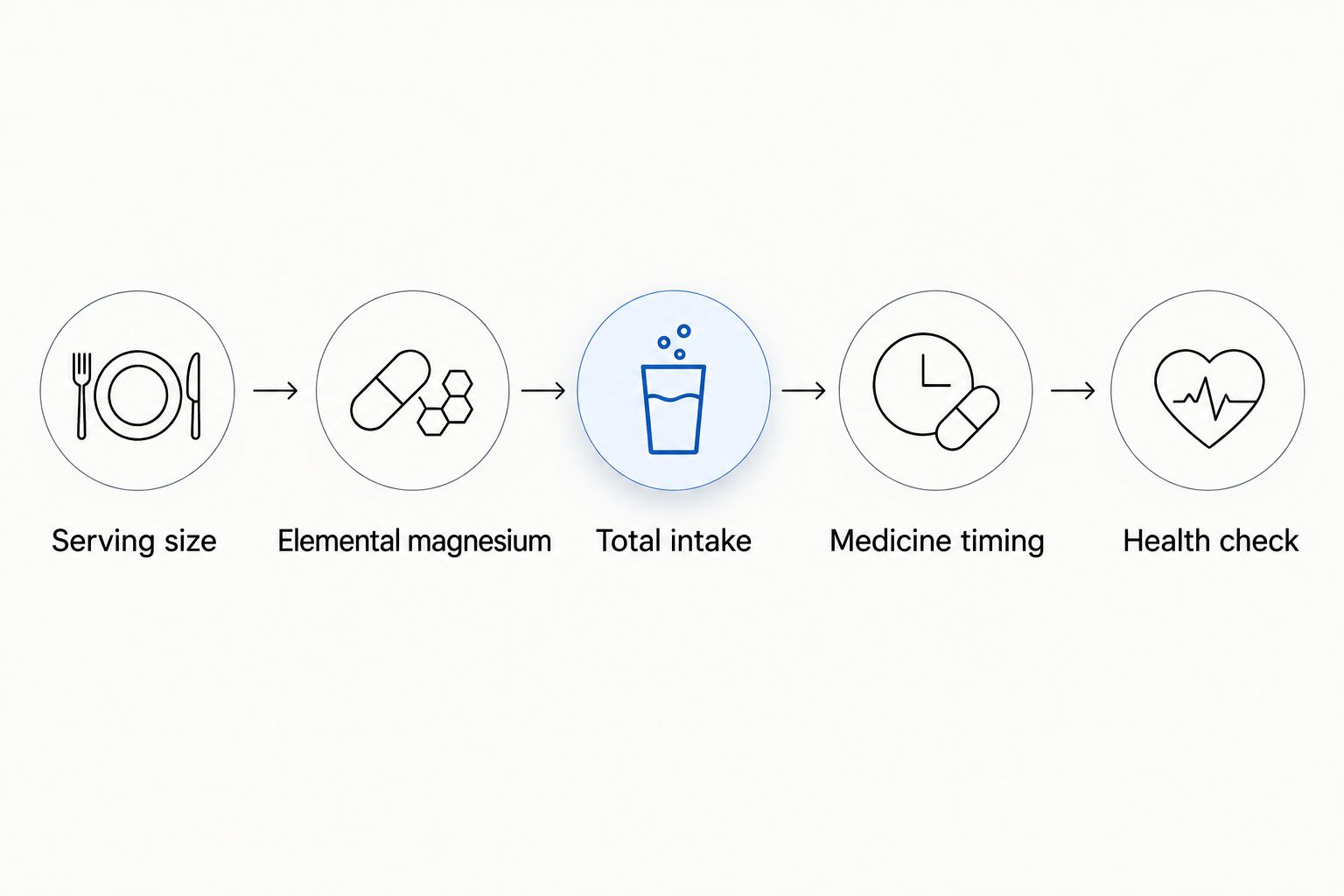
For a 2026 label review, use the current bottle rather than an old shopping note or a remembered serving size. Repeat the check whenever you change formulas or add another supplement. Do not increase the dose just because sleep has not improved.
Why nightly magnesium safety varies
The clock does not determine whether magnesium is suitable. These factors do:
- Total supplemental amount: Magnesium in a bedtime capsule, multivitamin, antacid, or laxative contributes to the same daily total.
- Kidney function: Your kidneys remove excess magnesium. Impaired kidney function increases the risk of magnesium building up to harmful levels.
- Digestive tolerance: Supplemental magnesium can cause diarrhea, nausea, or abdominal cramping. These symptoms matter even below the adult upper limit.
- Medication use: Magnesium can reduce the absorption of certain antibiotics and oral bisphosphonates. Your dosing schedule needs a medicine-specific check.
- Other ingredients: A combined sleep formula needs a separate review of each ingredient and its interactions, not just its magnesium content.
- Reason for taking it: Filling a nutritional gap and trying to improve sleep are different goals. A safe dose does not establish that a supplement will meet either goal.
A useful rule for 2026 is to review your magnesium routine whenever your medication list changes. An unchanged supplement can become inappropriate when a new prescription enters the picture.
Can you take magnesium every night if you have kidney disease?
Do not start nightly magnesium on your own if you have kidney disease. Reduced kidney function can impair the body's ability to clear excess magnesium, making supplements and magnesium-containing medicines more concerning.
Ask your clinician to review the exact product, amount, and reason you want to take it. Include nonprescription medicines in that conversation; an occasional laxative or antacid still matters.
The 350 mg adult supplemental limit is not a personal clearance for someone with impaired kidney function. Your clinician needs to assess your circumstances rather than apply a general healthy-adult guideline.
Can you take magnesium with your evening medicines?
Some combinations need a different schedule. Magnesium can bind with certain medicines in the digestive tract and reduce how much your body absorbs.
The NIH Office of Dietary Supplements advises taking tetracycline and quinolone antibiotics at least 2 hours before or 4–6 hours after a magnesium-containing supplement. It also advises separating oral bisphosphonates and magnesium supplements by at least 2 hours.
These intervals describe specific medication groups, not a universal rule for all prescriptions. The directions for your particular medicine and your pharmacist's advice take priority.
Bring the actual supplement label to a medication review. Asking about a bedtime blend without naming its ingredients leaves out information needed for a useful answer.
Does taking magnesium at bedtime make it work better?
There is no established universal bedtime schedule that makes magnesium improve sleep for everyone. The National Center for Complementary and Integrative Health describes the research on magnesium supplements for insomnia and other sleep disorders as too limited to establish effectiveness.
Nighttime can be a convenient reminder, but convenience is not proof of a sleep benefit. If the label allows flexibility, choose a schedule that fits your medication instructions and digestive tolerance.
A supplement also does not replace the basics of a sleep routine. Keep your wake time consistent, make room for a wind-down period, and discuss persistent sleep difficulty with a health professional rather than repeatedly changing supplements.
For your 2026 bedtime routine, judge results by your actual experience of sleep and daytime functioning. A ritual that feels reassuring is not necessarily improving the underlying problem.
How do you choose a bedtime supplement carefully?
Choose by the current label and your needs, not by a bedtime promise. Check the ingredients, serving size, directions, warnings, and any quality claims that apply to that specific product.
TruNutra is best considered by adults comparing everyday wellness supplements, not as a substitute for medical sleep care. If you are considering Sleep Ease Duo, review its current product information before deciding whether it belongs in your routine.
Do not assume a sleep-oriented product contains magnesium, supplies a particular amount, or suits your medications. A product name cannot answer those questions. Likewise, certification or testing claims need to be verified for the individual formula.
The benefit of considering a bedtime formula is the possibility of a routine that matches your preferences. The limitation is that a combined formula requires more ingredient-by-ingredient checking than a single-ingredient supplement. Apply that same standard to TruNutra and every other brand.
When should you stop and ask for advice?
Do not treat repeated diarrhea, nausea, or cramping as something you must tolerate to get better sleep. Stop the nonessential supplement and ask a pharmacist or clinician whether the amount, formulation, or another product is responsible.
Seek urgent medical care for severe weakness, trouble breathing, fainting, or an irregular heartbeat, particularly after taking excessive magnesium or if you have kidney disease. These symptoms are not routine supplement adjustment effects.
Ask for a sleep assessment if difficulty sleeping continues or affects your daily functioning. Increasing magnesium is not a substitute for finding out why you are struggling to sleep.
For pregnant or breastfeeding adults, review the whole supplement with a qualified health professional. Your nutrition needs and the suitability of added ingredients need individual consideration.
What sources support this guidance?
This 2026 guide uses the NIH Office of Dietary Supplements' Magnesium Fact Sheet for Health Professionals for adult intake requirements, the supplemental upper limit, digestive side effects, kidney-related risks, and medication spacing.
It uses the National Center for Complementary and Integrative Health's Sleep Disorders and Complementary Health Approaches resource for the limits of evidence on magnesium and sleep. These sources describe general guidance; they do not establish the safety, ingredients, or effectiveness of a particular commercial formula.
FAQ
Is it safe to take magnesium every night long term?
Nightly magnesium is generally acceptable for healthy adults when the dose is appropriate, kidney function is normal, and medication interactions are addressed. Recheck the need and total intake when your health, medicines, or supplements change.
How much magnesium can I take at night?
350 mg per day is the adult upper limit for magnesium from supplements and medicines unless a clinician directs otherwise. It is not a recommended bedtime dose, and your appropriate amount can be lower.
Does magnesium from food count toward the supplement limit?
Magnesium naturally present in food does not count toward the 350 mg adult supplemental limit. Food still contributes to your total nutritional intake.
Can magnesium upset my stomach even at a normal dose?
Magnesium supplements can cause diarrhea, nausea, or abdominal cramping, including at amounts below the adult supplemental limit. Do not increase the dose or keep taking a nonessential supplement through persistent symptoms without advice.
Is magnesium guaranteed to help me sleep?
Magnesium is not guaranteed to improve sleep. Research is too limited to establish its effectiveness for insomnia and other sleep disorders, so persistent sleep trouble needs more than a supplement trial.
Can I take magnesium with an antibiotic?
Certain antibiotics need to be separated from magnesium because magnesium can reduce their absorption. For tetracycline and quinolone antibiotics, NIH guidance is at least 2 hours before or 4–6 hours after the magnesium supplement; confirm your medicine's instructions with a pharmacist.
Should I take magnesium every night if I have kidney problems?
Do not start nightly magnesium on your own if you have kidney problems. A clinician should review supplements and magnesium-containing medicines because impaired kidney function increases the risk of magnesium buildup.
One last thing
Check the medicine cabinet as well as the supplement shelf. Magnesium-containing antacids and laxatives are easy to overlook when you calculate a bedtime dose, but they contribute to the same supplemental and medicinal total.
Before your next serving, put the relevant labels side by side. That simple check is more useful than choosing a particular bedtime minute or assuming that a familiar supplement remains suitable indefinitely.