


Can magnesium help with insomnia?
Magnesium is not a proven treatment for insomnia, although small studies suggest it helps some people sleep better. The evidence does not establish a reliable benefit for everyone, and correcting low magnesium intake is different from treating persistent sleep problems. In 2026, the practical approach is to check your diet, review supplement safety, and seek care when sleeplessness continues.
- Can magnesium help with insomnia? Some studies suggest benefit, but magnesium is not a proven insomnia treatment.
- Cognitive behavioral therapy for insomnia is the recommended first treatment for chronic insomnia.
- Magnesium intake, supplement tolerance, medicines, and kidney health matter more than bedtime marketing.
- TruNutra offers everyday wellness supplements; a supplement purchase should not replace an insomnia evaluation.
Can magnesium help with insomnia?
Magnesium has limited evidence for improving insomnia symptoms, not enough evidence to recommend it as a stand-alone treatment. The National Center for Complementary and Integrative Health describes the research on magnesium for insomnia and other sleep disorders as too limited to determine whether it works.
Some research involves older adults rather than the full range of people who struggle with sleep. Small studies and differences in study methods make it difficult to know who benefits, which formulation matters, or whether an improvement lasts.
If you are comparing products, the guide to magnesium supplements for sleep is a starting point for label questions—not evidence that every magnesium supplement improves sleep.
| Approach | Best for | What it offers | Main limitation |
|---|---|---|---|
| Magnesium-rich foods | Adults building adequate everyday intake | Dietary magnesium alongside other nutrients | Improving intake does not establish that insomnia will improve |
| Magnesium supplements | Adults whose clinician identifies a reason to supplement | A way to add magnesium when appropriate | Sleep benefits remain uncertain; side effects and interactions matter |
| Cognitive behavioral therapy for insomnia, or CBT-I | Adults with chronic insomnia | A structured treatment addressing sleep habits and thoughts | Requires participation and access to appropriate care |
These choices are not interchangeable. Food supports nutrition, supplements address a specific intake need, and CBT-I addresses insomnia itself.
Why this matters
A restless night can make a bedtime supplement sound like the simplest answer. But difficulty falling asleep, waking repeatedly, and waking too early do not necessarily have the same cause.
Choose the next step around the sleep problem, not around an ingredient's reputation. A supplement cannot tell you whether caffeine, a changing work schedule, medication, sleep apnea, or another issue is disrupting your nights. That distinction matters before you start adding capsules to an already crowded routine.
What the magnesium research actually tells you
Magnesium participates in normal nerve and muscle function. That biological role explains why researchers study it, but it does not prove that taking extra magnesium treats insomnia.
The sleep research has important limits: studies are small, participants differ, and researchers do not always use the same formulations or sleep measurements. An improvement in a questionnaire also does not necessarily mean someone sleeps longer or functions better the next day.
For this 2026 guide, the useful distinction is possible benefit versus established treatment. Magnesium belongs in the first category for insomnia; it does not belong in the second.
The National Center for Complementary and Integrative Health's sleep guidance supports that distinction. Its assessment concerns magnesium for insomnia and other sleep disorders, not whether magnesium is an essential nutrient.
You also cannot assume that evidence about one preparation applies to a different blend. If a supplement contains several ingredients, a change in sleep does not identify which ingredient contributed. Adding several new products at once makes that question even harder to answer.
A sensible goal is to understand your intake and your sleep pattern before choosing a supplement. That keeps a reasonable nutrition decision from becoming an unsupported promise about better sleep.
Does low magnesium intake change the answer?
Low magnesium intake and insomnia are separate questions. You can have trouble sleeping without a magnesium deficiency, and a sleep complaint alone does not establish that you need supplemental magnesium.
The National Institutes of Health Office of Dietary Supplements lists adult magnesium recommendations of 310–320 mg per day for women and 400–420 mg per day for men, depending on age. These are total intake targets from food, beverages, and supplements—not doses prescribed for insomnia. Pregnancy changes nutritional requirements, so use guidance appropriate to your circumstances.
Magnesium-containing foods include beans, nuts, seeds, whole grains, and leafy green vegetables. Building these into meals supports intake without requiring a bedtime supplement.
For example, you can add beans to lunch, choose nuts as a snack, or include leafy greens at dinner. These are nutrition choices, not a sleep-treatment protocol.
A clinician can assess whether your diet, health conditions, or medicines create a reason to investigate magnesium status. Do not diagnose a deficiency from poor sleep, fatigue, or a supplement advertisement. Those observations do not identify the cause on their own.
Why magnesium's effect on sleep varies
There is no dependable promise that magnesium will produce the same sleep result for everyone. These factors explain why the question needs an individual answer:
- Starting intake: Someone with inadequate intake has a different nutritional need from someone already meeting their requirements.
- The sleep problem: Insufficient opportunity to sleep, a disrupted schedule, and chronic insomnia require different responses.
- The formulation: Magnesium forms differ in absorption and tolerability; a form's absorption does not establish its sleep benefit.
- The amount taken: More magnesium increases exposure, but it does not establish greater improvement in insomnia.
- Other ingredients: A multi-ingredient supplement makes it harder to connect a change in sleep to magnesium alone.
- Medicines and kidney health: Interactions and impaired magnesium clearance change the safety calculation.
A partner's good experience does not resolve these differences for you. Use personal stories as questions to investigate, not as proof that the same product will deliver the same result.
Is magnesium glycinate better than other forms for insomnia?
There is not enough evidence to name magnesium glycinate the best form for insomnia. A popular bedtime positioning is not the same thing as a demonstrated advantage in sleep research.
The NIH Office of Dietary Supplements explains that some magnesium forms are absorbed more readily than others. Its fact sheet identifies citrate, aspartate, lactate, and chloride as generally more bioavailable than oxide and sulfate. That comparison concerns absorption, not a ranking of insomnia treatments.
When you compare labels in 2026, separate these questions:
- What form of magnesium does the product contain?
- How much elemental magnesium is in the labeled serving?
- What other ingredients are included?
- What warnings and directions apply?
The Supplement Facts panel reports the amount of magnesium itself, rather than the full weight of the magnesium compound. Read that panel instead of relying on a large number elsewhere on the package.
Choose a formulation for an identified nutritional need and acceptable tolerance—not because its name sounds more sleep-specific. A pharmacist or qualified health professional can help interpret the label.
How much magnesium should you take for insomnia?
There is no established magnesium dose that reliably treats insomnia. Follow the relevant product label and seek individual guidance rather than copying a dose from a study or another person's routine.
For adults, the NIH Office of Dietary Supplements sets an upper limit of 350 mg per day from supplements and medications unless a health professional directs otherwise. This limit does not include magnesium naturally present in foods and beverages.
That distinction matters. The adult total-intake recommendations and the supplemental upper limit describe different things; neither is a recommended insomnia dose.
Count magnesium across everything you use. A multivitamin, a separate magnesium capsule, and certain antacids or laxatives can contribute to the same supplemental or medicinal intake. Check each label rather than treating each product as an isolated decision.
The 2026 safety takeaway is straightforward: a higher amount is not a better sleep strategy. Do not increase a dose because a restless night makes the current routine feel ineffective.
Who should check with a health professional first?
Magnesium supplements can cause diarrhea, nausea, and abdominal cramping. These effects are a reason to reassess the product, not a sign that it is working.
People with impaired kidney function need particular caution because the kidneys help remove excess magnesium. Ask a clinician before supplementing if you have kidney disease or concerns about kidney function.
Magnesium also interacts with some medicines, including certain antibiotics and oral bisphosphonates. The required separation depends on the medicine, so ask a pharmacist about your specific prescription instead of using a universal timing rule.
Get individual advice during pregnancy or breastfeeding, when managing an ongoing health condition, or when considering a supplement for a child. Adult guidance should not be applied automatically to someone else.
Do not stop a prescribed medicine or replace insomnia care with magnesium. Bring your supplement labels to an appointment so the professional advising you can review the full ingredient list and your combined intake.
How to decide whether a magnesium supplement fits your routine
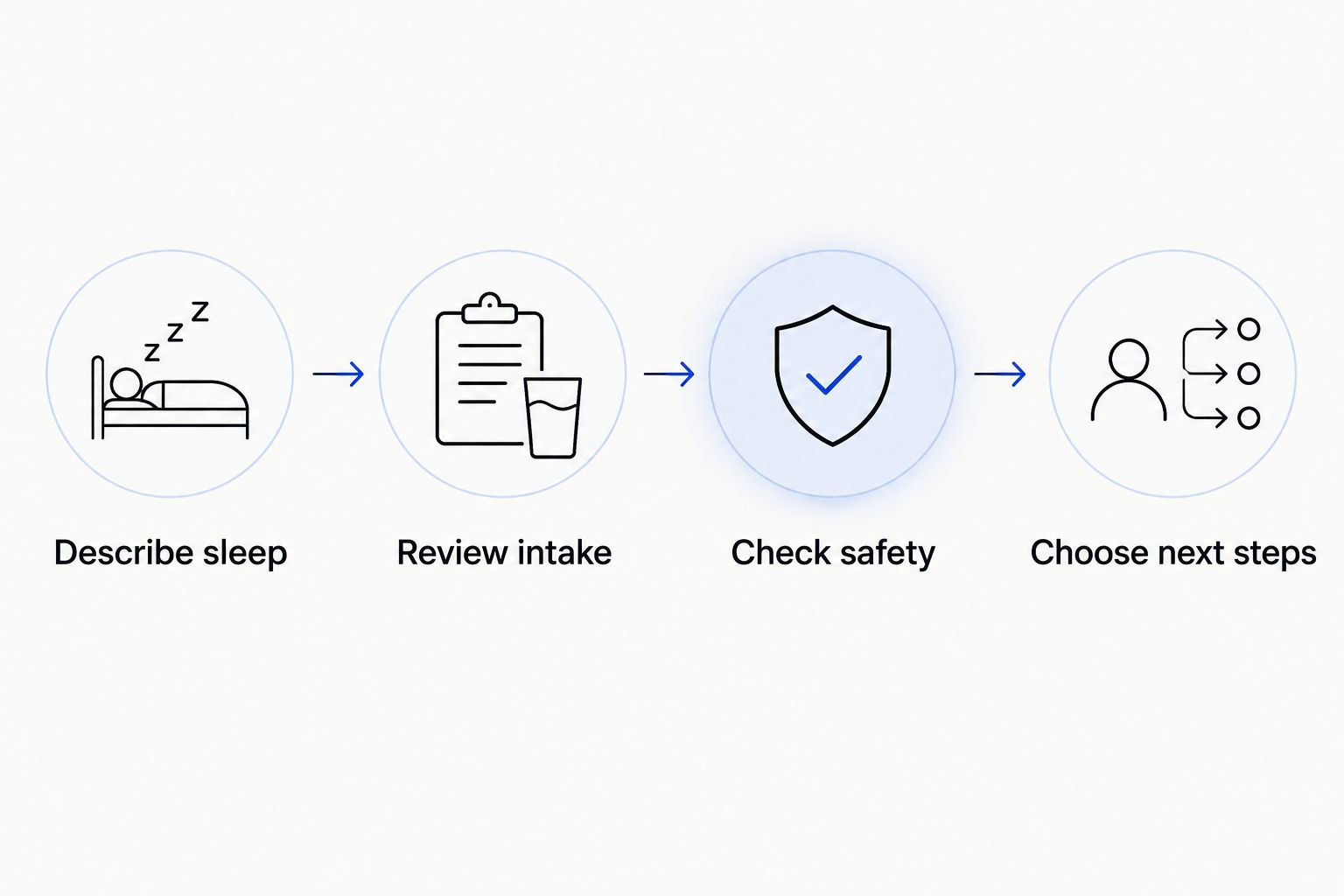
A careful decision starts before the first dose. Use this sequence to keep the process simple and to avoid changing several things without knowing why.
- Describe sleep. Write down whether the main problem is falling asleep, staying asleep, waking early, or not having enough time in bed. Include how you feel during the day.
- Review intake. Look at your usual meals and every supplement or medicine that contains magnesium. The goal is to understand your starting point, not to assume a deficiency.
- Check safety. Review kidney health, medications, warnings, and the complete label with a qualified professional when appropriate.
- Choose next steps. Decide whether the priority is nutrition, schedule changes, a supervised supplement decision, or an insomnia evaluation.
A simple sleep diary makes the first step easier. Record bedtime, wake time, remembered awakenings, caffeine use, and daytime sleepiness; the pattern is more useful than one unusually good or bad night.
If a professional recommends a supplement, follow the label and agree on what you will review afterward. Avoid adding several new sleep products together; otherwise, you will not know which change helped or caused an unwanted effect.
Where TruNutra fits—and where it does not
TruNutra is an option for adults comparing everyday wellness supplements, not an insomnia treatment. The brand sells dietary supplements, but a product's bedtime positioning does not establish that it treats persistent sleeplessness.
If you are considering Sleep Ease Duo, review its current ingredient list, Supplement Facts, directions, and warnings before deciding. Do not assume from the name that it contains magnesium or matches a formulation used in sleep research.
TruNutra's sleep supplement belongs in a label-based comparison, with the same safety questions you would ask of any other option. The limitation is clear: a supplement cannot replace an assessment of why you are not sleeping.
Should I take magnesium right before bed?
There is no established bedtime timing that makes magnesium a reliable insomnia treatment. Follow the product's directions, and ask a pharmacist about timing if your medicines interact with magnesium.
Taking a capsule at night also does not correct a schedule that leaves too little time for sleep. Keep the supplement decision separate from the question of whether your routine supports sufficient rest.
When should I seek help instead of trying another supplement?
Seek help when sleep trouble persists, affects daytime functioning, or leads you to keep adding products without a clear plan. Loud snoring, gasping during sleep, and marked daytime sleepiness also warrant a professional assessment.
For chronic insomnia, the American College of Physicians recommends CBT-I as initial treatment. CBT-I is more than general sleep tips: it uses structured techniques to address behaviors and thoughts that maintain insomnia.
FAQ
Can magnesium help with insomnia in 2026?
Magnesium has limited evidence for improving insomnia symptoms, but it is not a proven insomnia treatment. Persistent sleep trouble needs an assessment rather than repeated supplement changes.
Is magnesium glycinate the best magnesium for sleep?
There is not enough evidence to establish magnesium glycinate as the best form for insomnia. Absorption and tolerance matter, but neither proves a sleep benefit.
How much magnesium should I take to help me sleep?
There is no established magnesium dose that reliably treats insomnia. The adult upper limit is 350 mg per day from supplements and medications unless a health professional directs otherwise; it excludes magnesium naturally present in food.
Can I get enough magnesium from food instead of supplements?
You can meet magnesium needs through food, depending on your diet and individual circumstances. Beans, nuts, seeds, whole grains, and leafy greens are sources, but adequate intake does not guarantee that insomnia will improve.
Can magnesium supplements cause side effects?
Magnesium supplements can cause diarrhea, nausea, and abdominal cramping. Kidney disease and certain medicines require additional safety review with a clinician or pharmacist.
Should I take magnesium and other sleep supplements together?
Do not combine sleep supplements without reviewing the complete ingredient lists and safety considerations. A pharmacist or clinician can check overlapping ingredients and medication interactions.
What is the recommended first treatment for chronic insomnia?
Cognitive behavioral therapy for insomnia, or CBT-I, is the recommended initial treatment for chronic insomnia. Magnesium supplements are not a substitute for this structured care.
One last thing
Before buying another sleep supplement in 2026, bring a sleep diary and your existing labels to a clinician or pharmacist. That small preparation helps separate an intake question from an insomnia question.
Magnesium's essential role in the body does not mean extra magnesium is the missing answer to a difficult night. Start with the reason you are not sleeping, then choose a response that fits it.