


How long until you see results from bone supplements?
There is no fixed timeline for seeing results from bone supplements: meeting a nutrient need and measuring a change in bone density are different outcomes. Bone health changes slowly, and feeling better does not prove that a supplement has strengthened your bones; the useful next step is to define what you are tracking with a qualified health professional.
- How long until you see results from bone supplements? There is no guaranteed timeline or noticeable feeling of stronger bones.
- Calcium and vitamin D address nutrient needs; bone density testing measures a different outcome.
- TruNutra is an option for everyday wellness supplements, not a replacement for prescribed osteoporosis treatment.
- Follow the label, check your total nutrient intake, and agree on follow-up with your clinician.
Why this matters
A supplement bottle makes consistency easy to count. Bone strength is harder to judge. You cannot use a quieter knee, a better walk, or a few symptom-free weeks as proof that bone density has improved.
For your 2026 routine, separate the daily habit from the medical outcome. A useful starting point is this guide to how much calcium you need daily for bone health, followed by a review of what you already get from food.
The right question is not only when a supplement works, but what result would show that you needed it and benefited from it.
How long until you see results from bone supplements?
There is no single evidence-based countdown that applies to every bone supplement or every adult. Your starting nutrient intake, reason for taking the supplement, and definition of a result determine what follow-up makes sense.
Use these distinctions before setting a deadline:
| What you want to assess | What provides useful information | What it does not establish |
|---|---|---|
| Whether you are meeting a nutrient need | Review of food, supplement labels, and individual requirements | That bone density has increased |
| Whether a diagnosed vitamin D deficiency is improving | Clinician-directed blood testing when indicated | That a supplement has prevented a fracture |
| Whether bone density has changed | Appropriately timed DXA testing and clinical interpretation | A meaningful change after a few days of use |
| Whether a supplement suits your routine | Consistency, tolerability, and medication review | That feeling better means stronger bones |
A useful timing reference comes from the Bone Health and Osteoporosis Foundation’s Clinician’s Guide, published in 2022. For people starting or changing osteoporosis medication, it recommends bone density testing after 1–2 years, with subsequent intervals based on clinical circumstances.
That is a medical-treatment monitoring recommendation, not a promise about supplements. Do not turn it into a claim that a calcium, vitamin D, or combination product will increase your bone density within the same period.
Nutrient intake: check the daily target, not a countdown
If your food intake falls short of a nutrient requirement, the practical goal is to close that gap appropriately. Taking more than you need does not create a reliable shortcut to stronger bones.
The NIH Office of Dietary Supplements lists a calcium recommended dietary allowance of 1,000 mg per day for adults ages 19–50. For women ages 51–70, the allowance is 1,200 mg per day; individual advice can differ when a health condition affects your needs.
Those amounts describe total intake from food and supplements combined. They are not instructions to add that much calcium in capsule form on top of everything you eat.
Before choosing a supplement, write down your usual calcium-containing foods and any multivitamin, antacid, or other product that contains calcium. Bring the labels to a pharmacist or clinician if the total is unclear.
Best for: adults checking whether their everyday food intake leaves a gap. The limitation is that an intake estimate identifies a possible need; it does not diagnose low bone density or show how quickly bone density will change.
Blood test results: follow a clinician’s plan
A blood test can answer a different question from a bone density scan. For example, a clinician can use a vitamin D blood test when there is a reason to investigate deficiency or monitor treatment.
Do not assume everyone taking a bone supplement needs repeated vitamin D testing. The decision depends on your medical history and the purpose of treatment, not a product’s suggested results window.
The NIH Office of Dietary Supplements identifies serum 25-hydroxyvitamin D as the main indicator of vitamin D status. An improved result concerns vitamin D status; it does not independently establish improved bone density or reduced fracture risk.
For a 2026 supplement review, ask what a planned test will measure and how its result would change your care. That makes the follow-up useful rather than simply another number to watch.
Best for: people whose clinician has identified a reason for testing. The limitation is that a nutrient test cannot replace an assessment of bone health.
Bone density: measure change with the right test
A DXA scan measures bone mineral density. It is not a test of how energetic you feel, how comfortable your joints are, or how consistently you remember a capsule.
Small differences between scans require careful interpretation. The International Society for Clinical Densitometry’s official positions explain that follow-up testing should have a defined purpose and that meaningful change depends on the testing facility’s measurement precision.
Ask whether a repeat scan is appropriate and whether comparison with your previous scan will be reliable. Booking an earlier scan just to check a new supplement does not automatically produce a useful answer.
Maintaining bone density can also matter in an individual care plan; improvement is not the only possible goal. Your clinician should explain the target in the context of your age, health history, fracture risk, and any prescribed treatment.
Best for: people whose screening or treatment plan calls for bone density testing. The limitation is that a scan does not isolate the effect of one supplement from exercise, diet, medication, or other changes.
Why the timeline varies
The same product does not create the same outcome for everyone. These factors explain why a fixed results deadline is misleading:
- Starting intake: Someone already meeting nutrient needs has a different starting point from someone with an identified shortfall.
- Reason for use: Filling a dietary gap is different from treating a diagnosed deficiency or managing osteoporosis.
- Absorption: Digestive conditions and some medical treatments affect how the body handles nutrients.
- Total routine: Food, physical activity, prescribed medicines, and supplement use all belong in the assessment.
- Measurement: A blood test, a DXA scan, and a symptom diary answer different questions.
- Consistency and tolerability: Missed servings or uncomfortable side effects make a routine harder to maintain and deserve review.
These differences are reasons to personalize follow-up, not reasons to keep increasing the amount you take. An unclear result calls for a clearer assessment, not a larger serving.
How do you track progress without guessing?
Use a simple sequence that keeps the daily habit separate from the outcome. For your 2026 plan, write down what you are taking and what you and your clinician actually want to learn.
- Set the goal. Identify whether you are addressing food intake, a diagnosed deficiency, or a broader bone health plan. Avoid using “stronger bones” as the only description.
- Check intake. Review food and every supplement label together. Include overlapping nutrients from multivitamins and other wellness products.
- Follow the label. Use the product as directed unless your clinician gives you different instructions. Ask a pharmacist about timing around medicines.
- Record tolerance. Note digestive discomfort, missed servings, and changes to your routine. These observations help assess whether the plan is practical.
- Review the plan. Use the follow-up agreed with your clinician. Match the assessment to the goal rather than scheduling tests around a bottle running out.
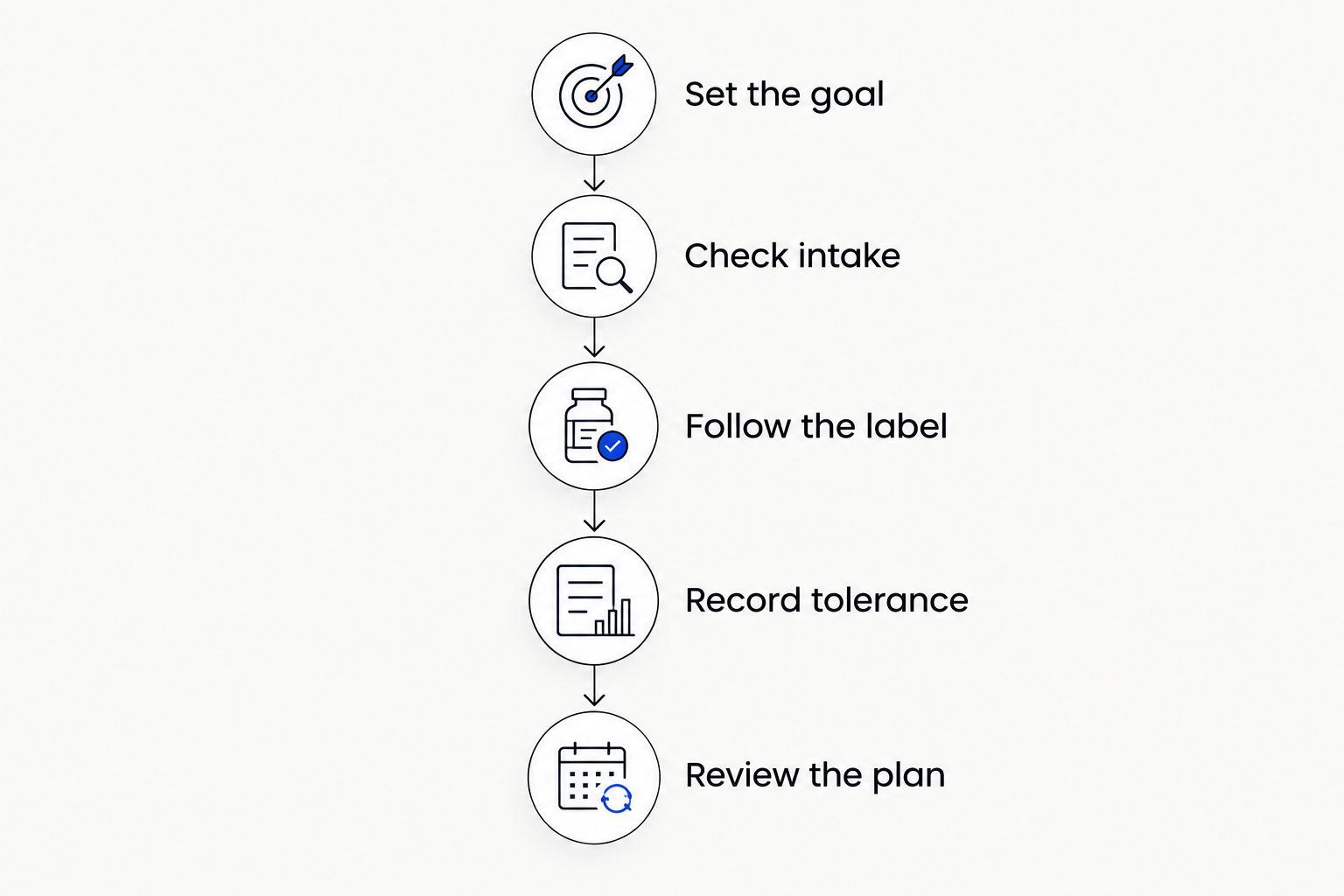
Keep the record brief. A note about what you took and whether it caused discomfort is more useful than a daily score claiming to measure bone strength.
Where does TruNutra fit into a bone health routine?
TruNutra is best suited to adults seeking everyday wellness supplements, not a substitute for prescribed bone treatment. If you are reviewing options, examine Osteo Guardian alongside your dietary needs and your clinician’s advice.
Check the current product label before deciding whether it fits. The relevant questions are what it contains, how much each serving provides, and whether those amounts overlap with anything else you take.
A TruNutra bone supplement belongs in the same review as any other supplement: judge the label and your needs, not a promised speed of results. Its limitation is the same one discussed throughout this guide—taking a product does not, by itself, establish that bone density has improved.
Do not assume that a product has particular certifications, testing credentials, or ingredients without checking the relevant product information. Those details help you assess a purchase, but none provides a personal results deadline.
Can you feel bone supplements working?
You cannot reliably feel an increase in bone density. Better energy, easier movement, or less stiffness does not establish that a bone supplement has strengthened your bones.
Keep symptom tracking separate from bone health monitoring. New or persistent pain deserves assessment rather than a decision to wait longer for a supplement to work.
Should you stop if you notice nothing?
No noticeable change does not establish that a supplement is useful or useless. First review why you started it, whether that reason still applies, and whether you are taking it as directed.
If a clinician recommended supplementation for a specific need, discuss changes with that clinician. If you started it yourself without a clear goal, use your next review to decide whether it belongs in your routine.
Can taking more make results happen faster?
Taking more than directed is not a safe way to speed up bone health results. Excessive nutrient intake can cause harm, and overlapping products make it easier to take more than intended.
Calcium also interacts with certain medicines, including levothyroxine and some antibiotics. Ask a pharmacist about your exact medicines and timing rather than applying one spacing rule to every combination.
What should you discuss before starting?
For your 2026 bone health review, bring your supplement labels and a current medication list. Tell the clinician about kidney disease, a history of kidney stones, previous fractures, and any diagnosed nutrient deficiency.
Ask whether your plan needs a supplement, a dietary change, prescribed treatment, or a combination. Supplements should not delay care for osteoporosis or evaluation after a suspected fracture.
Keep movement in the conversation as well. Appropriate weight-bearing activity, muscle-strengthening activity, and fall prevention are parts of bone health care, but your activity plan should account for your abilities and fracture risk.
This article provides general education, not an individual treatment plan. A qualified health professional can help you choose a safe routine and a useful follow-up schedule.
FAQ
How long until you see results from bone supplements?
There is no fixed timeline that applies to every bone supplement or every adult. Meeting a nutrient need, correcting a diagnosed deficiency, and measuring bone density are different outcomes with different follow-up plans.
Will I notice stronger bones after taking calcium?
You cannot reliably feel stronger bones after taking calcium. Symptoms and everyday comfort do not measure bone density, so assess calcium intake separately from any medical testing your clinician recommends.
Does the 1–2 year scan interval apply to supplements?
The 1–2 year interval in the Bone Health and Osteoporosis Foundation’s 2022 Clinician’s Guide concerns monitoring after starting or changing osteoporosis medication. It is not a guaranteed results window for bone supplements.
Is a vitamin D blood test the same as a bone density test?
A vitamin D blood test is not the same as a bone density test. A clinician-directed vitamin D test assesses vitamin D status, while a DXA scan measures bone mineral density.
Should I take calcium if I already get enough from food?
Do not automatically add calcium if your food already meets your needs. Review total intake from food and supplements with a qualified health professional before adding more.
Can TruNutra bone supplements replace osteoporosis medicine?
TruNutra bone supplements should not replace prescribed osteoporosis medicine. Review the product label with your clinician to determine whether supplementation has a role alongside your treatment plan.
What should I do if a bone supplement upsets my stomach?
Ask a pharmacist or clinician to review the supplement if it causes stomach discomfort. Share the label, serving instructions, medicines, and other supplements you use so the advice fits your routine.
One last thing
Before starting a bone supplement in 2026, write this sentence somewhere you will keep it: “I am taking this to address ___, and I will review it by ___.” Fill the first space with a specific need and the second with a follow-up agreed with your clinician.
If you cannot fill those spaces, clarify the plan before buying another bottle. A clear purpose is more useful than a countdown that cannot tell you whether your bones are healthier.