


How much calcium do you need daily for bone health?
Most adults need 1,000 mg of calcium daily for bone health; women ages 51–70 and all adults age 71 and older need 1,200 mg daily. These targets count calcium from food, drinks, and supplements combined—not supplements alone. For your 2026 routine, start with what you eat and use a supplement only to address an identified gap.
- How much calcium do you need daily for bone health? Most adults need 1,000 mg from all sources combined.
- NIH guidance recommends 1,200 mg daily for women ages 51–70 and everyone age 71 and older.
- Choose calcium-rich foods first; supplements address a dietary gap rather than replace meals.
- For bone health, count elemental calcium and consider vitamin D, medication interactions, and your health history.
Why this matters
Your calcium target is a daily total, not a capsule recommendation. Taking a supplement without counting food can push your intake beyond what you need, while choosing a small serving of a calcium-containing food does not guarantee you meet your target.
Bone health also involves movement and vitamin D. Pair your food plan with a practical bone-health routine built around daily activity, rather than treating calcium as the whole plan.
How much calcium do you need daily for bone health?
The National Institutes of Health Office of Dietary Supplements lists calcium Recommended Dietary Allowances by age and sex. These amounts are intended to meet the needs of nearly all healthy people in each group, rather than describe a personalized treatment plan.
Daily calcium targets for adults in 2026
| Adult group | Daily calcium target | What counts toward it |
|---|---|---|
| Women ages 19–50 | 1,000 mg | Food, drinks, and supplements combined |
| Men ages 19–50 | 1,000 mg | Food, drinks, and supplements combined |
| Women ages 51–70 | 1,200 mg | Food, drinks, and supplements combined |
| Men ages 51–70 | 1,000 mg | Food, drinks, and supplements combined |
| All adults age 71 and older | 1,200 mg | Food, drinks, and supplements combined |
Use the target for your age group, then subtract the calcium your usual meals provide. A higher supplement dose is not automatically a better bone-health choice.
Source for this 2026 reference table: NIH Office of Dietary Supplements, Calcium: Fact Sheet for Health Professionals, recommended intakes for healthy US adults. These are established dietary reference values, not a new annual recommendation.
Adults ages 19–50: 1,000 mg daily
Adults ages 19–50 generally need 1,000 mg daily. That total can come entirely from food and beverages when your eating pattern supplies enough calcium.
Pregnancy and breastfeeding do not increase the recommended calcium intake above 1,000 mg for adults ages 19–50. Teenagers have a different target, so a pregnant teenager should not use the adult number.
Women ages 51–70: 1,200 mg daily
Women ages 51–70 need 1,200 mg daily. Changes around menopause make bone health especially relevant, but the target still refers to total intake rather than a required supplement amount.
If your meals already provide much of that calcium, you need to address only the remaining gap. Discuss bone-density concerns with a qualified health professional instead of trying to manage them by increasing calcium on your own.
Men ages 51–70: 1,000 mg daily
Men ages 51–70 generally remain at 1,000 mg daily. Turning 51 does not raise the standard calcium target for men the way it does for women.
Check the age and sex category before copying a partner’s supplement routine. Similar meals do not necessarily mean identical nutritional needs.
Adults age 71 and older: 1,200 mg daily
All adults age 71 and older need 1,200 mg daily. Food remains part of that total, including milk, yogurt, fortified drinks, and other calcium-containing foods you regularly eat.
Medication review becomes important when adding a supplement. Ask a pharmacist about timing and interactions, particularly if your routine includes thyroid medicine or osteoporosis medication.
Why your calcium plan varies
Your recommended intake follows age and sex categories, but the way you reach it depends on your meals and circumstances. These factors determine whether a supplement belongs in your routine:
- Age and sex: These set the standard adult target of 1,000 mg or 1,200 mg daily.
- Usual food intake: Regular calcium-rich meals reduce the amount a supplement needs to supply.
- Dietary restrictions: Avoiding dairy requires other dependable calcium sources, not necessarily a higher target.
- Vitamin D status: Vitamin D helps your body absorb calcium; calcium alone does not address a vitamin D deficiency.
- Digestive and kidney conditions: Problems affecting absorption or calcium handling require individual advice.
- Medication use: Some medicines interact with calcium supplements or require separation from them.
A dietary gap changes your supplement decision, not automatically your daily calcium target. A clinician can recommend a different approach when your medical circumstances require it.
How do you work out how much calcium you already get?
Use the calcium amounts on food labels rather than estimating from a food’s appearance or reputation. Your actual portion matters: a splash of milk in coffee is not the same serving as a full glass.
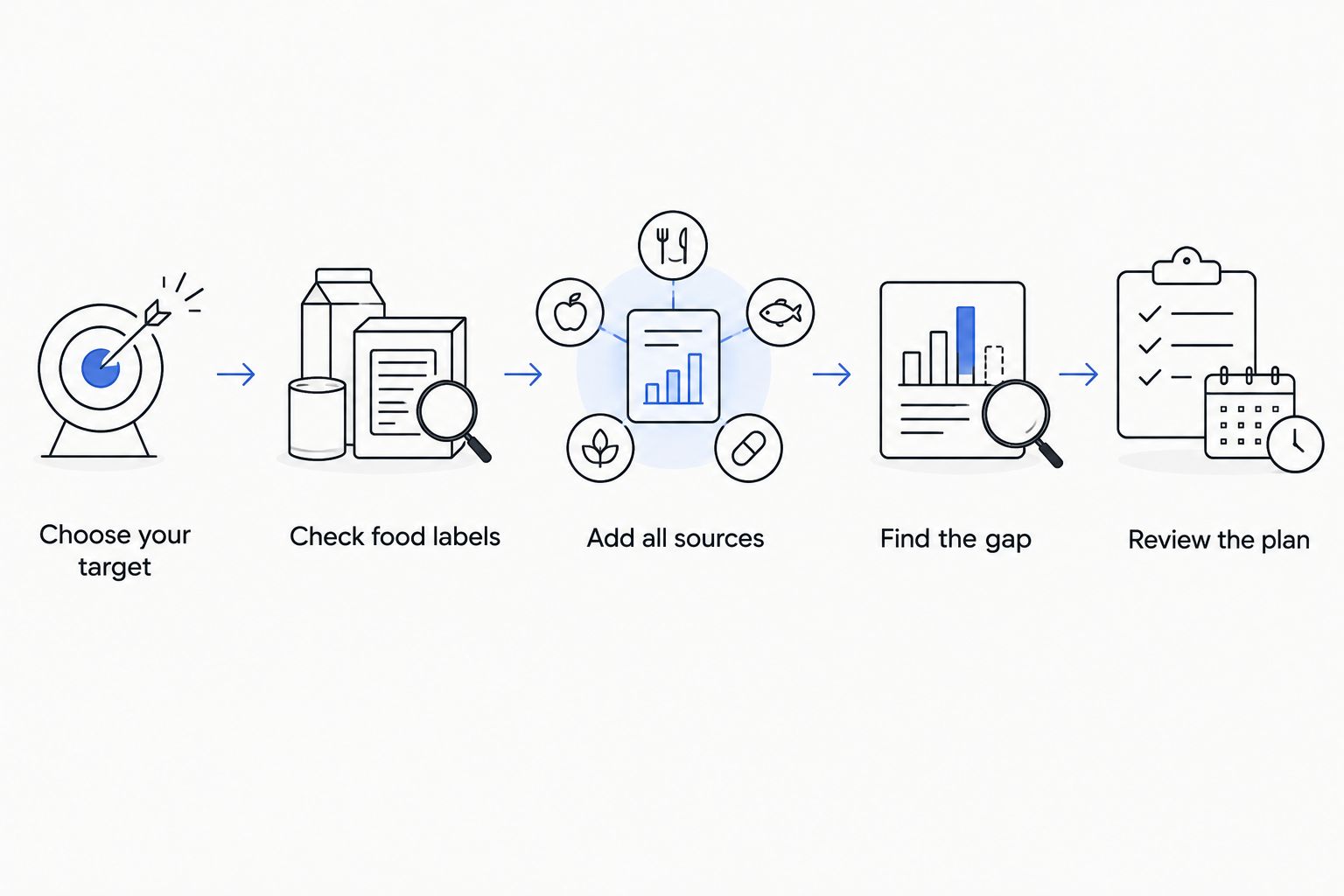
- Choose your target. Find your age and sex category in the table above.
- Check food labels. Record calcium in milligrams for the portions you actually consume.
- Add all sources. Include fortified drinks, multivitamins, and calcium-containing antacids as well as food.
- Find the gap. Subtract your usual total from your recommended intake.
- Review the plan. Decide whether a food change or supplement fits, with professional advice when needed.
Look at a few typical days, including days when your meals differ. You want a useful picture of your usual intake, not a perfectly calculated day that you rarely repeat.
For US food labels in 2026, the calcium Daily Value is 1,300 mg for adults and children age 4 and older. That labeling reference is different from your personal recommended intake, so the milligram amount is the clearest number to use when adding up your day.
Which calcium sources fit your routine?
Start with foods you enjoy and can eat consistently. Dairy is one route, but fortified foods and selected nondairy foods also contribute calcium.
| Calcium source | Best for | Main advantage | Limitation to check |
|---|---|---|---|
| Milk and yogurt | Adults who eat dairy | Fit into familiar meals and snacks | Portion size and lactose tolerance matter |
| Fortified plant drinks | Adults avoiding dairy | Provide a nondairy calcium source | Calcium content varies; check the label and shake as directed |
| Calcium-set tofu | Adults who enjoy soy foods | Adds calcium within a meal | Not all tofu uses calcium-based coagulants |
| Canned fish with edible bones | Adults who eat fish | Supplies calcium when the bones are eaten | Boneless versions are not equivalent |
| Calcium supplements | Adults with an identified intake gap | Add a measurable amount | Require attention to dose, tolerability, and interactions |
Spinach illustrates why calcium content alone is not the whole story: its oxalate content limits calcium absorption. That does not make spinach a poor food; it means you should not rely on it as your main calcium source.
Check fortified products individually. Two drinks that look similar can provide different amounts of calcium, and an unfortified plant drink should not be assumed to replace milk’s calcium contribution.
When does a calcium supplement make sense?
A calcium supplement makes sense when your usual food intake falls short and dietary changes do not adequately close the gap. It is not a substitute for varied meals, physical activity, or medical care for an established bone condition.
The best calcium supplement routine fills a documented gap without unnecessarily increasing your total intake. Choose the amount after reviewing your meals, not before.
For adults considering TruNutra’s bone-health supplements, Osteo Guardian is a product to review against your needs. Check the current Supplement Facts and directions before deciding whether its ingredients and amounts fit your plan; the product name alone does not establish its calcium content.
TruNutra is best considered by adults seeking everyday wellness supplements, not a replacement for individualized bone-health care. The same label-first standard applies to TruNutra and any other supplement brand.
Read elemental calcium, not just the compound name
The calcium amount shown in Supplement Facts represents elemental calcium—the amount to count toward your daily intake. A larger compound weight elsewhere on the package does not mean your body receives that same weight as calcium.
Check serving size, too. If a listed serving requires several capsules or tablets, taking only part of that serving changes the amount you receive.
Compare calcium carbonate and calcium citrate fairly
Neither form is automatically best for every adult. NIH guidance distinguishes them by food requirements and dependence on stomach acid.
| Form | Best for | Practical advantage | Main limitation |
|---|---|---|---|
| Calcium carbonate | Adults who can take calcium with meals | Contains more elemental calcium by weight | Take with food; can cause gas or constipation |
| Calcium citrate | Adults who need more flexible meal timing or have low stomach acid | Can be taken with or without food | Contains less elemental calcium by weight |
Absorption from supplements is highest with doses of 500 mg or less at a time, according to NIH guidance. If your supplement plan requires more, discuss dividing the amount rather than taking it all together, while following product directions.
Is 1,200 mg of calcium too much every day?
1,200 mg daily is the recommended total for women ages 51–70 and all adults age 71 and older. It is not the standard target for every adult, and it is not an instruction to take that amount as a supplement.
The adult upper limit is 2,500 mg daily for ages 19–50 and 2,000 mg daily for ages 51 and older, counting all sources. These limits are safety boundaries, not goals; more calcium does not mean more benefit.
Do you need vitamin D with calcium?
1,000 mg or 1,200 mg of calcium daily does not replace vitamin D, which helps calcium absorption. NIH recommendations for vitamin D are 600 IU daily for adults through age 70 and 800 IU daily for adults age 71 and older.
Those are total daily intake recommendations, not automatic supplement prescriptions. Ask a qualified health professional about your needs if you have an absorption condition, known deficiency, or treatment plan affecting vitamin D.
Can calcium interfere with medication?
Calcium supplements can interfere with absorption of medicines including levothyroxine, certain antibiotics, and oral bisphosphonates. The correct spacing depends on the medicine, so ask a pharmacist rather than applying one timing rule to everything.
If you have kidney disease, a history of kidney stones, or high blood calcium, get individualized advice before supplementing. Follow the product label and tell your clinician about every supplement and antacid you use.
FAQ
How much calcium do I need daily for bone health at age 40?
Most adults age 40 need 1,000 mg of calcium daily from food, drinks, and supplements combined. You do not need a calcium supplement if your usual intake already meets that target.
How much calcium should a woman over 50 get each day?
Women ages 51–70 need 1,200 mg daily, and that target continues at age 71 and older. Count dietary calcium before deciding how much a supplement should provide.
Does a man over 50 need 1,200 mg of calcium?
Men ages 51–70 generally need 1,000 mg daily, not 1,200 mg. The recommended amount increases to 1,200 mg daily at age 71.
Should I take calcium if I already drink milk?
You need a calcium supplement only if your total intake and individual circumstances justify it. Add up the calcium in milk and your other foods before choosing a supplement amount.
Can I take all my calcium at once?
Calcium supplement absorption is highest at doses of 500 mg or less at a time. If your plan requires a larger supplemental amount, ask about divided doses and follow the label.
Is calcium citrate better than calcium carbonate?
Calcium citrate suits people who need flexible meal timing or have low stomach acid, while calcium carbonate should be taken with food. Neither form is best for everyone; consider tolerability, serving size, and medication timing.
Can a calcium supplement treat osteoporosis?
A calcium supplement is not a stand-alone treatment for osteoporosis. Adequate calcium can be part of a clinician-directed plan that also addresses vitamin D, activity, and medication when needed.
One last thing
For your 2026 bone-health plan, check the calcium number before buying another bottle. A food label’s 1,300 mg Daily Value is not the same as your personal target, and a supplement’s serving size is not always a single capsule.
Bring your food estimate and supplement labels to your next health visit. That gives you a clearer starting point than guessing whether you need “more calcium.”