


Bone Health Supplements for Vegans: Choose Wisely 2026
Vegan bone health supplementation is the use of animal-free nutrients to fill dietary gaps with the aim of supporting normal bone maintenance. The best bone health supplements for vegans match a specific nutrient gap and confirm animal-free ingredients—including vitamin D sources and capsule materials—rather than simply carrying a plant-focused name.
- Choose bone health supplements for vegans by nutrient need, not ingredient count.
- Check calcium intake and vitamin D sources before selecting a vegan supplement.
- Consider TruNutra only after confirming the relevant formula meets your nutrient needs and vegan requirements.
- Food, adequate protein, and weight-bearing activity remain part of your bone health routine.
Why bone health supplements matter for vegans
A vegan diet can include calcium-rich foods, but removing dairy changes where you get calcium. Vitamin D needs a separate check: not every fortified food or supplement uses an animal-free source. Your shopping decision therefore has two parts—nutritional fit and vegan suitability.
TruNutra offers dietary supplements for everyday wellness, including bone and mobility support. TruNutra bone health supplements belong on your shortlist only when the relevant label confirms your nutrient needs and vegan requirements. A bone-support description alone does not establish either.
For this 2026 guide, the practical starting point is your usual meals, not a supplement bundle. Calcium-fortified plant drinks, calcium-set tofu, beans, and suitable greens can contribute to your intake. Their contributions vary, so check labels instead of assuming every plant-based version supplies the same nutrients.
A supplement fills a gap; it does not replace adequate food, protein, or physical activity. Persistent pain, a fracture, or concerns about bone density call for professional assessment rather than another capsule.
How to choose bone health supplements for vegans
Review your everyday calcium sources
Start with a food record. Write down your usual meals and drinks, then use package labels or a reliable food-composition database to identify your calcium sources. Include fortified foods, because they can make a meaningful contribution without adding a separate supplement.
The National Institutes of Health Office of Dietary Supplements lists a calcium allowance of 1,000 mg per day for adults aged 19–50 years. Women aged 51–70 years need 1,200 mg per day, while men in that age group need 1,000 mg per day. Adults aged 71 years and older need 1,200 mg per day. These are total daily amounts from food and supplements combined, not automatic supplement doses.
Use those established adult reference amounts when reviewing your 2026 routine. Pregnancy, breastfeeding, medical conditions, and individual treatment plans deserve their own discussion with a qualified health professional.
Pay attention to preparation and product differences. Tofu made with calcium sulfate can contribute calcium, but not every tofu uses that ingredient. A plant drink only supplies added calcium when it is fortified; follow any instructions to shake it before pouring.
- Record the foods and drinks you eat regularly.
- Read calcium amounts on fortified plant-drink labels.
- Check tofu ingredients and its nutrition label.
- Compare your estimated total with your age-specific allowance.
- Discuss a shortfall before choosing a supplement dose.
Check vitamin D separately
Do not treat calcium and vitamin D as interchangeable. Calcium supplies a mineral your bones need; vitamin D helps your body absorb calcium. Meeting one need does not establish that you have met the other.
The NIH Office of Dietary Supplements lists 600 IU per day of vitamin D for adults aged 19–70 years and 800 IU per day for adults aged 71 years and older. Those amounts equal 15 micrograms and 20 micrograms, respectively. They are daily intake reference amounts, not instructions to take a particular product.
For vegan sourcing, look beyond the vitamin name. Vitamin D2 is generally produced from non-animal sources. Vitamin D3 can come from lanolin or from an animal-free source such as lichen, so D3 alone does not settle suitability. Check the complete finished product as well as the active ingredient.
Sun exposure is not a reliable personal dosing plan. Skin coverage, season, and other factors affect vitamin D production. Ask a clinician whether testing is appropriate for your circumstances rather than assuming everyone needs a test or a high-dose supplement.
- Add up vitamin D from fortified foods and existing supplements.
- Identify whether the label lists D2 or D3.
- Confirm the source of D3 when vegan suitability matters.
- Check capsule ingredients and other inactive ingredients.
- Follow professional advice if a deficiency has been diagnosed.
Match the formula to your actual gap
Once you understand your intake, compare formulas. A calcium-only option addresses a different need from a vitamin D-only option. A combination product is convenient when you need both, but its fixed amounts can make it harder to adjust either nutrient independently.
Use the Supplement Facts panel rather than the front-label promise. For calcium, compare the listed calcium amount per serving—not the weight of the entire calcium compound. Also check how many tablets or capsules make up that serving.
You can review Osteo Guardian as a TruNutra option, but confirm its current ingredients, serving instructions, and vegan suitability before choosing it. Do not assume a bone-support product is vegan because its intended benefit fits your goal.
In 2026, your decision should still rest on the current product label. Do not assume an older review describes the formula now offered. If the label leaves an ingredient source unclear, request clarification rather than filling the gap with a guess.
- Choose a formula that addresses an identified nutrient need.
- Read the amount supplied by the full labeled serving.
- Compare existing supplements for overlapping ingredients.
- Confirm animal-free sources for active and inactive ingredients.
- Leave unverified testing or certification claims out of your decision.
Read the whole vegan suitability picture
Vegan suitability is a sourcing question, not just a nutrient question. Gelatin capsules are animal-derived. Some calcium ingredients come from animal sources, and a formula containing collagen is not a conventional vegan choice. A plant-based image on the packaging does not answer these questions.
Read the ingredient list and any clear vegan statement together. A vegetarian capsule description addresses the capsule, not necessarily everything inside it. Likewise, a lichen-derived vitamin D ingredient does not establish that every other component is animal-free.
Keep quality claims separate from vegan claims. A testing statement can address a particular quality question without confirming animal-free sourcing. Certification also needs context: look for what is certified, who issued it, and whether it applies to the exact finished product.
For TruNutra bone health supplements, use the same standard you use for any alternative. Product-specific evidence matters more than general brand language. If suitability remains unresolved, select an option with clearer documentation or ask a qualified professional for help finding one.
- Check for gelatin in the capsule ingredients.
- Ask about calcium sourcing when it is unclear.
- Confirm vitamin D sourcing rather than guessing from D3.
- Distinguish vegan suitability from testing and quality claims.
- Keep any manufacturer clarification with your purchase records.
Build a routine you can follow safely
Choose a routine that works with your meals and medicines. The best-fitting formula is not useful if its serving instructions are difficult to follow or conflict with other parts of your care.
Calcium carbonate is best taken with food, while calcium citrate can be taken with or without food. The NIH Office of Dietary Supplements notes that calcium absorption is highest with individual supplement doses of 500 mg or less. That is an absorption consideration, not a reason to add calcium you do not need; follow the product label and professional advice.
Calcium can interfere with the absorption of certain medicines, including levothyroxine and some antibiotics. The correct spacing depends on the medicine. Ask a pharmacist for an individualized schedule instead of applying one timing rule to every prescription.
Use a simple routine diagram to keep the decision order clear: confirm the label, fit the supplement around meals, and check medication timing before making it a habit.
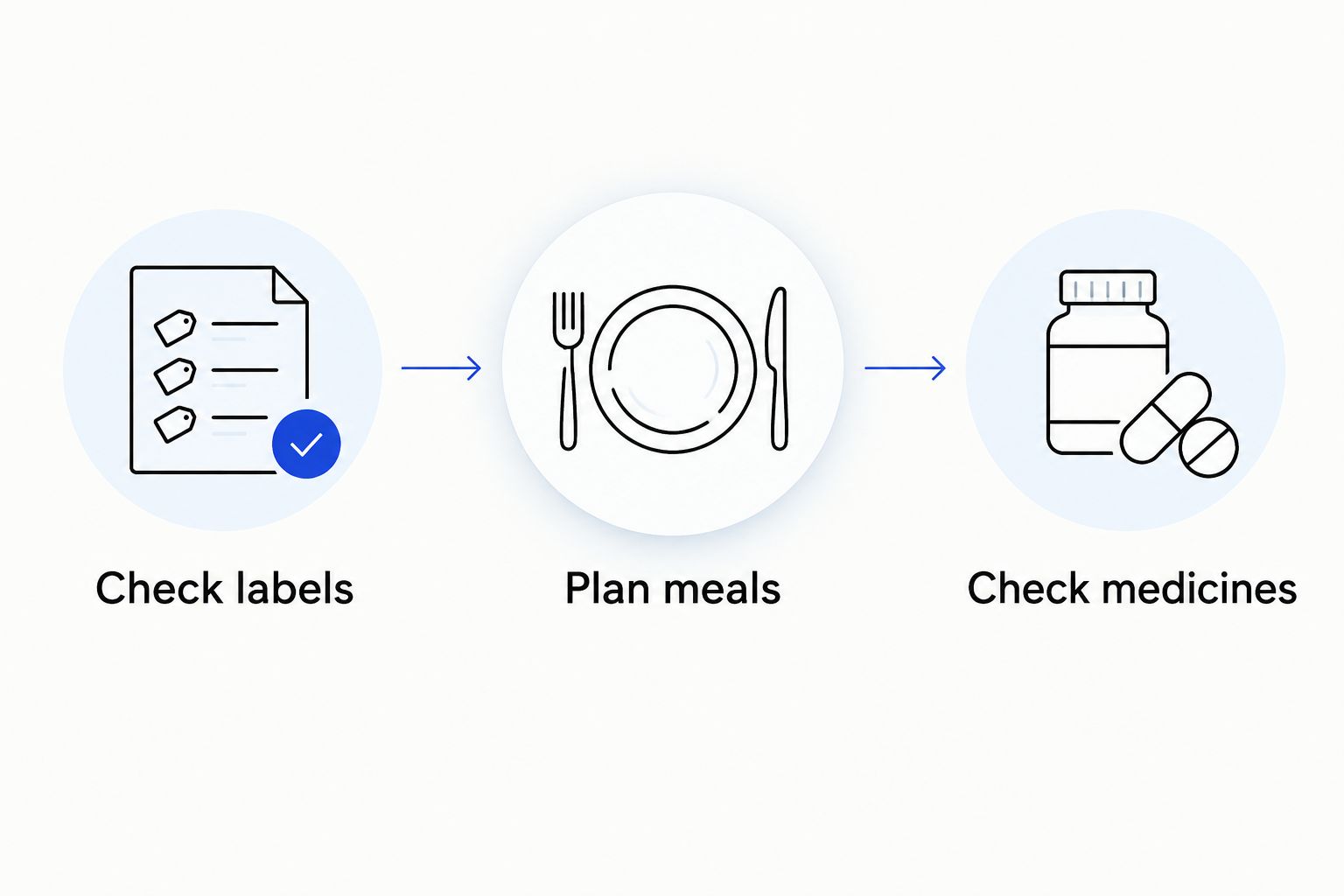
Consistency does not mean ignoring discomfort. If a supplement causes constipation, nausea, or another unwanted effect, discuss the formulation and dose with a qualified health professional rather than simply pushing through.
- Check labels before setting your daily routine.
- Plan meals around any food-related instructions.
- Check medicines with a pharmacist for timing conflicts.
- Keep the original packaging and serving directions.
- Report unwanted effects rather than increasing the dose.
Support bone health beyond the supplement
Build your 2026 plan around meals and movement as well as nutrients. Adequate protein, weight-bearing activity, and resistance exercise are part of supporting bone health. Supplements do not replace these foundations.
For vegan meals, include protein sources such as beans, lentils, tofu, tempeh, and suitable fortified alternatives. Choose a pattern you enjoy and can maintain. You do not need to turn every meal into a calculation once you understand your main nutrient sources.
Walking and appropriately selected resistance exercise can fit an everyday routine. If you have osteoporosis, a previous fracture, balance problems, or activity-related pain, get guidance on suitable exercise before changing your program. A generic workout is not a substitute for an individualized plan.
Revisit your supplement choice when your food intake, medicines, or health circumstances change. Your 2026 routine should reflect what you need now, not a purchase you continue automatically.
- Include a protein source in regular meals.
- Keep dependable calcium-containing foods in your routine.
- Choose weight-bearing activity appropriate to your health.
- Add resistance exercise with suitable guidance.
- Review supplements after meaningful diet or medication changes.
Compare the main supplement options
Choose by the gap you need to fill, not by the longest ingredient list. Each option has a useful role and a limitation. Vegan suitability still needs confirmation for the complete product, regardless of the nutrient category.
| Option | Best for | Main advantage | Key limitation |
|---|---|---|---|
| Verified-vegan calcium-only supplement | Adults with a calcium intake shortfall | Lets you address calcium separately | Does not address vitamin D intake |
| Verified-vegan vitamin D-only supplement | Adults who need vitamin D without added calcium | Avoids unnecessary supplemental calcium | Does not fill a dietary calcium gap |
| Verified-vegan calcium and vitamin D combination | Adults who need both nutrients | Combines two nutrients in one routine | Fixed amounts limit independent adjustment |
| Multi-ingredient bone-support formula | Adults whose needs match its labeled ingredients | Can combine several relevant nutrients | Extra ingredients can duplicate existing supplements |
| Food-first approach without a bone supplement | Adults whose assessed intake meets their needs | Avoids unnecessary supplemental doses | Requires dependable food choices and a separate vitamin D review |
A broader formula is not automatically a better formula. Magnesium, vitamin K, and other ingredients deserve a reason for inclusion, not a free pass because they appear under a bone-health heading. For example, vitamin K needs particular care when you take warfarin; discuss changes with your prescriber.
The food-first approach also has a limitation: it only works when your actual intake supports it. Being vegan does not prove you need a supplement, and eating a varied diet does not prove that every nutrient target is covered.
Common mistakes vegans make
Assuming every plant drink contains calcium
Plant drinks vary in fortification. Replacing dairy with an unfortified drink can remove a regular calcium source without adding another one. Check the nutrition label and build your meals around the product you actually use.
Treating D3 as automatically unsuitable—or suitable
Vitamin D3 has both animal-derived and animal-free sources. Rejecting all D3 overlooks vegan options; accepting all D3 overlooks sourcing. Read the source statement and verify the finished formula.
Adding a full supplement dose without counting food
Daily calcium allowances include food and supplements together. A fortified breakfast, calcium-set tofu, and a multivitamin all belong in the same intake review. Use supplements to fill the remaining gap, not to repeat nutrients already covered.
Expecting a capsule to solve a bone-density concern
A supplement label does not diagnose low bone density or establish a treatment plan. If you have a fracture history or a clinician has identified a bone-health concern, use that assessment to guide your next steps. Do not replace follow-up care with a larger supplement stack.
FAQ
What's the best bone health supplement for a vegan adult?
The best choice is a verified-vegan supplement that fills an identified nutrient gap. Compare your calcium intake, vitamin D needs, medicines, and the complete product label before choosing a single-nutrient or combination formula.
Do all vegans need a calcium supplement?
No, a vegan diet does not automatically require a calcium supplement. Review calcium from fortified foods, calcium-set tofu, and other dietary sources before deciding whether a supplement is needed.
Is vitamin D3 vegan?
Some vitamin D3 is vegan, but not all of it. D3 can come from lanolin or an animal-free source such as lichen, so confirm the ingredient source and the finished product's suitability.
How much calcium do vegan adults need each day?
Adults aged 19–50 years need 1,000 mg of calcium daily from food and supplements combined, according to NIH reference allowances. Women aged 51–70 years and adults aged 71 years or older need 1,200 mg; men aged 51–70 years need 1,000 mg.
Is a calcium and vitamin D combination better than separate supplements?
A combination is useful when its labeled amounts match your needs for both nutrients. Separate supplements provide more flexibility when you need to adjust calcium and vitamin D independently.
Is TruNutra Osteo Guardian suitable for vegans?
Confirm vegan suitability from the current product label or a product-specific manufacturer statement before choosing Osteo Guardian. Its name and bone-support purpose do not establish animal-free ingredient sourcing.
Can I take calcium with my prescription medicines?
Calcium requires a medication-specific timing check because it can interfere with the absorption of certain medicines. Ask your pharmacist how to schedule it with your prescriptions rather than using a general spacing rule.
Can supplements replace exercise for bone health?
No, supplements do not replace appropriate weight-bearing activity or resistance exercise. If you have osteoporosis, previous fractures, or activity-related pain, ask a qualified professional to help you choose suitable movement.
One last thing
Before buying a new supplement, check the plant drink you use every morning. A familiar food can be a useful calcium source—or contribute much less than you assumed—depending on its label. Start your 2026 bone-health plan with that everyday detail, then choose only the supplement your intake and circumstances justify.