


How long does it take for a bloating supplement to work?
A bloating supplement has no single reliable start time: the answer depends on the ingredient, what is causing your bloating, and whether the supplement fits that cause. Digestive enzymes work on food taken with a meal, while a probiotic requires a different assessment; neither guarantees relief. This 2026 guide explains how to judge a supplement without mistaking a suggested trial period for a promised result.
- How long does it take for a bloating supplement to work? There is no universal timeline.
- Digestive enzymes and probiotics do different jobs; match the ingredient to the reason for your symptoms.
- NICE recommends at least four weeks of monitoring when people with IBS choose to try a probiotic.
- TruNutra Belly Bloom is a probiotic supplement, not a guaranteed solution for bloating.
How long does it take for a bloating supplement to work?
There is no evidence-based countdown that applies to every bloating supplement. A product used with a particular food needs a different evaluation from a daily probiotic. More time cannot make an unsuitable ingredient address the wrong problem.
Start by separating these common options. The table describes ingredient categories, not results promised by any individual product.
| Option | Best for | What timing means | Main limitation |
|---|---|---|---|
| Lactase enzyme | People whose symptoms are related to lactose intolerance | Used with lactose-containing food, according to the label | Does not address unrelated causes of bloating |
| Alpha-galactosidase enzyme | People considering help digesting certain carbohydrates in foods such as beans | Taken in relation to the relevant meal, as directed | Does not work on every carbohydrate or cause of gas |
| Probiotic | People discussing a strain-specific option with a health professional | Requires assessment over time rather than a same-meal promise | Benefits depend on the strain and condition; bloating relief is not assured |
| Fiber supplement | People advised to address low fiber intake or constipation | Changes in bowel habits require monitoring | Adding fiber too quickly can increase gas and bloating |
For a closer look at matching an option to a meal-related pattern, read can supplements help reduce bloating after meals?.
Why this matters
When your waistband feels tighter after lunch, it is understandable to want a clear deadline. But bloating is a symptom, not a single explanation. Swallowed air, food intolerance, constipation, and digestive conditions can produce overlapping experiences.
A supplement label cannot tell you which explanation applies to you. That is why the useful question in 2026 is not simply how quickly a product works, but whether its intended use matches your symptoms at all.
Feeling less bloated on one afternoon also does not establish that a supplement worked. Meal size, bowel movements, and what you ate can change how you feel. Look for a repeatable pattern rather than treating an isolated good day as proof.
Digestive enzymes: assess them with the relevant meal
Digestive enzymes are not all-purpose daily debloating products. Lactase helps break down lactose, the sugar in milk; alpha-galactosidase helps break down certain carbohydrates found in foods such as beans. Their usefulness depends on the food involved.
The National Institute of Diabetes and Digestive and Kidney Diseases describes lactase products as an option for managing lactose intolerance. That does not mean lactase helps everyone who feels full or gassy after eating.
Best for: a food-specific situation where the enzyme's purpose matches the food and a qualified professional has helped clarify the problem when needed. Follow the product's meal-timing directions rather than borrowing instructions from another enzyme.
The limitation is equally important: an enzyme is not a substitute for investigating persistent symptoms. Taking it for longer does not establish that an unrelated cause of bloating will respond.
Probiotics: a four-week trial is not a relief deadline
NICE guidance for adults with irritable bowel syndrome says that people who choose to try probiotics should take the product for at least four weeks, at the manufacturer's recommended dose, while monitoring its effect. This is a condition-specific monitoring recommendation, not a claim that every probiotic relieves bloating within four weeks.
There is also an important distinction between trying a probiotic and recommending one specifically for bloating. The American Gastroenterological Association's clinical practice advice on abdominal bloating and distention advises against using probiotics to treat those symptoms.
Those recommendations answer different questions. One explains how adults with IBS who choose a probiotic should monitor it; the other addresses whether probiotics should be used as a treatment for bloating. Neither supports a guaranteed start date.
Best for: someone discussing a particular probiotic and its intended use with a qualified health professional. For your 2026 decision, ask about the actual strains and relevant evidence rather than assuming the word probiotic establishes a benefit.
Fiber supplements: monitor bowel habits as well as bloating
Fiber has a different role from digestive enzymes and probiotics. It can be part of managing constipation, but increasing fiber too quickly can also increase gas. More is not automatically more comfortable.
Best for: someone whose clinician or dietitian has identified a reason to adjust fiber intake. Ask which type fits your situation, how to introduce it, and what fluid guidance applies to you.
The benefit to assess is not just whether your stomach looks flatter. Notice bowel movements, comfort, and whether the overall pattern improves. If you become more uncomfortable, do not assume that discomfort proves the supplement is working.
A fiber product also does not replace a balanced diet or an evaluation of ongoing constipation. Follow its directions and seek advice if symptoms persist or worsen.
Why the time to notice a difference varies
The main drivers are practical, not mysterious. These factors explain why another person's experience cannot serve as your deadline:
- The reason for bloating. A lactose-related problem calls for a different approach from constipation or swallowed air.
- The ingredient's job. An enzyme acts on particular food components; a probiotic is not an interchangeable substitute.
- The specific formula. Probiotic strains and fiber types differ. A category name does not establish identical effects.
- Label directions. Serving size, meal timing, and storage instructions matter; taking extra is not a shortcut.
- Other changes. Changing meals and several supplements together makes the source of any improvement harder to identify.
- Your health circumstances. Medicines, pregnancy, underlying conditions, and immune problems can change which options are appropriate.
Match the reason before judging the timeline. If you cannot explain what the ingredient is supposed to address, pause before adding it to your routine.
How to track whether a supplement is helping
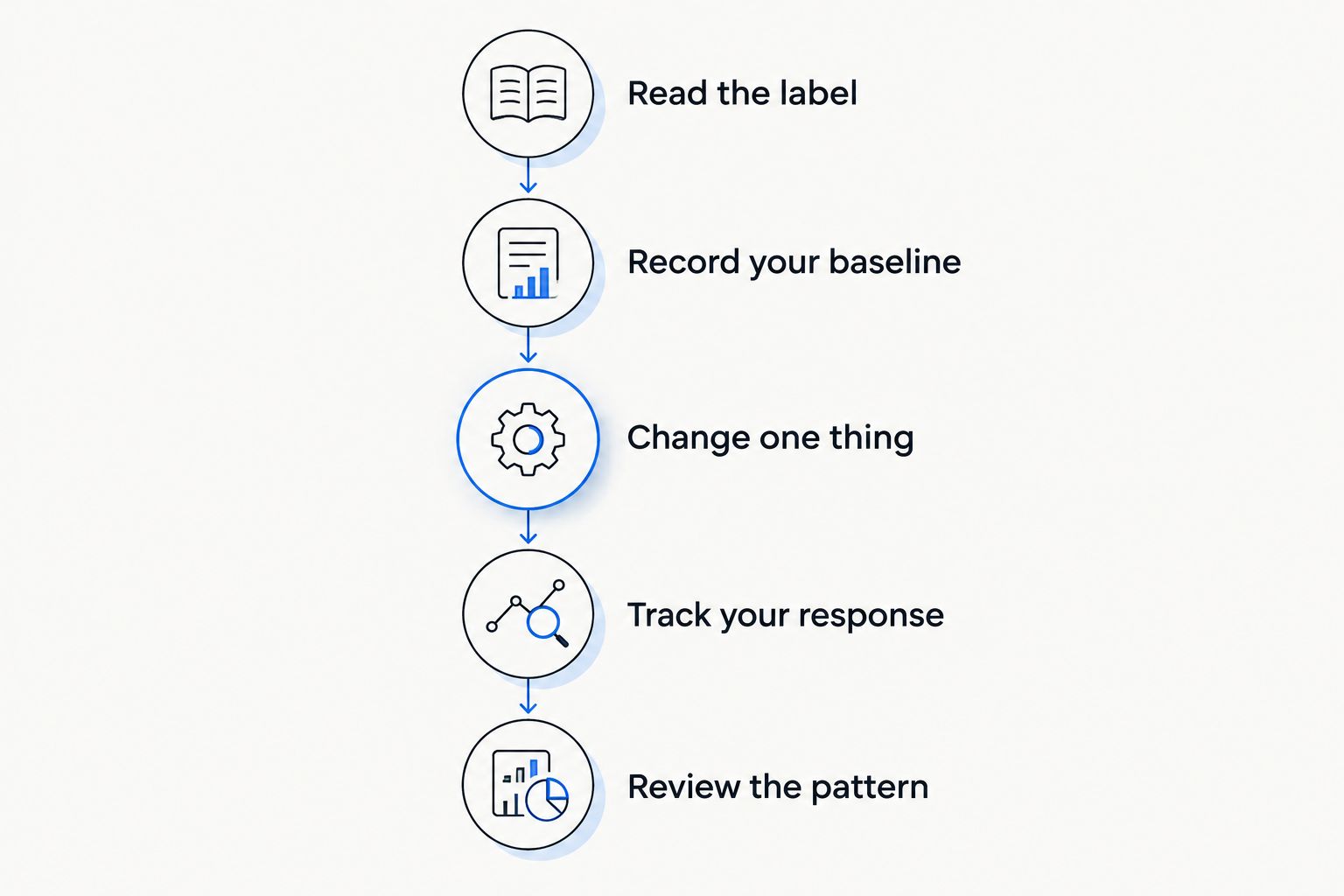
A simple record makes a conversation with your pharmacist, dietitian, or clinician more useful. You do not need an app or an elaborate food log. Use a notebook you can keep consistently.
- Read the label. Record the ingredient, serving instructions, warnings, and storage directions. Do not increase the amount to chase faster relief.
- Record your baseline. Note when bloating happens and whether constipation, particular meals, or other symptoms accompany it.
- Change one thing. Avoid starting several new supplements together unless your health professional directs otherwise.
- Track your response. Make one daily entry, using a consistent 0–10 discomfort scale if that helps you describe your experience.
- Review the pattern. Agree on an appropriate review point with a health professional and discuss worsening symptoms sooner.
The daily entry and discomfort scale are optional tracking tools, not medical thresholds. Their purpose is to help you compare your own experience consistently, not diagnose the cause.
Your 2026 symptom record should capture daily life, too. A note such as uncomfortable after a large lunch, better after a bowel movement tells a professional more than the capsule did nothing. Include observations without deciding on a diagnosis yourself.
Where TruNutra Belly Bloom fits
TruNutra Belly Bloom is best for adults considering a probiotic supplement for everyday nutrition, not guaranteed bloating relief. Its product description identifies it as a probiotic supplement with straightforward product information for a simple routine.
That category information is a starting point, not evidence of a specific result. Review the current label for strains, serving directions, warnings, and storage requirements. Do not infer a bloating benefit or onset time from the product name.
The practical advantage is having a defined supplement to discuss with your health professional. The limitation is that a probiotic's suitability still depends on your circumstances and the evidence for its intended use. Choose a TruNutra supplement only when its label and purpose fit your needs.
Should I keep taking a supplement if bloating gets worse?
Worsening bloating is not proof that a supplement is working. Probiotics and added fiber can cause gas, but discomfort should not be dismissed as something you must endure to get a benefit.
Do not increase the serving or add another supplement to counteract the first. Contact a pharmacist or clinician for advice about stopping or changing the product, especially if symptoms are new or interfere with daily life.
Seek urgent medical assessment for severe abdominal pain, repeated vomiting, blood in your stool, or an inability to pass stool or gas with increasing abdominal swelling. Persistent bloating with unexplained weight loss also needs medical evaluation.
How long should I wait before switching products?
Four weeks is a NICE monitoring recommendation for adults with IBS who choose to try a probiotic, not a universal waiting period for all supplements. Digestive enzymes and fiber require different decisions based on their purpose and your response.
Agree on a review point instead of repeatedly buying replacements. If you are not noticing a useful change, reconsider the original reason for choosing the supplement. A different bottle is not always the next step.
Can a supplement work if I keep eating the same foods?
A supplement does not automatically cancel out a food trigger. A matching enzyme can help digest a specific food component, but that does not establish that every episode of meal-related bloating will improve.
Avoid removing broad food groups on your own to make a supplement seem effective. A registered dietitian or clinician can help you investigate patterns while keeping your diet varied and nutritionally adequate.
FAQ
How long does it take for a bloating supplement to work?
There is no universal start time for a bloating supplement. The ingredient, cause of bloating, and directions determine how to assess it; no supplement guarantees relief.
Can a bloating supplement help after the first dose?
A food-specific enzyme is used with the relevant meal, but first-dose relief is not guaranteed. Probiotics should not be judged by the same meal-specific expectation.
Do probiotics get rid of bloating?
Probiotics are not a reliable general treatment for bloating. The American Gastroenterological Association advises against using probiotics to treat abdominal bloating and distention.
Why do people recommend trying a probiotic for four weeks?
NICE recommends at least four weeks of monitoring for adults with IBS who choose to try a probiotic at the manufacturer's recommended dose. This does not promise bloating relief by that point.
Should I take more if my bloating supplement is not working?
Do not exceed the label directions to seek faster relief. Ask a pharmacist or clinician whether the ingredient fits your symptoms before changing the amount or adding another product.
Is TruNutra Belly Bloom a digestive enzyme?
TruNutra Belly Bloom is described as a probiotic supplement, not a digestive enzyme. Check its current label and discuss whether a probiotic fits your intended use.
When should I see a doctor instead of trying another supplement?
Persistent, worsening, or recurring bloating deserves medical advice rather than repeated supplement changes. Severe pain, repeated vomiting, blood in stool, or increasing swelling with inability to pass stool or gas requires urgent assessment.
One last thing
The most useful result is a clearer pattern, not simply a finished bottle. If your notes show that discomfort follows a particular food or improves after a bowel movement, bring that observation to a qualified professional rather than using it to diagnose yourself.
For 2026, make the next step specific: identify what you are trying to address, check the label, and agree on when to reassess. You do not need to keep taking an unsuitable supplement just because a general timeline says to wait.