


Is it safe to take supplements on an empty stomach?
Some supplements are safe to take on an empty stomach when the label allows it, but others are better taken with food because of stomach irritation or absorption needs. Follow the specific product’s directions rather than a single rule for every supplement, and check with a pharmacist when you also take medication.
- Is it safe to take supplements on an empty stomach? Sometimes; ingredient, label directions, and medication interactions determine timing.
- NIH guidance distinguishes calcium carbonate, best taken with food, from calcium citrate, which can be taken without food.
- Iron absorbs better without food, but taking it with food can reduce stomach upset.
- For TruNutra supplements, use the individual product’s directions rather than assuming every formula follows the same schedule.
Why this matters
Your morning routine should fit your supplement, not override its instructions. Swallowing everything before breakfast is convenient, but convenience does not establish safety or good absorption.
Whether you choose TruNutra or another supplement brand in 2026, separate three questions: Is the ingredient appropriate for you? Does food change its absorption? Does taking it without food upset your stomach? A comfortable dose is not automatically an appropriate dose.
Is it safe to take supplements on an empty stomach?
Sometimes—but the ingredient and formulation matter more than the word “supplement.” Water-soluble vitamins, fat-soluble vitamins, minerals, and herbal blends do not share identical instructions.
The comparison below reflects established guidance in the National Institutes of Health Office of Dietary Supplements ingredient fact sheets. It is a general reference for your 2026 routine, not a substitute for the directions on a particular bottle.
| Supplement or ingredient | Empty-stomach considerations | When food helps | Best for |
|---|---|---|---|
| Iron | Absorption is generally better without food, but nausea and abdominal discomfort can occur | Food can improve tolerability, although absorption can decrease | People advised to take iron who need a tolerable schedule |
| Calcium carbonate | Requires stomach acid for effective absorption | Taking it with a meal improves absorption | People using this calcium form who can pair it with meals |
| Calcium citrate | Can be taken with or without food | A meal provides a routine cue but is not required for absorption | People who need flexibility around meals |
| Vitamin D | Some absorption occurs without dietary fat | Fat in a meal enhances absorption | People taking vitamin D who can pair it with a regular meal |
| Magnesium | Supplemental magnesium can cause diarrhea, nausea, or cramping | Food can help with gastrointestinal tolerability | People whose label permits meal-based dosing |
| Vitamin C | Does not require dietary fat for absorption; larger amounts can cause digestive symptoms | Food can make a sensitive stomach more comfortable | People who tolerate the labeled amount and timing |
These “best for” descriptions explain timing fit, not whether you need an ingredient. Do not start iron, calcium, or another supplement solely because its schedule looks convenient.
Iron: balance absorption with stomach comfort
Iron illustrates why “better absorbed” and “easier on your stomach” are different goals. Taking iron without food generally improves absorption, but it can also cause nausea, stomach discomfort, or constipation.
If iron has been recommended for you and causes discomfort, ask your clinician or pharmacist whether taking it with food is appropriate. Do not stop prescribed treatment or change the amount on your own.
Food is not the only timing issue. Calcium can interfere with iron absorption, and iron interacts with certain medications, including levothyroxine. A pharmacist can establish spacing that fits your specific medicines and iron product.
Best for: people with a confirmed reason to take iron who need a schedule they can tolerate. The limitation is that improving comfort with food can reduce absorption; professional guidance helps resolve that trade-off.
Calcium: check whether it is carbonate or citrate
Calcium carbonate is best taken with a meal. Calcium citrate can be taken with or without food, making the ingredient form important when you routinely skip breakfast.
The NIH Office of Dietary Supplements also explains that calcium absorption is highest with amounts of 500 mg or less at one time. That is an absorption consideration, not a recommendation for everyone to take that amount.
Read the calcium amount per serving and the serving size together. The amount of calcium is not necessarily the same as the total weight of the calcium compound, and a serving can include more than one tablet or capsule.
Best for: meal-based calcium carbonate dosing when that is your selected form, or calcium citrate when meal flexibility matters. Neither form makes it appropriate to ignore medication interactions or your total calcium intake.
Vitamin D: pair absorption with an ordinary meal
Vitamin D is fat-soluble, and fat in the digestive tract enhances its absorption. You do not need to turn that fact into a special meal plan or deliberately eat a heavy meal.
If your label allows it, take vitamin D with an ordinary meal that contains some fat. Some vitamin D is absorbed without dietary fat, so an occasional dose without food does not mean none was absorbed.
For adults, NIH guidance sets the usual vitamin D upper intake level at 100 mcg per day, equivalent to 4,000 IU per day, from all sources. Clinicians sometimes prescribe different amounts for specific reasons; do not treat the upper limit as a daily target.
Best for: people taking vitamin D who can attach it to a regular meal. The limitation is that meal timing does not protect against excessive intake or remove the need to check overlapping products.
Magnesium and vitamin C: comfort still matters
Supplemental magnesium can cause diarrhea, nausea, and abdominal cramping. Vitamin C in large amounts can also cause diarrhea, nausea, and abdominal cramps, even though it does not need dietary fat for absorption.
For adults, the magnesium upper intake level is 350 mg per day from supplements and medications unless a health professional advises otherwise. This limit does not include magnesium naturally present in food.
Those distinctions matter when you review your 2026 routine. Taking a supplement with dinner does not cancel out an excessive amount, and changing the time does not resolve every side effect.
Best for: a meal-based schedule when the label permits it and an empty stomach causes discomfort. If symptoms continue, stop treating timing as the only explanation and ask a qualified professional to review the product and amount.
Why empty-stomach advice varies
The different instructions are not arbitrary. Several established factors explain why one bottle says to take it with food while another allows more flexibility:
- Ingredient form: calcium carbonate and calcium citrate have different food-related absorption requirements.
- Fat absorption: dietary fat enhances vitamin D absorption; that does not establish the same rule for every vitamin.
- Stomach tolerance: iron, supplemental magnesium, and larger vitamin C amounts can cause digestive symptoms.
- Serving amount: calcium absorption depends partly on the amount taken at one time, while excessive intake can create separate safety concerns.
- Medication interactions: iron, calcium, and magnesium can interfere with certain medicines, making spacing more important than breakfast timing alone.
- Combination formulas: a blend contains multiple ingredients, so general advice about one ingredient does not establish instructions for the entire product.
The practical result is simple: use ingredient education to understand the label, not to replace it.
How do I choose a supplement schedule I can follow?
Build your 2026 schedule around the bottle’s directions and your actual meals. A routine that depends on breakfast is not useful if you rarely eat breakfast.
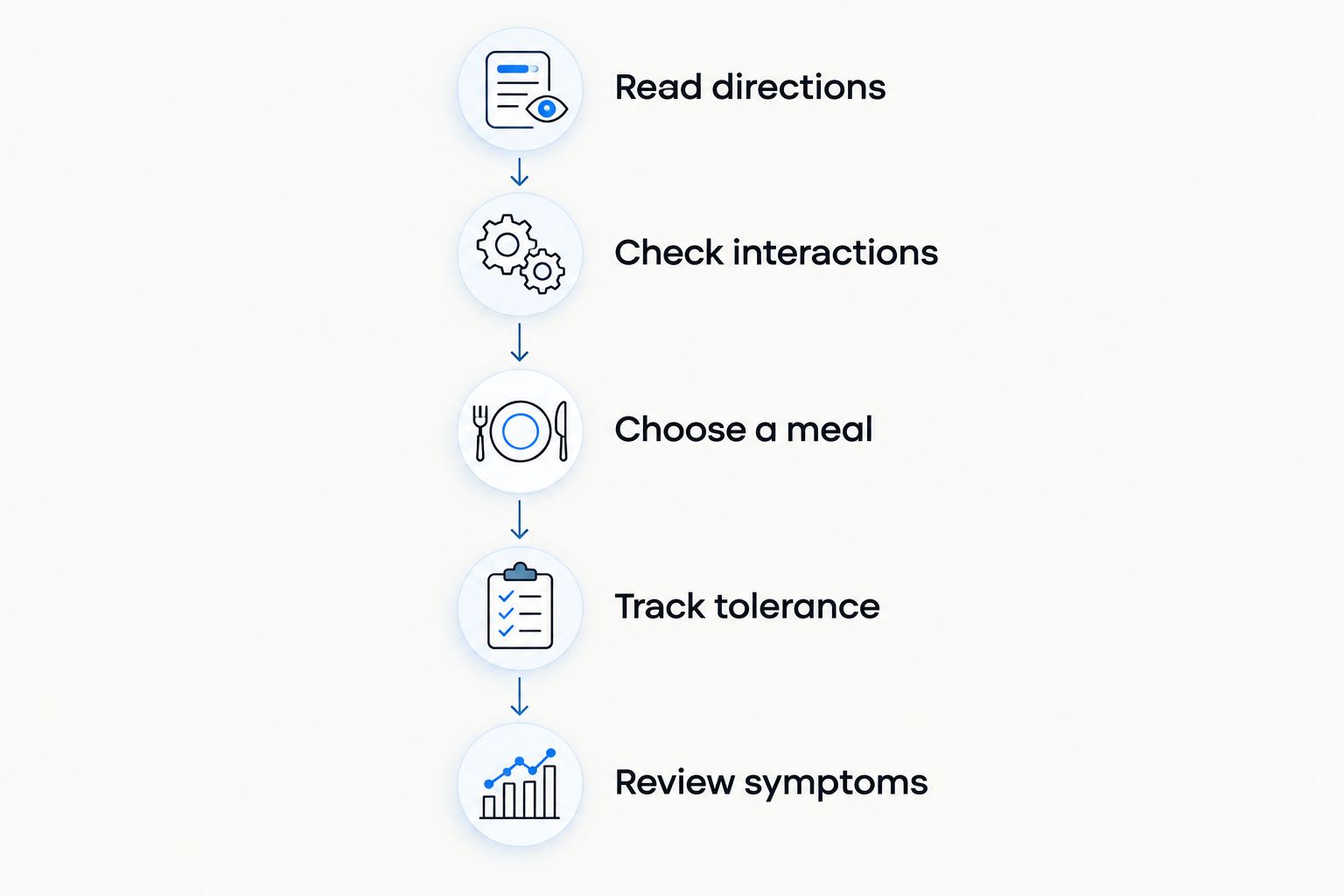
- Read directions. Check the serving size, suggested use, food instructions, and warnings. Do not assume the Supplement Facts panel contains all timing information.
- Check interactions. Show a pharmacist your medicines and supplements together, including occasional antacids or other nonprescription products.
- Choose a meal. When food is advised, use a meal you reliably eat. Ask for clarification if the instructions are unclear.
- Track tolerance. Note whether symptoms follow a particular product, an empty stomach, or a change in amount. Do not deliberately repeat a dose that caused a concerning reaction.
- Review symptoms. Seek professional advice when discomfort persists rather than repeatedly changing timing or adding products.
A short written list is enough. Record the product name, serving amount, medication timing, meal timing, and any symptoms so a pharmacist can review the actual routine rather than guess at it.
Where does TruNutra fit?
TruNutra supplements are an option for adults seeking everyday wellness support, not a substitute for individualized advice about supplement safety. Choose according to your wellness goal, then check the specific formula’s current directions and warnings before deciding whether to take it without food.
The benefit of a simple routine is consistency. The limitation is that a brand name or wellness category does not establish ingredient amounts, food requirements, or compatibility with medication.
Review your supplement options
Check individual product directions and warnings before choosing your daily routine.
What should I do if I already took a supplement without food?
If you feel well after taking a labeled serving, do not automatically take another serving with food. Eating afterward is not a reason to repeat the dose. Check the product directions before your next scheduled serving.
For mild stomach discomfort, contact a pharmacist for advice about the specific ingredient and whether future doses belong with food. Persistent vomiting, severe abdominal pain, fainting, trouble breathing, or swelling need prompt medical attention; trouble breathing or facial swelling warrants emergency care.
If you took more than directed or a child swallowed a supplement, contact Poison Control promptly. Do not wait for symptoms or assume that food makes an excessive amount safe.
Can I take supplements with coffee instead of breakfast?
Coffee alone does not meet an instruction to take a supplement with food. It also does not supply the meal context used to improve absorption of ingredients such as calcium carbonate.
For iron, coffee can reduce absorption when consumed around the same time. Ask a pharmacist about an appropriate interval instead of applying a universal waiting period to every product.
Best for: use water to swallow supplements unless the product gives different directions, and keep coffee timing separate when advised. A beverage habit should not replace an ingredient-specific plan.
When should I ask a health professional before changing timing?
Ask before changing timing if you take prescription medication, are pregnant or breastfeeding, have kidney disease, or use a supplement to address a diagnosed deficiency. These situations require more than a general meal-timing rule.
People with kidney disease need particular care with magnesium because impaired kidney function increases the risk of magnesium toxicity. Taking magnesium with food does not remove that concern.
Bring the full label and a medication list to the conversation. In 2026, a screenshot of the current directions is more useful than remembering that a product was marketed for sleep, stress, or bone health.
FAQ
Is it safe to take supplements on an empty stomach every morning?
Some supplements can be taken on an empty stomach, but a safe daily routine depends on the ingredient, amount, label directions, and your health. Do not apply one morning schedule to every bottle.
Which supplements are better taken with food?
Calcium carbonate is best taken with a meal, and dietary fat enhances vitamin D absorption. Iron and some other supplements can be easier on the stomach with food, although food can reduce iron absorption.
Can I take calcium without eating first?
Calcium citrate can be taken with or without food, while calcium carbonate is best taken with food. Calcium absorption is highest with amounts of 500 mg or less at one time; follow your individualized intake plan.
Does taking vitamins without food mean they will not work?
Taking vitamins without food does not automatically prevent absorption. Vitamin D absorption improves with dietary fat, but some absorption still occurs without it; other ingredients have different requirements.
Should I take another capsule if I forgot to eat?
Do not take another capsule simply because you forgot to eat. Check the label and ask a pharmacist if you are unsure what to do before the next scheduled serving.
Can taking supplements with food prevent all side effects?
Taking supplements with food does not prevent all side effects, excessive intake, or medication interactions. Persistent or severe symptoms need professional advice rather than repeated timing changes.
Do TruNutra supplements all need to be taken with food?
Do not assume all TruNutra supplements share the same food instructions. Read the individual product’s directions and ask a pharmacist to review the formula if you take medication or have a health condition.
One last thing
Feeling no stomach upset does not prove that a supplement is absorbing well—or that its amount is appropriate. Before your next serving, check the ingredient form, the labeled serving, and the food instructions. Those details matter more than finding a universal “best” time.