


Can supplements interact with prescription medications?
Yes, supplements can interact with prescription medications by changing how much medicine your body absorbs, how quickly it breaks medicine down, or how strongly it acts. Some combinations increase side effects; others make a prescription less effective. Ask a pharmacist to review the exact supplement label alongside your medication list before adding it, and do not stop a prescription on your own.
- Can supplements interact with prescription medications? Yes—ingredients can affect drug absorption, effectiveness, and side effects.
- A pharmacist should check the full Supplement Facts panel, not just the product name.
- Separating doses helps certain absorption interactions, but it does not make every combination safe.
- Trunutra supplements belong in an everyday wellness routine only after an ingredient-specific medication review.
Why this matters
A bedtime capsule, bone-health supplement, or daily multivitamin belongs on the same medication list as your prescriptions. A familiar ingredient is not automatically compatible with the medicine you take.
For your 2026 supplement review, Trunutra is best suited to adults seeking everyday wellness supplements after a pharmacist has reviewed the specific formula. You can explore Trunutra for the brand's wellness options, but choosing a product and checking its suitability are separate steps. A product description cannot replace a review of your medications, health history, and current label.
Can supplements interact with prescription medications?
Yes. The FDA's consumer guidance on mixing medications and dietary supplements explains that supplements can change a medication's absorption, metabolism, or elimination. They can also add to a medicine's effects, such as drowsiness or bleeding risk.
The examples below illustrate different interaction types. They are not a complete list, and they do not mean every supplement in a category interacts with every prescription.
| Supplement and prescription combination | What can happen | What to ask your pharmacist |
|---|---|---|
| Calcium with levothyroxine | Calcium can reduce absorption of thyroid medicine | What separation does my prescription label require? |
| Magnesium or calcium with ciprofloxacin | Minerals can reduce antibiotic absorption | How should I arrange the antibiotic and mineral doses? |
| Vitamin K with warfarin | Changes in vitamin K intake can change warfarin's effect | How can I keep my intake consistent? |
| St. John's wort with certain antidepressants | The combination can cause serious serotonin-related side effects | Should I avoid this combination? |
| Melatonin with sedating medicines | Sleepiness can increase | Is this combination appropriate, including before driving? |
The practical lesson is simple: identify the ingredient and prescription together. Asking whether a supplement is generally safe leaves out the part that determines the interaction.
Absorption interactions: less medicine reaches your body
Some minerals bind certain medicines in the digestive tract, reducing how much medicine your body absorbs. You might feel no immediate difference even though the prescription is working less effectively.
Calcium and levothyroxine are a useful example. NIH Office of Dietary Supplements guidance describes separating calcium carbonate from levothyroxine by at least 4 hours. Follow your own prescription instructions and confirm the schedule with your pharmacist rather than applying that interval to every mineral or medication.
Ciprofloxacin has different instructions. FDA-approved labeling directs taking ciprofloxacin at least 2 hours before or 6 hours after products containing certain minerals, including calcium, magnesium, iron, or zinc. These are medication-specific instructions—not a universal supplement schedule.
Additive effects: a combination does more than intended
A supplement and a prescription can affect the same body function. Together, they can increase an effect such as sleepiness, even when you take each product as directed.
For example, NCCIH advises people taking medicines to discuss melatonin with a healthcare professional, including because of medication interactions. Adding a sleep supplement to a sedating prescription deserves a review before the first dose, not after you notice next-morning grogginess.
Do not assume that taking one product at dinner and another at bedtime solves the problem. Their effects can still overlap.
Metabolism interactions: medicine levels change
Some supplements affect enzymes or transport systems that handle medicines. This can lower or raise medication exposure, depending on the combination.
St. John's wort is a well-established example. NCCIH identifies interactions with numerous medicines, including some antidepressants, birth control pills, and transplant medicines. Taking the products several hours apart does not reliably prevent this type of interaction.
Why supplement interaction risk varies
Your risk depends on more than the supplement's front label. These factors give your pharmacist the information needed to assess the combination:
- Exact ingredients. A single-ingredient supplement and a blend require different reviews. Include active ingredients and other label information.
- Amount per serving. Serving size and the number of servings you take determine your actual exposure. Include overlapping ingredients from other products.
- The specific prescription. Medicines within a broad category do not necessarily share the same interaction profile. Provide the exact name and formulation.
- Timing and frequency. An occasional sleep supplement still matters, as does a mineral taken with your morning medicine.
- Your health history. Kidney or liver problems, pregnancy, breastfeeding, and an upcoming procedure can change the advice you receive.
- The rest of your routine. Over-the-counter medicines, alcohol, herbal teas, powders, and other supplements can affect the assessment.
For a 2026 review, bring current labels rather than relying on a list saved from a previous purchase. Check the package in your hand before assuming a familiar product has the same formulation.
How do I check a supplement before taking it?
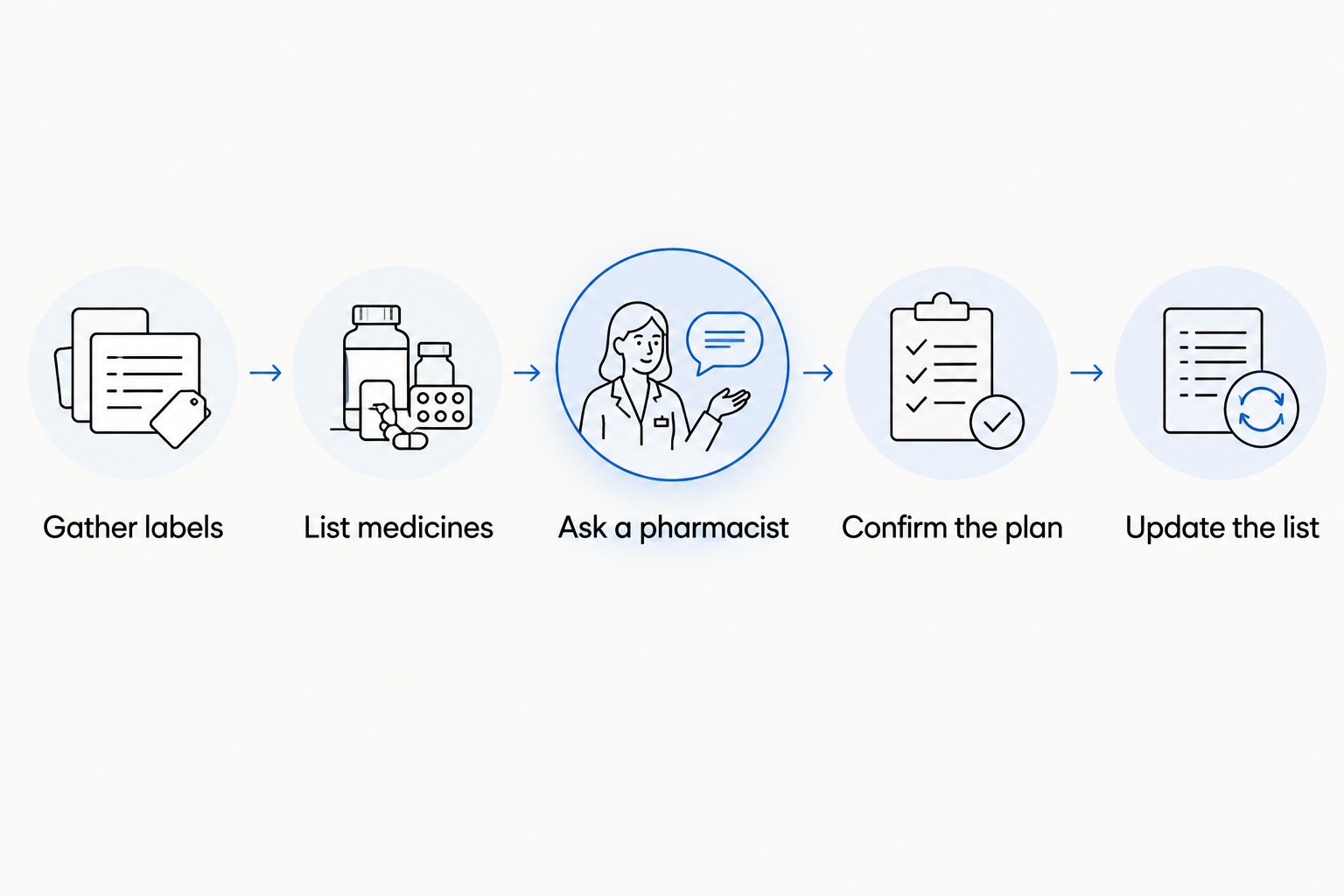
Use this sequence before introducing a new supplement. It works whether you are considering something for everyday stress, sleep, mobility, or general wellness.
- Gather labels. Photograph the Supplement Facts panel, serving directions, warnings, and ingredient list. Include powders, gummies, and occasional-use products—not just capsules.
- List medicines. Record prescription names, strengths, formulations, and usual timing. Add over-the-counter medicines, including sleep aids and pain relievers.
- Ask a pharmacist. Request a check of the exact combination. Explain the benefit you are seeking and mention relevant health conditions or upcoming procedures.
- Confirm the plan. Ask whether to avoid the supplement, separate doses, monitor something, or speak with your prescriber. Get the instructions in writing when possible.
- Update the list. Record any approved addition and share the updated list when a medicine changes. Keep it accessible for appointments and urgent care visits.
A useful question is whether your exact prescription and dose are compatible with the ingredients shown on the label. Also ask what to do if you miss a dose or accidentally take the products together. A clear plan is easier to follow than a general instruction to be careful.
Do I need to avoid all supplements if I take prescriptions?
No. Taking a prescription does not automatically rule out every supplement, but it does make ingredient-specific screening important.
Some people have a clear reason to use a supplement, such as a clinician's recommendation to address a nutritional need. Others are looking for everyday wellness support. In either case, the potential benefit must be weighed against interactions, duplicate ingredients, and the demands of another daily product.
The simplest suitable routine is better than an unchecked supplement stack. If you already take several products, ask your pharmacist which ones need review before adding another.
A routine cleared in early 2026 needs another check when your prescription, dose, health status, or supplement changes. Previous approval applies to the combination reviewed; it is not blanket approval for future additions.
Are stress and sleep supplements different from vitamins?
They can present different concerns, but neither category gets an automatic safety pass. Minerals can interfere with absorption, while herbs and sleep ingredients can affect medication handling or add to a prescription's effects.
Ashwagandha illustrates why the exact ingredient matters. NCCIH identifies potential interactions with thyroid hormone medicines, sedatives, immunosuppressants, and medicines for diabetes or high blood pressure. That does not establish what will happen to every person; it identifies combinations that need professional review.
If thyroid medicine is part of your routine, the guide on whether ashwagandha can affect thyroid levels provides related context. Your pharmacist or prescriber still needs to assess your particular medicine and supplement.
For any TruNutra formula you are considering, use the current product label for that review. The potential advantage is a supplement aligned with your everyday wellness goal; the limitation is that product positioning alone cannot establish compatibility with a prescription.
What if I already took a supplement with my medication?
Do not panic, double a dose, or change a prescription schedule to compensate. Contact your pharmacist or prescriber with the exact product names, amounts, and times taken. The right response depends on the combination and whether you have symptoms.
For a suspected poisoning or an accidental excess, contact Poison Control promptly. Seek emergency care for trouble breathing, collapse, a seizure, or inability to wake someone. Do not wait for an online interaction checker to settle an urgent situation.
For nonurgent concerns, save the packaging and write down what happened. Feeling fine does not rule out an interaction, but taking two products together does not automatically mean harm occurred.
Can I trust an online interaction checker?
An online checker is a starting point, not clearance to take a combination. Its usefulness depends on whether it includes the exact ingredient, formulation, and medication involved.
| Review option | Best for | Main benefit | Main limitation |
|---|---|---|---|
| Online interaction checker | Preparing questions | Flags some known combinations | An absent warning does not establish safety |
| Pharmacist review | Checking a complete medication list | Connects ingredients with prescriptions and timing | Requires accurate labels and health information |
| Prescriber review | Decisions involving treatment or monitoring | Addresses changes to your care plan | Needs an updated supplement list |
Use a pharmacist review for the combination and a prescriber for treatment changes. Do not stop a medicine because a search result describes a possible interaction.
Sources for your 2026 medication review
The general examples in this guide are supported by FDA consumer guidance on mixing medications and dietary supplements; NIH Office of Dietary Supplements fact sheets on calcium, magnesium, and vitamin K; NCCIH information on St. John's wort, melatonin, and ashwagandha; and FDA-approved ciprofloxacin labeling.
These sources address ingredient-level interactions and medication instructions. They do not establish that a particular branded formula is suitable for you. Use the current prescription information and supplement label with your pharmacist for an individual decision.
FAQ
Can supplements interact with prescription medications even if they are natural?
Yes, natural ingredients can interact with prescription medications. Herbs, minerals, and other supplement ingredients can change drug absorption, medication levels, or side effects.
Can I prevent an interaction by taking my supplement at night?
Taking a supplement at night does not reliably prevent an interaction. Separation helps certain absorption problems, but it does not prevent all overlapping effects or changes in medication metabolism.
How far apart should I take calcium and thyroid medication?
At least 4 hours is the separation described in NIH guidance for calcium carbonate and levothyroxine. Confirm the instructions for your exact prescription and calcium product with your pharmacist.
Can I take magnesium with an antibiotic?
Magnesium can reduce absorption of certain antibiotics, so the answer depends on the prescription. Ciprofloxacin labeling specifies taking the antibiotic at least 2 hours before or 6 hours after magnesium-containing products; other antibiotics have different instructions.
Should I stop my prescription before starting a supplement?
Do not stop a prescription on your own to start a supplement. Ask your pharmacist or prescriber whether the supplement is appropriate and whether any treatment changes are needed.
Do I need another interaction check if my medicines change in 2026?
Yes, a medication change in 2026 calls for another review of your supplements. Include changes in dose, formulation, timing, and occasional-use medicines.
Can I use TruNutra supplements while taking prescription medication?
Suitability depends on the exact TruNutra formula, your prescriptions, and your health history. Bring the current Supplement Facts panel and medication list to your pharmacist before starting the product.
One last thing
Starting a supplement is not the only change worth reporting—stopping one can matter, too. For example, changing vitamin K intake can affect warfarin management. Tell your care team about additions, removals, and changes in how often you take a product.
Make one practical update to your 2026 routine: keep photos of supplement labels beside your medication list. The most useful safety tool is an accurate record that your pharmacist can actually review.