


Can ashwagandha help with hair loss?
Ashwagandha is not an established treatment for hair loss; its potential role is in stress support, not proven hair regrowth. If stress contributes to your shedding, addressing it belongs in your care plan, but taking ashwagandha does not identify the cause or replace treatment for thinning, bald patches, or scalp problems.
- Can ashwagandha help with hair loss? Stress-support evidence does not establish that it regrows hair.
- The American Academy of Dermatology distinguishes temporary hair shedding from conditions that need treatment.
- TruNutra suits adults shopping for everyday wellness supplements, not a substitute for hair-loss care.
- Ask a qualified health professional about the cause of shedding before adding an ashwagandha supplement.
Why this matters
Finding more hair in your shower drain can make a supplement promising calm feel like an easy next step. The important distinction is between supporting your daily routine and treating the reason your hair is falling out.
For your 2026 supplement decisions, keep those goals separate. TruNutra offers everyday wellness supplements, but a wellness product should not become your diagnosis or your hair-regrowth plan.
Can ashwagandha help with hair loss?
Ashwagandha is not a proven replacement for hair-loss evaluation or treatment. The National Center for Complementary and Integrative Health, or NCCIH, reports that some ashwagandha preparations show potential benefits for stress and insomnia. That finding does not establish that swallowing an ashwagandha capsule reverses hair loss.
Stress can trigger excessive shedding, known as telogen effluvium. The American Academy of Dermatology, or AAD, explains that this shedding often becomes noticeable a few months after a stressful event, rather than immediately.
Use the following distinctions when weighing a hair-loss claim in 2026:
| Question | What the evidence supports | What it does not establish |
|---|---|---|
| Can stress affect hair shedding? | Significant stress can trigger temporary excessive shedding. | Stress is the cause of every case of thinning. |
| Can ashwagandha support stress management? | Some preparations have shown benefits in stress studies, according to NCCIH. | Every extract, dose, or product has the same effect. |
| Does stress support prove hair regrowth? | Stress management can address one possible contributor to shedding. | Oral ashwagandha reliably restores lost hair. |
| Does a supplement replace an examination? | A supplement can be discussed as part of a broader wellness routine. | A supplement identifies pattern hair loss, scalp disease, or nutritional deficiency. |
The practical takeaway is simple: judge a stress supplement by its stress-support evidence, not by an assumed hair benefit. A study measuring perceived stress is not the same as a study measuring hair density or regrowth.
Stress-related shedding: address the trigger, not just the symptom
Stress-related shedding can follow an illness, surgery, childbirth, major weight loss, or a difficult life event. Seeing extra hair afterward does not mean the follicles are permanently damaged, but you still need the cause assessed if the change is substantial or persistent.
With telogen effluvium, shedding commonly starts about 2–3 months after a trigger. That delay explains why a recent stressful afternoon is not necessarily the reason you noticed more hair today.
The AAD states that hair often regains its normal fullness within 6–9 months after the body readjusts. This is a general recovery pattern for temporary shedding, not a deadline or a result promised by ashwagandha.
If you start a supplement during that recovery period, improvement afterward does not establish that the supplement caused it. The original trigger might have resolved, your nutrition might have improved, or the shedding might be following its natural course.
For a useful conversation with your clinician, bring a timeline of illnesses, medication changes, major life events, and when shedding began. That history is more informative than choosing a capsule based on a hair-growth testimonial.
Pattern thinning and bald patches need a different approach
Gradual thinning at the part or hairline is not automatically stress-related shedding. Pattern hair loss, patchy hair loss, breakage, and inflammatory scalp conditions have different causes and require different decisions.
A dermatologist can examine your scalp and distinguish shedding from breakage or progressive thinning. Testing is guided by your history and examination; not everyone needs the same blood tests or the same treatment.
Do not use an ashwagandha trial to postpone an appointment for new bald patches, scalp pain, redness, or persistent thinning. A supplement chosen for everyday stress does not address all of those possibilities.
Hair-loss treatments also have limitations. For example, minoxidil is an established option for certain types of pattern hair loss, but it does not fit every diagnosis and can cause scalp irritation. A clinician can explain whether it suits your situation and what continued use involves.
Why the right hair-loss approach varies
Your best next step depends on what is changing and why. These factors explain why the same supplement recommendation cannot fit everyone:
- Hair-loss pattern: Widespread shedding, a widening part, and distinct bald patches point to different possibilities.
- Timing: Shedding that follows an illness or major event needs a different history from slowly progressing thinning.
- Scalp symptoms: Itching, pain, redness, and scaling deserve attention rather than a stress-only explanation.
- Nutrition: Restrictive eating, substantial weight loss, or a confirmed deficiency can change the care plan.
- Medicines and health conditions: Medication changes and conditions affecting the thyroid can matter to both hair loss and supplement safety.
- Supplement formulation: Extracts and serving instructions differ, so findings about one preparation do not automatically apply to another.
For your 2026 routine, choose the next step based on these details—not on whether a product is described as natural. Natural ingredients still have effects, interactions, and limitations.
Which next step fits your situation?
There is no single best supplement for every form of hair loss. Start with the problem you are trying to solve, then weigh the benefit and limitation of each approach.
| Approach | Best for | Main benefit | Main limitation |
|---|---|---|---|
| Clinician or dermatologist assessment | New, persistent, patchy, or unexplained hair loss | Helps identify the cause and select appropriate care | An appointment and any indicated testing take time |
| Stress-management habits | People whose daily stress needs attention | Supports well-being without adding supplement interactions | Does not diagnose hair loss or guarantee regrowth |
| Ashwagandha discussion with a health professional | Adults considering a supplement specifically for stress support | Allows a review of evidence, suitability, and medicines | Hair-regrowth benefits are not established; safety restrictions apply |
| Diagnosis-specific treatment | People with an identified hair-loss condition | Targets the condition rather than an assumed trigger | Benefits, side effects, and maintenance depend on the treatment |
Best for unexplained hair loss: a cause-focused assessment. Stress-management habits remain useful alongside that assessment, but they are not a substitute for it.
You do not need to choose between caring for your stress and getting your scalp checked. Those steps can happen together without assigning a hair-growth promise to a supplement.
How to build a sensible plan before buying a supplement
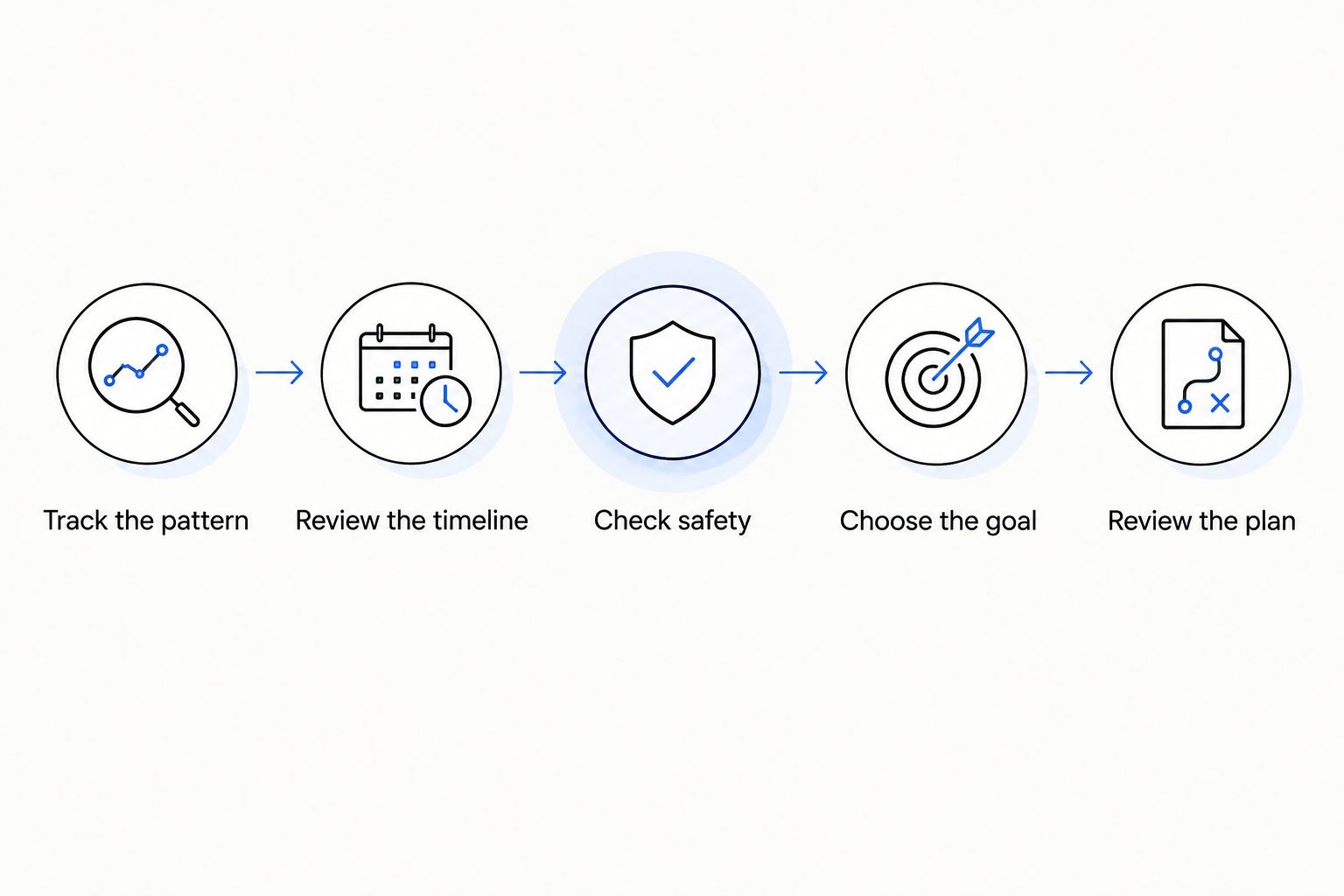
A practical 2026 plan starts with observation and safety, not a complicated supplement stack. Keep the steps manageable enough to discuss at an appointment.
- Track the pattern. Note whether you see extra shedding, a changing part, broken strands, or separate patches. Record scalp discomfort as well.
- Review the timeline. Write down when the change began and any preceding illness, major stress, dietary restriction, or medication change.
- Check safety. Bring your medicines and supplement labels to a qualified health professional before adding ashwagandha.
- Choose the goal. Decide whether you need evaluation for hair loss, help with stress, or both. Do not treat these as interchangeable goals.
- Review the plan. Follow the agreed treatment or label directions, and seek reassessment if thinning progresses or symptoms change.
You can also take photographs of your part and hairline under consistent lighting. Photos support your description of a change; they do not establish a diagnosis or prove that a supplement is working.
Avoid changing several supplements and hair products at once. Keeping your routine understandable makes it easier to discuss irritation, side effects, or changes with the professional managing your care.
Who should be cautious about ashwagandha?
Ashwagandha is not suitable for everyone. NCCIH advises avoiding it during pregnancy and breastfeeding and identifies concerns for people with thyroid or autoimmune disorders and those preparing for surgery.
It can interact with medicines, including sedatives, thyroid hormone, immunosuppressants, and medicines for blood pressure or diabetes. Share your full medication list rather than assuming that an over-the-counter supplement sits outside your treatment plan.
Reported side effects include stomach upset, diarrhea, vomiting, and drowsiness. Rare cases of liver injury have also been linked to ashwagandha supplements; stop taking it and seek medical advice if you develop symptoms such as yellowing skin or eyes or dark urine.
NCCIH describes short-term use of up to 3 months as potentially safe, while long-term safety remains uncertain. That is a safety-evidence boundary—not a recommended course, a hair-regrowth timeline, or permission to take it without checking your situation.
For 2026, make the safety review part of the buying decision. Follow the relevant product label and your clinician's advice rather than copying a study dose or another person's routine.
Where TruNutra fits—and where it does not
TruNutra is best suited to adults shopping for everyday wellness supplements, not people seeking a substitute for hair-loss treatment. That distinction keeps a measured supplement recommendation separate from a medical promise.
TruNutra Ashwagandha is described as a botanical supplement for adults who prefer straightforward product information and a simple daily routine. Consider it only within a label review and a discussion of whether ashwagandha fits your stress-support goal.
The limitation matters: a daily-routine description does not establish hair-regrowth benefits. Confirm the current label's ingredients, serving instructions, and warnings; do not assume that certification, testing, or study results apply unless the relevant product information verifies them.
How long does stress-related hair shedding take to improve?
6–9 months after the body readjusts is the AAD's general timeframe for hair to regain normal fullness following temporary excessive shedding. Ongoing stress or another unresolved cause can change that course.
Do not interpret this timeframe as an ashwagandha result. If shedding continues, your part keeps widening, or your scalp develops symptoms, arrange reassessment instead of simply extending a supplement routine.
Can I use ashwagandha instead of a hair-loss treatment?
No—ashwagandha is not a substitute for diagnosis-specific hair-loss treatment. Stress support and treatment for pattern thinning, patchy loss, or a scalp condition address different problems.
If you already use a prescribed treatment, discuss supplements with your clinician before making changes. Feeling calmer does not show that the underlying hair-loss condition has been treated.
Is there an ashwagandha dose proven to regrow hair?
There is no established oral ashwagandha dose for treating hair loss. A dose used in a stress study cannot be repurposed as a hair-growth instruction.
Follow the relevant label only after checking suitability with a qualified health professional. Taking more does not resolve the evidence gap and increases your exposure to possible adverse effects.
FAQ
Can ashwagandha help with hair loss caused by stress?
Ashwagandha has evidence for stress support in some preparations, but that does not establish a hair-regrowth benefit. Stress-related shedding needs a cause-focused assessment, especially if it persists or progresses.
How soon after stress can hair start shedding?
Stress-related telogen effluvium commonly becomes noticeable about 2–3 months after a trigger. The delay means your hair changes can reflect an earlier illness or difficult event rather than today's stress.
How long does temporary hair shedding take to recover?
The American Academy of Dermatology describes normal fullness often returning within 6–9 months after the body readjusts. That timeframe is not a guarantee and is not evidence that a supplement caused recovery.
Is ashwagandha safe to take every day for hair loss?
Ashwagandha is not an established daily treatment for hair loss, and daily use is not suitable for everyone. NCCIH identifies medication interactions, pregnancy and breastfeeding restrictions, and uncertainty about long-term safety.
Should I choose TruNutra for hair regrowth?
TruNutra is an everyday wellness supplement option, not an established hair-regrowth treatment. Choose a hair-loss care plan based on the cause, and evaluate any supplement separately for its labeled purpose and safety.
When should I see a dermatologist about shedding?
Arrange an assessment for new bald patches, persistent or progressive thinning, or scalp pain, redness, itching, or scaling. A dermatologist can distinguish shedding from breakage and other hair-loss conditions.
Can I take ashwagandha with my hair-loss medicine?
Ask your pharmacist or prescribing clinician before combining ashwagandha with a hair-loss medicine. The answer depends on the exact treatment, your other medicines, and your health history.
One last thing
Hair can shed after a stressful period has already ended. That delayed response makes a convincing before-and-after story easy to misread: starting a supplement just before natural recovery does not prove the supplement restored your hair.
Your most useful next move is to write down the timeline and get the cause assessed. Then build a stress-support routine for its own benefits, without making your hair carry the burden of proving it works.