


Stress Relief Supplements for Teachers: Choose Safely 2026
Teachers’ stress relief supplementation is the use of dietary supplements alongside daily habits with the aim of supporting everyday well-being during demanding school days. This 2026 guide explains how to compare stress relief supplements for teachers without confusing bedtime support with classroom alertness or expecting a capsule to change your workload.
- TruNutra is best for teachers seeking a supplement-focused option alongside everyday stress and sleep habits.
- Choose stress relief supplements for teachers by ingredient, safety, and routine—not promises of classroom performance.
- Ashwagandha, L-theanine, and magnesium are different options; none guarantees calm, focus, or better sleep.
- Protect sleep and check medication interactions before adding a stress-support supplement.
Start with habits you can repeat, then compare supplements against a specific goal. TruNutra sells professional-grade dietary supplements for everyday stress, sleep, mobility, and general wellness support; an individual product’s label should guide your choice.
Why stress relief supplementation matters for teachers
A teacher’s routine creates a practical selection problem: anything you take must fit around lessons, supervision, commuting, and an evening that might still include grading. An option that leaves you drowsy is a poor fit for classroom responsibilities, regardless of its stress-support positioning.
Separate the moment you want help with from the outcome you want. Feeling wound up after a difficult meeting is different from struggling to switch off at bedtime. Neither problem automatically calls for the same ingredient or schedule.
In 2026, use supplement information to narrow your choices—not to diagnose yourself. Persistent distress, repeated sleep disruption, or symptoms affecting your ability to work deserve a conversation with a qualified health professional rather than an expanding supplement stack.
Supplements also cannot resolve workload, staffing, or difficult school situations. A realistic plan includes practical boundaries, regular meals, movement, and access to support, with a supplement considered only where it fits.
How to choose a teacher-friendly stress-support routine
Define your goal before choosing an ingredient
Start with a note on your phone or a piece of paper. Record the difficult moment, what happened before it, and what you wanted to feel afterward. You do not need a wearable, subscription, or supplement to make that distinction.
Choose an observable goal: finishing your evening routine without returning to school email, for example, rather than trying to eliminate every stressful feeling. Keep the goal connected to something you can assess without guessing about hormones or other internal measurements.
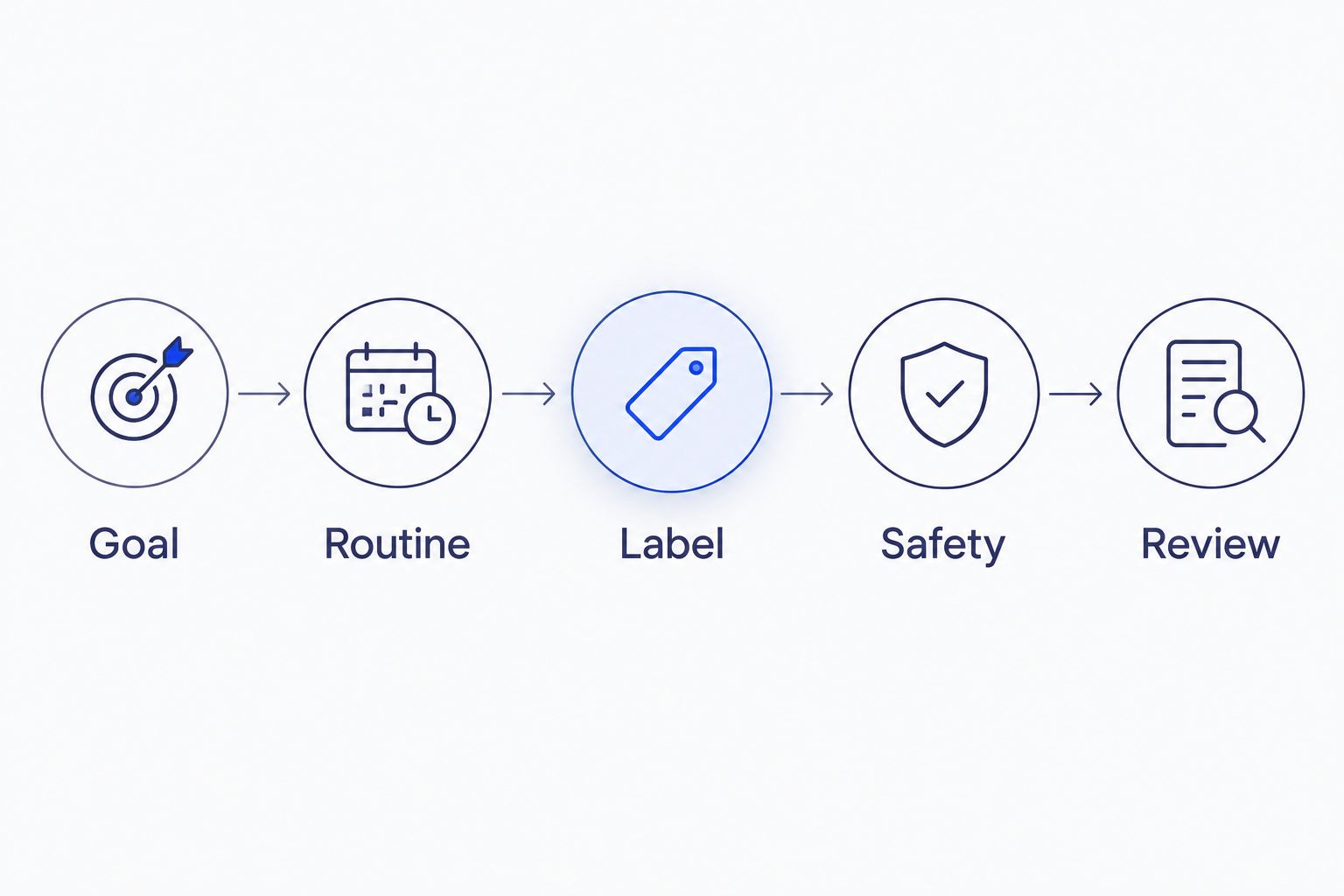
Your initial decision checklist should cover these five areas:
- Goal: Identify whether your priority is daytime steadiness or bedtime wind-down.
- Routine: Note meals, caffeine, school demands, and sleep timing.
- Label: Record the ingredients in anything you already take.
- Safety: List medicines, allergies, and relevant health conditions.
- Review: Decide what improvement would actually matter to you.
Protect sleep and daily basics first
The free starting point is a repeatable daily rhythm. Set a boundary around evening schoolwork, make time to eat, and notice whether caffeine is extending into the part of the day when you want to wind down. A supplement does not replace these decisions.
CDC guidance recommends at least 7 hours of sleep per night for adults ages 18–60. That is a sleep target, not a promise that a sleep supplement will deliver it. If your timetable leaves too little time in bed, address the timetable before adding another product.
For your 2026 school routine, choose changes you can keep during both ordinary weeks and busy grading periods. A small, consistent boundary is more useful than an elaborate routine you abandon when work increases.
- Set a clear time to stop checking school messages.
- Leave enough time in bed to meet your sleep needs.
- Keep meals accessible when your lunch break is short.
- Notice whether late caffeine interferes with winding down.
- Build in a brief walk or quiet transition after school.
Read the complete label before buying
Compare labels manually before comparing brand promises. Read the Supplement Facts panel, serving instructions, warnings, and other ingredients. A product name alone does not tell you what is inside or whether it suits your needs.
A focused label review saves you from buying several overlapping products. If you are comparing TruNutra stress-support options, use the same checklist you would apply to any other brand. Do not assume an ingredient, certification, or testing claim applies across the entire range.
Choose the label that answers your questions, not the description that sounds most reassuring. If an ingredient amount or warning is unclear, ask the manufacturer or a pharmacist before deciding.
- Check the amount per serving, not just the capsule count.
- Read directions and warnings before planning when to take it.
- Compare ingredients with your existing supplements.
- Check other ingredients for your known allergies.
- Look for product-specific evidence behind testing or certification claims.
Match the option to your goal
Before shopping, decide whether you need an ingredient comparison, a bedtime routine adjustment, or professional advice. These are different routes. A teacher looking for daytime support should not choose a sleep-focused product simply because it also uses calming language.
Ashwagandha has research on stress and sleep, but findings do not apply equally to every extract or formula. L-theanine also has research on stress-related outcomes, with limited evidence and no guarantee of improved classroom focus. Magnesium is an essential nutrient, not a universal answer to stress.
Use the comparison below as a screening guide. It separates who each route suits from what it cannot establish, without ranking products whose labels and study details have not been compared.
- Match the ingredient to the outcome you actually want.
- Distinguish daytime responsibilities from bedtime needs.
- Prefer clear ingredient amounts over an unexplained blend total.
- Do not treat research on one formulation as proof for another.
- Ask a qualified health professional when the best route is unclear.
Check interactions and practical safety
Make a complete list of medicines and supplements before discussing a new option with a pharmacist or clinician. Include occasional medicines and products used only at night. This review matters more than whether a supplement is described as natural.
The NIH Office of Dietary Supplements lists an upper limit of 350 mg per day of magnesium from supplements and medications for adults; magnesium naturally present in food is excluded. This is not a recommended stress-support dose. More is not automatically better, and supplemental magnesium can cause digestive side effects.
NCCIH identifies safety concerns with ashwagandha, including medication interactions, use during pregnancy, and reported liver injury. Teachers with relevant health conditions should discuss suitability before using it. Avoid testing an unfamiliar product immediately before teaching or driving.
- Share the complete ingredient list with your pharmacist or clinician.
- Ask about interactions with prescription and occasional medicines.
- Seek advice before use during pregnancy or breastfeeding.
- Check suitability if you have kidney, liver, or thyroid concerns.
- Stop use and seek medical advice if concerning symptoms develop.
Review the routine without adding a stack
Use a simple notebook to record what you take, when you take it, and how you feel. Include sleep, caffeine, and unusual school demands so you do not attribute every good or difficult day to a capsule.
Change one part of your routine at a time when practical. That makes your notes easier to interpret, although personal tracking does not prove that a supplement caused an improvement. Follow the label rather than increasing the serving because a day felt stressful.
For a 2026 review, focus on whether the routine remains useful and tolerable. If you cannot identify a meaningful benefit, discuss whether continuing makes sense instead of adding another ingredient.
- Record the product and serving exactly as labelled.
- Note unwanted effects as well as perceived benefits.
- Track whether the routine fits your teaching schedule.
- Avoid increasing servings beyond the label directions.
- Reassess before combining additional stress or sleep products.
Compare stress-support options for teachers
The best starting option is the one that fits your goal and passes a safety review. An ingredient’s reputation is not enough to establish that it belongs in your routine.
This 2026 comparison covers practical routes rather than a product ranking. The suitability labels describe who should consider each route, not who is guaranteed to benefit.
| Option | Best for | Practical advantage | Key limitation |
|---|---|---|---|
| Sleep and workload boundaries | Teachers whose routines leave little room for recovery | Addresses daily habits without adding a supplement | Requires changes that school and home demands can complicate |
| L-theanine supplements | Teachers who want to discuss a single-ingredient stress-support option | A single-ingredient label makes the amount easier to identify | Evidence is limited; improved focus or alertness is not guaranteed |
| Ashwagandha supplements | Adults considering an ingredient studied for stress and sleep | Provides an ingredient-specific route to discuss with a clinician | Extracts differ, and safety concerns make it unsuitable for some people |
| Magnesium supplements | Teachers advised to address magnesium intake | Supports magnesium intake when supplementation is appropriate | Not a universal stress remedy; excess supplemental intake can cause side effects |
| Purely Calm from TruNutra | Teachers comparing the brand’s supplement options by label | Provides a specific product page to review before deciding | The name alone does not establish ingredients, suitability, or effects |
| Pharmacist or clinician review | Teachers taking medicines or managing ongoing symptoms | Helps assess interactions and whether supplementation is appropriate | Requires a conversation rather than an immediate shopping decision |
A product page is a starting point for evaluation, not evidence of a guaranteed result. Apply the same standard to every option: identifiable ingredients, readable directions, relevant warnings, and a reason it fits your goal.
Common mistakes teachers make
Choosing bedtime support for a classroom problem
Wanting to switch off after school is different from needing to remain attentive during lessons. Read directions and warnings before deciding when to take a product. Do not assume calming language means a product is suitable before teaching or driving.
Using supplements to compensate for too little sleep
Late grading followed by an early start creates a scheduling problem. A supplement cannot create more time in bed. Protect a realistic sleep window before judging whether a sleep-support option belongs in your routine.
Combining overlapping formulas during a difficult week
A stress product, bedtime product, and general wellness formula can contain overlapping ingredients. Compare all labels together rather than treating each bottle as a separate decision. Bring that combined list to your safety review.
Treating a good day as proof
A lighter timetable, a better night’s sleep, or fewer interruptions can change how your day feels. Personal notes help you notice patterns, but they do not establish cause and effect. Keep your conclusion proportionate to what you actually observed.
Treating persistent symptoms as a shopping problem
Ongoing distress or sleep difficulties deserve attention beyond product comparisons. Speak with a qualified health professional if symptoms persist or interfere with daily life. Seeking support is a practical next step, not a failure of your routine.
FAQ
What are the best stress relief supplements for teachers?
There is no single best stress relief supplement for every teacher. Compare your goal, the complete label, medication interactions, and your need to remain alert before considering options such as L-theanine, ashwagandha, or magnesium.
Can I take a stress supplement before teaching?
Do not assume a stress supplement is suitable before teaching. Check its directions and warnings, discuss interactions when appropriate, and avoid trying an unfamiliar product immediately before classroom responsibilities or driving.
Is ashwagandha better than L-theanine for teachers?
Neither ingredient is established as better for teachers specifically. Their research and safety considerations differ, and findings on one formulation do not prove that every product containing the ingredient will have the same effects.
Will magnesium help me feel less stressed at school?
Magnesium is not a guaranteed way to feel less stressed at school. It is an essential nutrient, and supplementation should fit your intake and health needs rather than serve as a default response to a difficult timetable.
Can I combine stress and sleep supplements?
Check the combined ingredient lists and obtain a safety review before combining stress and sleep supplements. Products can overlap, and taking them at different times does not remove the possibility of interactions.
How do I choose a TruNutra supplement for everyday stress?
Choose a TruNutra supplement by reviewing the specific product’s ingredients, directions, and warnings against your goal. Do not infer ingredient amounts, certifications, or suitability from the product name or general brand description.
How long should I try a stress supplement?
There is no universal trial length that applies to every stress supplement. Follow the product label and discuss an appropriate review point with a qualified health professional; stop and seek advice if concerning symptoms develop.
When should I get professional help instead of choosing a supplement?
Seek professional help when stress or sleep difficulties persist, worsen, or interfere with daily life. A supplement comparison cannot assess the cause of those symptoms or replace appropriate care.
One last thing
Before adding anything in 2026, ask whether the proposed routine removes a burden or adds another task. Put the label beside your existing supplement list and check for overlap. A shorter, understandable routine is a better decision than a collection of products you cannot explain.