


Best daily multivitamins for women over 50 in 2026
Best starting point after menopause: an iron-free multivitamin matched to your diet. Best when iron is medically indicated: an iron-containing formula. Best for swallowing difficulty: a chewable multivitamin. Best for a vegan routine: a multivitamin with verified vegan ingredients and appropriate vitamin B12 coverage. This 2026 guide compares formula types so you can choose a daily multivitamin for women over 50 without treating every bottle as interchangeable.
- Choose a daily multivitamin for women over 50 by nutrient amounts, medication compatibility, and dietary gaps—not front-label promises.
- An iron-free multivitamin is a sensible starting point after menopause unless a qualified health professional recommends iron.
- TruNutra wellness supplements should be evaluated by their individual labels, not assumed to replace a multivitamin.
- Calcium and vitamin D needs depend on age; compare food intake with supplement amounts before adding products.
Why this matters
A multivitamin fills selected nutritional gaps; it does not make every meal nutritionally complete. Start with what you eat, then use the Supplement Facts panel to identify what a formula actually adds. The guide to whether a daily multivitamin can replace a healthy diet explains that distinction.
Age alone does not settle the choice. Menopause status, dietary restrictions, medications, swallowing comfort, and existing supplements all affect which formula fits. A woman who still menstruates needs a different iron discussion from someone who has stopped.
The best daily multivitamin for women over 50 fills a dietary gap without adding unnecessary nutrients. More ingredients and larger amounts do not automatically make a better choice.
What makes the best daily multivitamin for women over 50?
Use these criteria when comparing labels in 2026:
- Dietary fit: Nutrients should address what your usual meals leave short, rather than duplicate everything you already take.
- Appropriate iron: Menopause status and professional advice matter more than the words “women's formula.”
- Useful nutrient amounts: Read amounts per full serving, not just the number of ingredients on the front.
- Medication compatibility: Have a pharmacist review the complete formula alongside your prescriptions and other supplements.
- Manageable serving: Check tablet size, serving count, directions, and whether the format fits your routine.
- Verifiable quality: Look for product-specific evidence behind testing or certification claims. Do not assume a claim applies across a brand.
Daily multivitamin options at a glance
These are ranked formula types, not interchangeable product endorsements. A chewable or vegan formula can also be iron-free; choose the nutrient profile first and the format second.
| Rank and option | Best for | Standout feature | Key limitation |
|---|---|---|---|
| 1. Iron-free multivitamin | Postmenopausal adults without a reason to supplement iron | Leaves out iron that is not routinely needed as a supplement | Unsuitable when professional advice calls for iron |
| 2. Iron-containing multivitamin | Adults advised to include iron | Includes iron within a broader nutrient formula | Not a substitute for individualized iron treatment |
| 3. Chewable multivitamin | Adults who struggle with tablets | Avoids swallowing a whole tablet | Nutrient coverage varies; serving size needs checking |
| 4. Verified vegan multivitamin | Adults avoiding animal-derived ingredients | Matches a dietary preference when ingredients are verified | Vegan labeling alone does not establish nutritional adequacy |
1. Iron-free multivitamin: best after menopause
An iron-free multivitamin provides a selection of vitamins and minerals without added iron. It is a sensible first formula type to consider after menopause when a qualified health professional has not identified a reason for iron supplementation.
The NIH Office of Dietary Supplements lists an iron recommended dietary allowance of 8 mg daily for women ages 51 and older. That is a total-intake target from food and supplements—not an instruction to buy an 8 mg supplement.
Iron-free multivitamin pros:
- Avoids adding iron solely because the bottle is labeled for women.
- Keeps the iron decision separate from general nutritional coverage.
- Lets you compare other nutrients without treating iron as a required feature.
Iron-free multivitamin cons:
- Does not address an identified need for supplemental iron.
- Still requires a check for excessive or overlapping nutrients.
Best for: Postmenopausal adults seeking general nutritional coverage without a specific iron recommendation.
Verdict: Buy only after checking the full label against your diet and existing supplements.
2. Iron-containing multivitamin: best when iron is recommended
An iron-containing multivitamin combines iron with other vitamins and minerals. It belongs on your shortlist when a qualified health professional recommends iron and confirms that the formula's amount fits your situation.
Do not choose this option simply because you feel tired. Persistent fatigue deserves an assessment rather than an automatic switch to a product with iron, and a multivitamin is not a personalized treatment plan.
Iron-containing multivitamin pros:
- Includes professionally recommended iron within a broader formula.
- Makes the iron amount visible on a single Supplement Facts panel.
- Offers an alternative to an iron-free formula when iron is appropriate.
Iron-containing multivitamin cons:
- Iron can cause digestive side effects, including constipation or nausea.
- A multivitamin's iron amount is not automatically suitable for a diagnosed deficiency.
Best for: Adults whose clinician has specifically recommended supplemental iron.
Verdict: Hold until a qualified health professional confirms the amount and reason for use.
3. Chewable multivitamin: best for swallowing difficulty
A chewable multivitamin changes how you take the supplement, not what your body needs. Choose it when swallowing tablets makes consistency difficult, then compare its nutrient amounts with the same care you would use for a capsule.
Read the full serving instructions. One chewable piece is not necessarily one serving, and a pleasant flavor does not establish adequate mineral coverage.
Chewable multivitamin pros:
- Avoids the need to swallow a whole tablet.
- Provides another format when standard pills are difficult to take.
- Allows a familiar daily routine without choosing ingredients by pill size alone.
Chewable multivitamin cons:
- Some formulas leave out nutrients found in other multivitamins.
- Sweeteners, allergens, and serving counts require a separate label check.
Best for: Adults whose main obstacle is swallowing a conventional tablet or capsule.
Verdict: Buy for a genuine format need, provided the nutrient profile also fits.
4. Verified vegan multivitamin: best for a plant-based routine
A vegan multivitamin is formulated without animal-derived ingredients when that claim is verified for the product. It can fit a plant-based routine, but the vegan designation does not tell you whether nutrient amounts are appropriate.
Pay particular attention to vitamin B12. The NIH Office of Dietary Supplements lists an adult recommended dietary allowance of 2.4 mcg daily, and people eating little or no animal food need reliable B12 sources from fortified foods or supplements.
Verified vegan multivitamin pros:
- Fits an established preference to avoid animal-derived ingredients.
- Can provide B12 when the label confirms its inclusion.
- Encourages checking nutrient sources as well as amounts.
Verified vegan multivitamin cons:
- Vegan does not mean nutritionally complete or independently tested.
- Capsule materials and nutrient sources still need verification.
Best for: Adults following a vegan diet who want a compatible formula with suitable nutrient coverage.
Verdict: Buy only when both the vegan claim and nutrient amounts are verified.
Read these nutrient amounts before choosing
For your 2026 comparison, separate daily nutritional targets from the amount a supplement needs to supply. The following reference amounts come from the National Academies' dietary reference intakes, as summarized in NIH Office of Dietary Supplements fact sheets for calcium, vitamin D, vitamin B12, and iron.
Calcium: count food first
Women ages 51 and older have a calcium recommended dietary allowance of 1,200 mg daily from all sources. That does not mean your multivitamin should contain 1,200 mg.
Count calcium-rich foods and fortified drinks before deciding whether a supplement is needed. Do not assume that an age-specific multivitamin supplies your entire calcium requirement.
Vitamin D: check your age group
The vitamin D recommended dietary allowance is 600 IU daily for adults ages 51–70 and 800 IU daily after age 70. These are general total-intake reference amounts, not individualized instructions for correcting a deficiency.
Add together vitamin D from your multivitamin and any separate supplement. If a clinician has given you different instructions, follow that plan rather than adjusting it to match a comparison table.
Vitamin B12: check the source and context
Some older adults have difficulty absorbing vitamin B12 naturally present in food. NIH guidance notes that fortified foods and supplements provide a form that does not require the same initial release from food proteins.
That does not establish one ideal supplement amount for everyone. Discuss B12 with a qualified health professional if you follow a vegan diet, have absorption concerns, or take medications that affect B12 status.
Iron: do not confuse age with menopause status
The age-based reference amount is useful, but your personal circumstances still matter. Ongoing menstrual bleeding, a diagnosed deficiency, or a medical condition requires an individual discussion.
Do not add iron because a formula looks more complete. Choose it for an established reason.
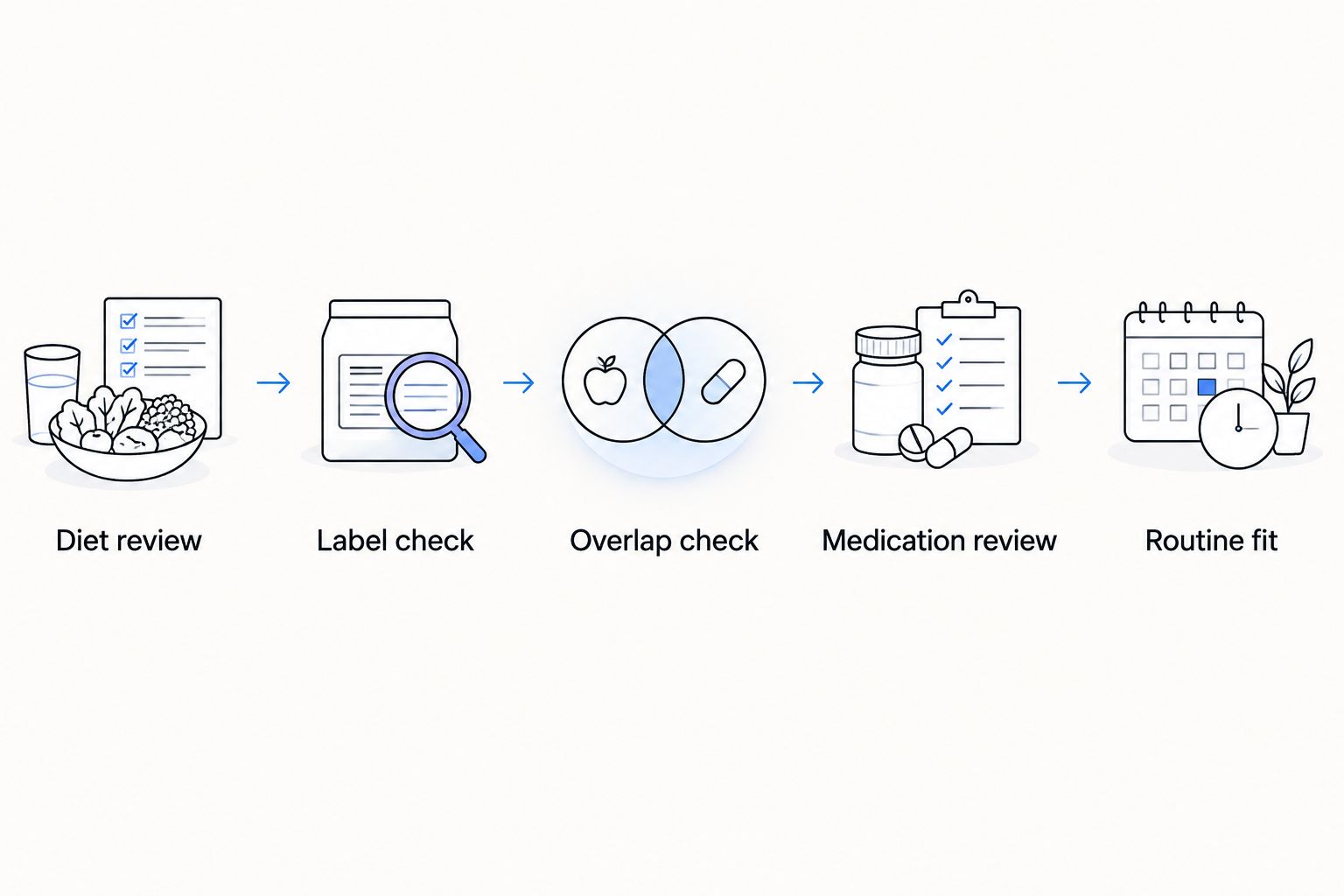
A simple label-checking sequence
Use the same sequence for every 2026 shortlist. This keeps the comparison focused on your needs rather than packaging.
- Diet review: Note foods you regularly eat and food groups you avoid.
- Label check: Read nutrient amounts, full serving size, ingredients, and warnings.
- Overlap check: Add nutrients from other supplements and fortified drinks.
- Medication review: Ask a pharmacist about interactions and timing.
- Routine fit: Follow the label and choose a format you can take consistently.
Bring photographs of every Supplement Facts panel to your pharmacist, including occasional-use products. Minerals can interfere with absorption of certain medicines, and vitamin K needs special attention for people taking warfarin. Timing advice should match the actual medication, not a general internet schedule.
Where TruNutra fits in your daily routine
TruNutra offers everyday wellness supplements, but a wellness product name does not establish that a formula is a daily multivitamin for women over 50. Evaluate a TruNutra supplement by its individual label and intended role, not as an automatic replacement for broad nutritional coverage.
For example, TruNutra Osteo Guardian is described as a botanical and nutritional supplement for daily wellness. That description does not establish its calcium amount, vitamin D amount, or suitability as a women's multivitamin.
Best for: Adults considering a separate daily-wellness supplement after identifying its ingredients and intended place in their routine.
The advantage is having a specific product to evaluate against a defined need. The limitation is equally important: neither the name nor the general description settles nutritional suitability. Review the current label and discuss any overlap before combining it with a multivitamin.
How these options are ranked
This 2026 ranking prioritizes dietary fit, appropriate iron, readable nutrient amounts, medication compatibility, manageable servings, and verifiable quality claims. Iron-free formulas appear first because they are a practical starting point after menopause—not because every woman over 50 should take one.
The later options answer different needs: professionally recommended iron, swallowing comfort, and vegan ingredient preferences. This is a formula-selection guide, not a claim that individual products were tested head-to-head.
Which daily multivitamin should you choose?
Start with an iron-free formula after menopause unless professional advice points elsewhere. Then check B12, vitamin D, calcium coverage, serving instructions, and overlap with what you already take.
Choose an iron-containing formula only for an established reason. Choose chewable or vegan options when those needs apply, without relaxing the nutrient checks. If your diet already covers your needs, a multivitamin is not automatically necessary.
FAQ
What's the best daily multivitamin for women over 50?
The best daily multivitamin for women over 50 matches dietary gaps, medication needs, and menopause status. An iron-free formula is a sensible starting point after menopause unless a qualified health professional recommends iron.
Do women over 50 need a multivitamin every day?
Not every woman over 50 needs a daily multivitamin. Your usual diet, dietary restrictions, health history, and professional advice should determine whether supplementation is useful.
Should my multivitamin contain iron after menopause?
Do not assume you need supplemental iron after menopause. A qualified health professional should confirm the reason and amount if iron is being considered.
How much calcium do women over 50 need?
Women ages 51 and older have a calcium recommended dietary allowance of 1,200 mg daily from food and supplements combined. Estimate dietary intake before deciding whether a supplement is needed.
Are chewable multivitamins better than tablets?
Chewable multivitamins are better suited to people who struggle to swallow tablets, but they are not automatically nutritionally better. Compare the full serving size, nutrient amounts, sweeteners, and warnings.
Can I take a multivitamin with prescription medication?
Ask a pharmacist to check the exact multivitamin against your prescriptions before combining them. Certain minerals affect medication absorption, and vitamin K requires particular attention with warfarin.
Is TruNutra Osteo Guardian a women's multivitamin?
TruNutra Osteo Guardian is described as a botanical and nutritional supplement for daily wellness, not explicitly as a women's multivitamin. Review its current label before deciding whether it fits alongside other supplements.
One last thing
The largest number on a supplement label is not necessarily the most useful one. Check the serving size before comparing nutrient amounts: the panel can describe several tablets or chewables rather than a single piece. That small check makes your daily multivitamin comparison much clearer.