


Best adaptogen supplements for energy in 2026
Best for an ashwagandha-focused daily routine: TruNutra Ashwagandha. Best ingredient to discuss for stress-related fatigue: rhodiola. Best ingredient to discuss for general fatigue: Asian ginseng. No adaptogen supplement for energy is a proven best choice for everyone; this 2026 guide compares their uses, evidence limits, and safety considerations.
- Choose an adaptogen supplement for energy by its ingredients and safety information, not an energy promise.
- TruNutra Ashwagandha is an option for adults considering an ashwagandha-focused daily routine.
- Rhodiola and Asian ginseng have different research profiles; neither guarantees better everyday energy.
- Persistent fatigue deserves a health assessment rather than a larger supplement stack.
Why this matters
Feeling drained after a demanding afternoon is different from struggling to stay awake despite adequate rest. A supplement label cannot tell you which situation you are experiencing. Start with the pattern, not the product.
“Adaptogen” is a term used for certain plants and mushrooms associated with the body's response to stress. It is not a guarantee of effectiveness, a standardized formula, or a safety certification. Products carrying that word can contain very different ingredients.
The best decision in 2026 is to match the ingredient to your actual concern before choosing a bottle. If you already take supplements, start with this guide to whether energy supplements are safe to take every day. Adding another product is not automatically the next step.
What makes the best adaptogen supplement for energy?
Use these criteria before comparing the options below. A recognizable ingredient name is only the beginning of a useful label review.
- Relevant purpose: Distinguish everyday stress, poor sleep, and persistent fatigue instead of treating them as the same problem.
- Identifiable ingredients: Look for the botanical name, plant part, preparation, and amount per serving where applicable.
- Realistic evidence: Research on one extract does not establish that every product containing that plant has the same effects.
- Product-specific quality: Check evidence for testing or certification on the actual product, not just the brand's general messaging.
- Personal safety: Review medications, existing supplements, pregnancy or breastfeeding, and health conditions with a qualified professional.
- A manageable routine: Choose directions you can follow without doubling ingredients or repeatedly changing products.
For a 2026 shortlist, prioritize a readable label over a long ingredient list. More botanicals create more information to check; they do not establish a better result.
Adaptogen options at a glance
These are different decision paths, not interchangeable solutions. The ranking reflects the usefulness of each option for the stated shopping goal, not proof that one produces more energy than another.
| Option | Best for | Standout distinction | Key limitation |
|---|---|---|---|
| TruNutra Ashwagandha | Reviewing an ashwagandha-focused daily routine | A named botanical supplement in the brand's range | The product description does not establish an energy benefit |
| Rhodiola rosea supplements | Discussing stress-related fatigue with a professional | A botanical studied in relation to stress and fatigue | Evidence is insufficient for a firm effectiveness conclusion |
| Asian ginseng supplements | Discussing general fatigue after reviewing its cause | Panax ginseng has been studied for fatigue | Findings are mixed, and interactions need attention |
No price or performance ranking can resolve an ingredient mismatch. If your main concern is unexplained exhaustion, the most useful comparison is between possible causes—not supplement bottles.
1. TruNutra Ashwagandha: best for an ashwagandha-focused routine
TruNutra Ashwagandha is described as a botanical supplement for adults who prefer straightforward product information and a simple daily routine. It belongs on this shortlist as a brand option to review, not as a verified treatment for fatigue or a guaranteed source of energy.
Ashwagandha research is more relevant to certain stress and sleep outcomes than to an immediate lift in alertness. The National Center for Complementary and Integrative Health, or NCCIH, reports that some preparations have shown benefits for stress and insomnia, while evidence for other uses remains limited. Those findings do not establish the performance of this specific product.
TruNutra Ashwagandha pros:
- Provides a named botanical option rather than an undefined “energy” category.
- Fits shoppers who want to investigate ashwagandha specifically.
- Is presented around a simple daily routine rather than a rapid-result promise.
TruNutra Ashwagandha cons:
- Its supplied description does not establish improved energy or fatigue outcomes.
- Ashwagandha can cause drowsiness and stomach upset; rare liver injury has also been reported.
- Thyroid conditions, medications, pregnancy, and breastfeeding require particular attention.
Best for: Adults considering an ashwagandha-focused routine who will check the complete label and suitability first.
Verdict: Hold until the label and safety review are complete. Choose it because ashwagandha fits your informed plan, not because the word “adaptogen” promises more energy.
2. Rhodiola rosea: best for discussing stress-related fatigue
Rhodiola rosea is a botanical commonly discussed in connection with stress, stamina, and fatigue. That makes it relevant to this search, but relevance is not the same as established benefit. NCCIH concludes that there is not enough reliable evidence to determine whether rhodiola is useful for any health-related purpose.
For a 2026 comparison, the practical question is whether the specific product and research actually match. Check the botanical identity, plant part, extract details, and serving information rather than assuming every rhodiola preparation is equivalent.
Rhodiola rosea pros:
- Offers a distinct ingredient to investigate when your concern centers on fatigue during demanding periods.
- Has been studied in relation to stress and fatigue, making the evidence directly relevant to evaluate.
- Can be assessed separately from a multi-ingredient blend when sold on its own.
Rhodiola rosea cons:
- Research does not support a confident promise of improved everyday energy.
- Reported side effects include dizziness, headache, and insomnia.
- Medication interactions and limited pregnancy or breastfeeding information complicate self-selection.
Best for: Adults seeking a professional discussion about stress-related fatigue who understand the evidence remains uncertain.
Verdict: Wait for a suitability review. Rhodiola does not earn an automatic recommendation simply because you feel mentally worn out.
3. Asian ginseng: best for discussing general fatigue
Asian ginseng, also called Panax ginseng, is a separate botanical from ashwagandha and rhodiola. NCCIH describes research suggesting a possible small benefit for general fatigue, but findings are not consistent. That is a narrower conclusion than “ginseng boosts energy.”
Check the botanical name carefully. American ginseng and products called Siberian ginseng are not interchangeable with Panax ginseng, and research on one should not be transferred to another.
Asian ginseng pros:
- Has research addressing fatigue rather than relying only on general wellness language.
- Provides a clearly named botanical category to discuss with a health professional.
- Gives shoppers a distinct alternative to stress-focused ashwagandha products.
Asian ginseng cons:
- Research results are mixed and do not establish reliable benefits for everyone.
- Insomnia is a recognized side effect, which matters if poor sleep already contributes to tiredness.
- Potential effects on blood sugar and medication interactions require review.
Best for: Adults who have discussed ongoing fatigue with a professional and want to evaluate Panax ginseng specifically.
Verdict: Hold pending medication and sleep review. An option that disrupts your sleep is a poor fit for an everyday energy routine.
How this ranking works
This 2026 ranking separates shopping goals rather than declaring an efficacy winner. Ashwagandha leads for readers considering the brand's named botanical option; rhodiola and Asian ginseng occupy distinct discussion paths based on their research topics.
The evidence context comes from NCCIH's public ingredient summaries for ashwagandha, rhodiola, and Asian ginseng. These summarize ingredient-level evidence and safety information, not independent testing of the products in this guide.
No finished-product comparison, laboratory assessment, or head-to-head energy result supports a stronger ranking. Treat the shortlist as a way to narrow questions, not as proof that the first option works best.
Check the cause before choosing the ingredient
Before buying an adaptogen supplement for energy, make these checks in order. They help keep an ordinary afternoon slump separate from a concern that deserves medical attention.
- Sleep first: Look at sleep opportunity, schedule changes, snoring, and whether you wake feeling rested. Adults generally need about 7–9 hours of sleep nightly, according to NIH guidance; individual needs vary.
- Daily basics: Review meals, fluids, movement, and alcohol alongside your workload. CDC guidance recommends at least 150 minutes of moderate-intensity activity weekly for adults; build toward activity appropriate for your health and ability.
- Caffeine check: Count coffee, tea, energy drinks, and supplement ingredients together. FDA guidance cites 400 milligrams daily as an amount not generally associated with negative effects for most adults—not a target or a limit suitable for everyone.
- Health review: Seek professional advice for persistent, unexplained, worsening, or function-limiting fatigue. Do not use an adaptogen to postpone that assessment.
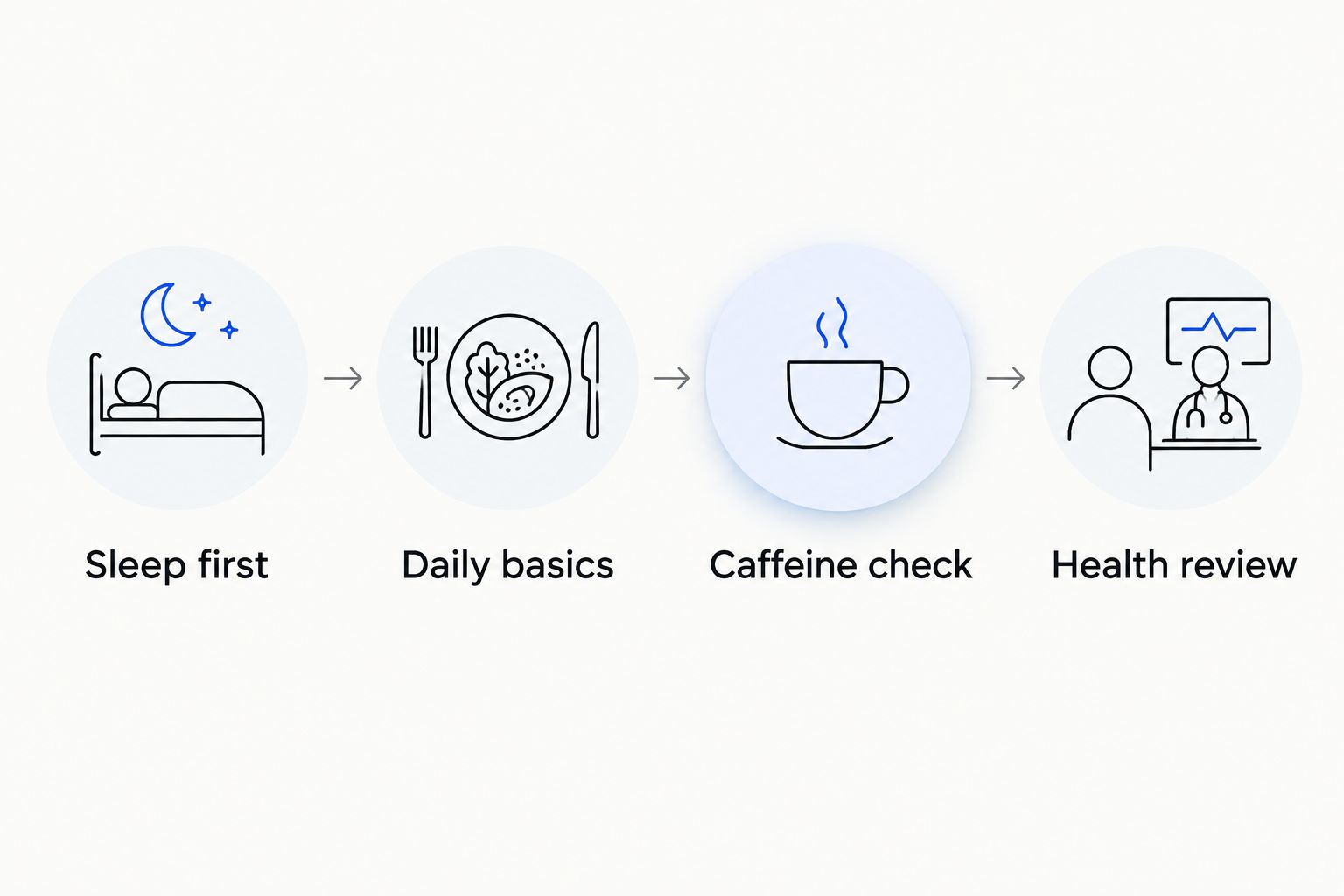
These checks are not a test you must pass before asking for help. If fatigue is disrupting your day, bring that concern to a qualified health professional even when your routine looks reasonable.
Read the label before building a routine
A label-first comparison protects you from treating different preparations as equivalent. Review the actual container information before following advice based on an ingredient name alone.
- Serving information: Separate the amount per capsule from the amount per serving. Follow the product's directions rather than importing a dose from another formula.
- Preparation details: Identify whether the label describes a powder, extract, or blend. Do not assume equal milligram amounts mean equivalent products.
- Other ingredients: Look for caffeine, overlapping botanicals, allergens, and ingredients already present in your routine.
- Warnings: Read the cautions before deciding when to take the product. A suggested routine is not a substitute for a medication review.
- Quality evidence: Verify any testing claim for the specific product. “Professional-grade” alone does not tell you which tests were performed.
Write down the exact product name and keep a photo of its Supplement Facts panel. That makes a conversation with your pharmacist or clinician more useful than describing it as “something natural for energy.”
Make changes you can evaluate
Start with a clear everyday goal, such as getting through your usual afternoon tasks without feeling unusually drained. Keep that goal separate from wearable scores or a single energetic morning. Neither establishes that a supplement caused an improvement.
Avoid starting several new supplements together. If your routine changes all at once, identifying what helped—or what caused an unwanted effect—becomes difficult. Keep a simple note of sleep, caffeine, the product used, and how you felt.
Do not increase a dose because the first few servings did not produce a noticeable lift. There is no universal adaptogen timeline, and more is not a substitute for a suitable ingredient. Stop using a product and seek advice if you develop concerning symptoms.
Which adaptogen supplement for energy should you choose?
For an undecided reader in 2026, the default is a label and health review—not an automatic purchase. Choose the ashwagandha route if that botanical fits your informed goal; discuss rhodiola or Asian ginseng only with their evidence limits and safety considerations in view.
TruNutra Ashwagandha is the brand option to review for an ashwagandha-focused daily routine, not a demonstrated solution for unexplained fatigue. If you cannot explain what you want the product to do, pause before adding it.
FAQ
What's the best adaptogen supplement for energy?
No adaptogen supplement for energy is proven best for everyone. Ashwagandha, rhodiola, and Asian ginseng have different research profiles, and the right decision depends on your concern, medications, and the specific product.
Is ashwagandha better than rhodiola for afternoon tiredness?
There is not enough evidence to declare ashwagandha better than rhodiola for afternoon tiredness. Review sleep, meals, caffeine, and the pattern of fatigue before choosing either botanical.
Will an adaptogen give me energy right away?
An adaptogen is not a reliable immediate energy boost. Do not assume that a product will work like caffeine or make you safe to drive when you feel sleepy.
Can I take an adaptogen with coffee?
Check the exact ingredients and your health circumstances before combining an adaptogen with coffee. A pharmacist or qualified clinician can review medications, added caffeine, sleep effects, and other concerns.
Can ashwagandha make me sleepy instead of energized?
Yes, ashwagandha can cause drowsiness. Follow the product warnings and avoid driving or other activities requiring alertness if you feel sleepy.
Who should check with a professional before taking adaptogens?
Anyone taking medication, managing a health condition, pregnant, or breastfeeding should seek product-specific advice before taking adaptogens. Safety differs by botanical; a natural origin does not establish suitability.
How long should I try an adaptogen before switching?
There is no universal trial period for adaptogens. Follow the label, agree on an evaluation plan with a qualified professional when appropriate, and do not wait through concerning side effects.
One last thing
“Adaptogen” does not tell you whether a product will feel calming, stimulating, or unnoticeable. Before buying, write one sentence describing your goal and one question about the label. If you cannot answer that question from the product information, get clarification rather than filling the gap with an assumption.