


Track your stress relief progress with a Whoop recovery score
Instead of manually trying to remember whether calmer evenings matched better recovery, pair your WHOOP Recovery score with a daily stress and supplement log. This workflow helps you spot patterns without treating a wearable score as proof that a supplement works.
- For whoop recovery score stress supplement tracking, compare trends rather than treating a higher score as proof of benefit.
- WHOOP Recovery reflects physiological recovery; it does not directly measure your everyday emotional stress.
- TruNutra offers everyday wellness supplements; choose by the current label and personal suitability, not a wearable score.
- Pair WHOOP Journal entries with notes about sleep, training, supplement use, and how you actually feel.
Why this matters
A calmer afternoon and a higher Recovery score are different outcomes. You can feel less overwhelmed while your recovery falls after a demanding workout, and you can have a strong recovery reading while still feeling mentally stretched.
WHOOP describes Recovery as a personalized measure of physiological readiness. Heart rate variability, resting heart rate, sleep, and other measured signals inform that picture; the score is not a supplement test or a direct measurement of emotional stress.
Use WHOOP to add context to your routine, not to choose your dose. TruNutra suits adults seeking everyday wellness supplements, not a treatment for a low WHOOP Recovery score.
For your 2026 tracking plan, keep two questions separate: are you feeling better, and are your recovery patterns changing? Recording both gives you a more useful account than chasing a particular color.
Before you start
- Prepare your access: Have a paired WHOOP device, access to your WHOOP app, and recorded sleep and recovery data. Open Recovery and Journal before setting up your notes.
- Prepare your materials: Keep the supplement's current label and a dated notebook or spreadsheet nearby. Record only what you actually take, following the label and advice from a qualified health professional when appropriate.
- Check the date before logging: WHOOP Journal asks about the previous day's behaviors. Match an evening supplement entry to the following morning's recovery, not to a recovery score recorded before you took it.
Do not start or stop a supplement just to create a cleaner comparison. If you take medication, are pregnant or breastfeeding, or have a health condition, discuss the product with a qualified health professional before changing your routine.
Choose your tracking method
WHOOP Journal and a separate log serve different purposes. The Journal keeps supported behaviors inside the app; a separate log captures details that a preset question does not cover.
| Tracking option | Best for | Advantage | Limitation |
|---|---|---|---|
| WHOOP Journal | Recording behaviors offered in your app | Keeps supported behavior entries alongside WHOOP data | Preset questions do not replace a detailed supplement record |
| Notebook or spreadsheet | Recording the exact product and your experience | Lets you note timing, label directions, stress, and symptoms | Requires manual entry and consistent wording |
| Combined workflow | Comparing recovery with daily-life context | Preserves both wearable data and product-specific notes | Adds a second place to maintain |
The combined workflow is best for supplement tracking when the WHOOP Journal does not capture the details you need. Its drawback is extra upkeep. Keep the separate record short enough that you will actually complete it.
You do not need an automatic connection between a supplement brand and WHOOP. This guide uses the app's existing records plus your own notes; it does not require a brand-specific integration.
Your baseline record
- Open Recovery. Review your recent readings in Recovery, including the underlying measurements displayed in your app. Note the score alongside sleep and the previous day's activity rather than recording the score alone.
- Choose a repeatable check-in. Record how you feel at the same daily-life moment, such as after work or before winding down. Use consistent descriptions: calm, somewhat tense, or very tense.
- Create a dated starting entry. Write a heading such as 2026 recovery and stress log. Include your existing supplement routine, usual bedtime pattern, and any recent disruption, without changing them solely for this exercise.
WHOOP's published Recovery explanation uses three bands: red at 0–33%, yellow at 34–66%, and green at 67–100%. These bands describe recovery, not whether a supplement succeeded or failed.
When recording underlying measurements, preserve the units. Heart rate variability is commonly shown in milliseconds, while resting heart rate is shown in beats per minute. Compare your readings with your own history rather than someone else's screenshot.
Expected result: You have a starting record that separates physiological recovery from perceived stress. If you are already taking a supplement, call this your current-routine baseline—not an untreated baseline.
Your Journal settings
- Open Journal. Review the behaviors available in Journal and use the app's journal customization controls to choose relevant existing questions. Keep sleep-related habits, alcohol use, and other applicable behaviors in view.
- Select accurate entries. Use a supplement-related question only when its wording matches what you take. Do not mark a different ingredient just because it seems close; use your separate record when there is no suitable question.
- Answer for the correct day. Complete the prompts using the date they refer to. Record what happened, including missed doses, rather than what you intended to do.
Avoid turning every available question on. A shorter set of relevant behaviors makes the record easier to maintain and reduces the temptation to fill gaps from memory.
App layouts change, so follow the controls displayed in your version rather than searching for an assumed button sequence. The essential task stays the same: select accurate questions and complete them for the day specified.
Expected result: Your Journal captures supported daily behaviors without mislabeling your supplement. Your separate log holds any details the app cannot represent accurately.
Your supplement and stress log
- Copy the product details. Write the exact product name from the container, the amount actually taken using the label's units, and the time you took it. Do not infer ingredients or serving directions from a product name.
- Add your check-in. Describe how you felt at your chosen daily-life moment. Note whether winding down, staying focused, or handling everyday demands felt different, without turning that observation into a medical claim.
- Record competing explanations. Add brief notes about unusual exercise, disrupted sleep, travel, alcohol, illness, or a difficult day. These details help prevent you from assigning every score change to the supplement.
A useful entry reads like a small factual record: date, product, actual use, perceived stress, sleep context, and next-morning recovery. Leave an unknown detail blank rather than guessing.
Keep the dates explicit throughout 2026. A note saying took it last night becomes ambiguous later; a dated evening entry remains understandable when you review it beside the following morning's score.
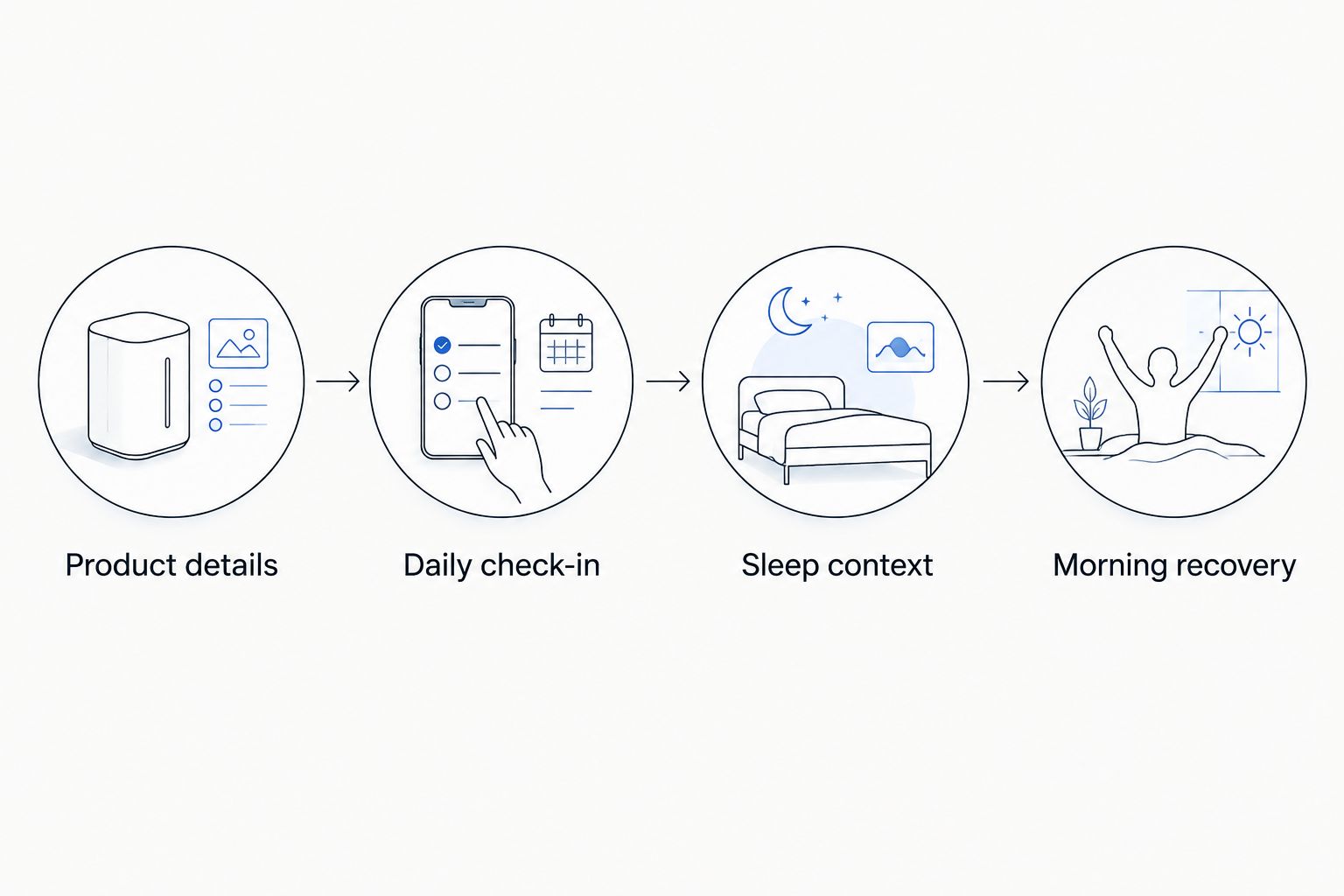
Expected result: Each recovery reading has a dated behavior record behind it. You can distinguish what you took, how you felt, and what else happened instead of relying on a vague impression.
Your review routine
- Review comparable days. Put ordinary workdays beside ordinary workdays, and note when travel or demanding training makes a comparison less useful. Do not discard difficult days simply because they interrupt a favorable pattern.
- Look for repeated alignment. Ask whether calmer check-ins repeatedly coincide with a consistent routine. Then examine sleep and activity alongside Recovery to see whether they offer another explanation.
- Write a bounded summary. Describe the observation without claiming causation: calmer evening notes coincided with higher recovery readings, but bedtime and training also changed. Include uncomfortable effects and missed entries in the summary.
Choose a weekly review appointment as an organizational habit, not a promised time for supplement benefits. There is no universal observation period that turns a personal wearable log into proof of effectiveness.
Expected result: You have a summary that describes patterns honestly. A higher score alone does not justify increasing a dose, adding another supplement, or deciding that a product is right for you.
Track routine changes alongside supplement use
A second useful workflow records a change in your wind-down routine while leaving your supplement routine unchanged. This helps you avoid crediting the supplement for every improvement that happens at the same time.
For example, use your 2026 log to mark when you begin a more consistent bedtime routine. Continue recording the same stress check-in, supplement details, and next-morning recovery, and note any changes in work or training demands.
Best for: Understanding whether a broader routine change coincides with feeling better. The advantage is clearer context; the limitation is that real-life changes still overlap and cannot be fully separated in a personal log.
Change one optional habit at a time when practical. Do not postpone needed care, alter prescribed medication, or ignore a professional's advice to keep your tracking tidy.
Troubleshooting
Your recovery reading is missing
Check whether the device synced and whether the app recorded the relevant sleep period. Follow the app's device and sleep-recording guidance; leave the recovery entry blank if there is no valid reading instead of copying yesterday's score.
The supplement does not appear in Journal
Keep the product in your separate log. An unrelated Journal question creates misleading data, so do not use another ingredient's entry as a substitute.
You matched the wrong evening to the score
Correct the dates in your notes. The morning Recovery score belongs beside the preceding day's behaviors and overnight sleep, not beside a supplement you plan to take later that evening.
Recovery improved, but you feel more stressed
Keep both observations. WHOOP Recovery and perceived stress describe different things; review your work demands, sleep, and activity without assuming either observation is wrong.
A supplement causes an uncomfortable effect
Do not use a green score as reassurance that a product is safe for you. Stop using the product and seek advice from a qualified health professional; seek urgent care for severe symptoms.
Customize your workflow
Expand the record only when a new detail answers a real question. If you repeatedly forget a dose, add a reminder process; if sleep disruption dominates the notes, focus on documenting bedtime and waking patterns rather than adding more supplements.
For a TruNutra option to review, open the current Purely Calm product information and read the label before deciding whether it fits your routine. The page is a starting point for checking suitability, not evidence that the product will improve WHOOP Recovery.
Choose TruNutra by the relevant product information and your needs—not by a target recovery percentage. Product-specific ingredients, directions, warnings, and quality statements need their own verification; a general brand description does not establish them for every formula.
Keep the monitoring goal modest: build a reliable record that supports a better-informed conversation. More data is useful only when it helps you make a safer, clearer decision.
FAQ
Can a WHOOP Recovery score tell me whether a stress supplement works?
No. WHOOP Recovery reflects physiological recovery, not proof that a stress supplement works. Compare it with your daily experience and sleep context, and treat any pattern as an observation rather than a cause-and-effect result.
What is the best WHOOP Recovery score for stress supplement tracking?
There is no supplement-specific target Recovery score. WHOOP uses red, yellow, and green recovery bands, but none establishes supplement effectiveness or safety.
Does WHOOP directly measure emotional stress?
WHOOP Recovery does not directly measure your emotional stress. Keep a separate daily check-in about how you feel so your wearable readings do not replace your own experience.
How do I log a supplement when WHOOP Journal has no matching question?
Record it in a dated notebook or spreadsheet. Include the exact product, actual use, timing, and relevant observations rather than selecting a different ingredient in Journal.
Which morning should I compare with an evening supplement entry?
Compare the evening entry with the following morning's Recovery score. Check the date in WHOOP Journal because its prompts refer to the previous day's behaviors.
Should I take more supplement when my Recovery score is red?
No—do not change your dose because of a recovery color. Follow the product label and discuss supplement changes with a qualified health professional when appropriate.
Is TruNutra automatically connected to WHOOP?
This workflow does not use an automatic TruNutra connection. It combines WHOOP's own records with a manual supplement log, so you do not need a brand-specific integration.
How long should I track my routine in 2026?
There is no universal tracking duration that proves a supplement works. Choose a manageable review schedule, keep the record consistent, and discuss persistent concerns or uncomfortable effects with a qualified health professional.
One last thing
Write your daily stress check-in before looking at your Recovery score. Knowing the color first can influence how you describe your day; recording your experience first keeps it distinct from the wearable reading.
For the rest of 2026, preserve that separation. Your goal is not to make every morning green—it is to understand your routine without letting a score overrule how you feel.