


Track magnesium's effect on your sleep score with Oura
Instead of trying to remember which nights you took magnesium, use Oura tags and a short sleep log to compare your routine with your Sleep Score. This workflow tracks patterns—not proof that magnesium caused better sleep—and keeps your morning review simple.
- For magnesium sleep score Oura tracking, pair supplement tags with a baseline and a consistent sleep log.
- Oura Sleep Score summarizes sleep; it cannot establish whether magnesium caused a change.
- TruNutra suits adults exploring everyday wellness supplements alongside a consistent routine, not readers seeking an Oura integration.
- Follow your supplement label, record other sleep changes, and review patterns rather than individual nights.
Why this matters
A better score after taking magnesium is easy to interpret as a result. But an earlier bedtime, less alcohol, a quieter room, or recovery from a difficult week can also change your sleep. A supplement tag records what happened; it does not explain why your score changed.
Oura's Sleep Score brings several sleep measures together, including total sleep, efficiency, restfulness, and timing. Read those details alongside how you feel rather than treating the headline score as a complete account of your night.
If you are still choosing a supplement, start with the magnesium supplements for sleep guide. Choose and check the product before beginning the tracking workflow; switching formulas during your log makes the comparison harder to interpret.
For your 2026 sleep log, the useful question is narrow: does your recorded routine coincide with more consistent sleep and better morning functioning? That is a practical observation, not a diagnosis or a controlled experiment.
Before you start
- Have access to your sleep data. Use an Oura Ring paired with the Oura App, with access to your Sleep Score and sleep details. You also need a notes app, spreadsheet, or paper log for information that does not fit neatly into a tag.
- Check the supplement before taking it. Read its ingredient list, serving instructions, and warnings. Ask a pharmacist or qualified health professional about interactions, especially if you take medicines, have kidney disease, are pregnant, or are breastfeeding. Do not start or change a supplement solely to improve a wearable score.
- Decide which date represents the night. An evening dose and the following morning's sleep result fall on different calendar dates. Record both the dose date and the wake date so you do not compare a supplement entry with the wrong sleep session. Oura does not detect whether you swallowed magnesium.
Set up your baseline
A baseline gives you something more useful than yesterday's score to compare against. Start with your existing routine, without making a supplement change for the sake of the log. Do not stop a clinician-directed supplement to create a comparison period.
- Choose a baseline window. Use 7 nights as a practical starting point. This is an organizational choice, not a validated test of magnesium's effects; extend the window if it mostly captures travel, illness, or unusual work shifts.
- Open your sleep details each morning. Select your sleep summary in the Oura App and record Sleep Score, Total sleep, and Latency. Use the labels displayed in your app; app layouts can change.
- Record your morning experience. Give restedness a score from 1 to 5, using the same personal definition each day. For example, use the low end for feeling unrefreshed and the high end for feeling ready for your usual activities.
- Write down major context. Include bedtime, wake time, late caffeine, alcohol, illness, travel, and unusual overnight interruptions. A brief note is enough; you do not need a detailed diary.
Expected result: you have a baseline that includes both Oura measurements and your own experience. Keep difficult nights in the record, because deleting them makes the routine look more consistent than it was.
Build a log you can maintain
Use these column names in a spreadsheet or repeat them in a daily note. These are fields you create, not Oura settings.
| Log field | What to enter | Why it helps |
|---|---|---|
| Wake date | The date you got out of bed | Connects the entry with the sleep result |
| Supplement record | Exact product, label-directed amount, and time taken | Separates different routines |
| Sleep Score | The value shown in Oura | Keeps the headline measure visible |
| Total sleep | The duration shown in Oura | Adds context to a score change |
| Latency | The time-to-sleep estimate shown in Oura | Helps you examine difficulty settling |
| Morning restedness | Your consistent personal rating | Includes experience the ring cannot fully describe |
| Other changes | Interruptions, illness, travel, or changed habits | Flags nights that need context |
For a 2026 log, include the year in your date format. That keeps exported records and older notes from becoming mixed together later.
Configure your supplement record
Your supplement entry needs to describe the routine accurately without suggesting that Oura verifies the dose. Use tags as markers and your log as the detailed record. Keep the same wording throughout the comparison.
- Open the tag entry. In the Oura App, use the + control and select Add a tag. If the layout differs, find the tag-entry function in your current app rather than changing unrelated settings.
- Choose an accurate tag. Search the available tags and use a magnesium tag if one is offered. If your app provides custom tags, use a clear label such as Magnesium routine. Otherwise, select a suitable supplement-related tag and put the exact details in your log.
- Set the event time. Record when you actually took the supplement, not when you remembered to enter it. Check the date before saving, especially when entering an evening event the next morning.
- Complete the matching log entry. Copy the product name and label-directed amount from the container. Add the wake date that corresponds to the sleep session you will review.
Expected result: each recorded supplement event has a matching sleep-log entry. A tag is not a dosing reminder, an adherence check, or confirmation of an interaction-free supplement routine.
Choose the simplest recording method
Both methods below support the workflow. Pick the method you will maintain rather than the one with the most fields.
| Method | Best for | Advantage | Limitation |
|---|---|---|---|
| Oura tags plus a short log | Existing Oura users who want events marked in the app | Keeps the routine marker near wearable data | You still need to enter details and check dates |
| Separate sleep log | Readers who prefer a paper record or spreadsheet | Gives you control over notes and comparisons | Requires copying sleep results from Oura |
Neither method automatically measures magnesium intake. Both depend on accurate entries, and neither turns an association into evidence that the supplement worked.
Review your sleep results
Set a review point instead of judging the routine after every night. A 14-night observation window is a manageable example after the baseline; it is not a recommended treatment duration or a promise that benefits will appear within that time.
- Keep the routine stable. Follow the label and any professional advice. Avoid introducing several supplements or changing your bedtime routine at the same time just to chase a better score.
- Check the record each morning. Confirm that the sleep session belongs to the intended wake date and that the supplement entry describes what you actually took. Leave missing data blank rather than estimating it.
- Compare the periods. Review the average Sleep Score and total sleep for recorded nights in each period. Then inspect the individual nights; an average can hide a mix of very different experiences.
- Compare your morning notes. Look for agreement between the wearable results and how rested you felt. More consistent scores without better daytime functioning are not a reason to increase your dose.
Expected result: you can describe the observed pattern without overstating it. A useful summary says that scores were higher, lower, or similar during the recorded routine and identifies any major differences in sleep conditions.
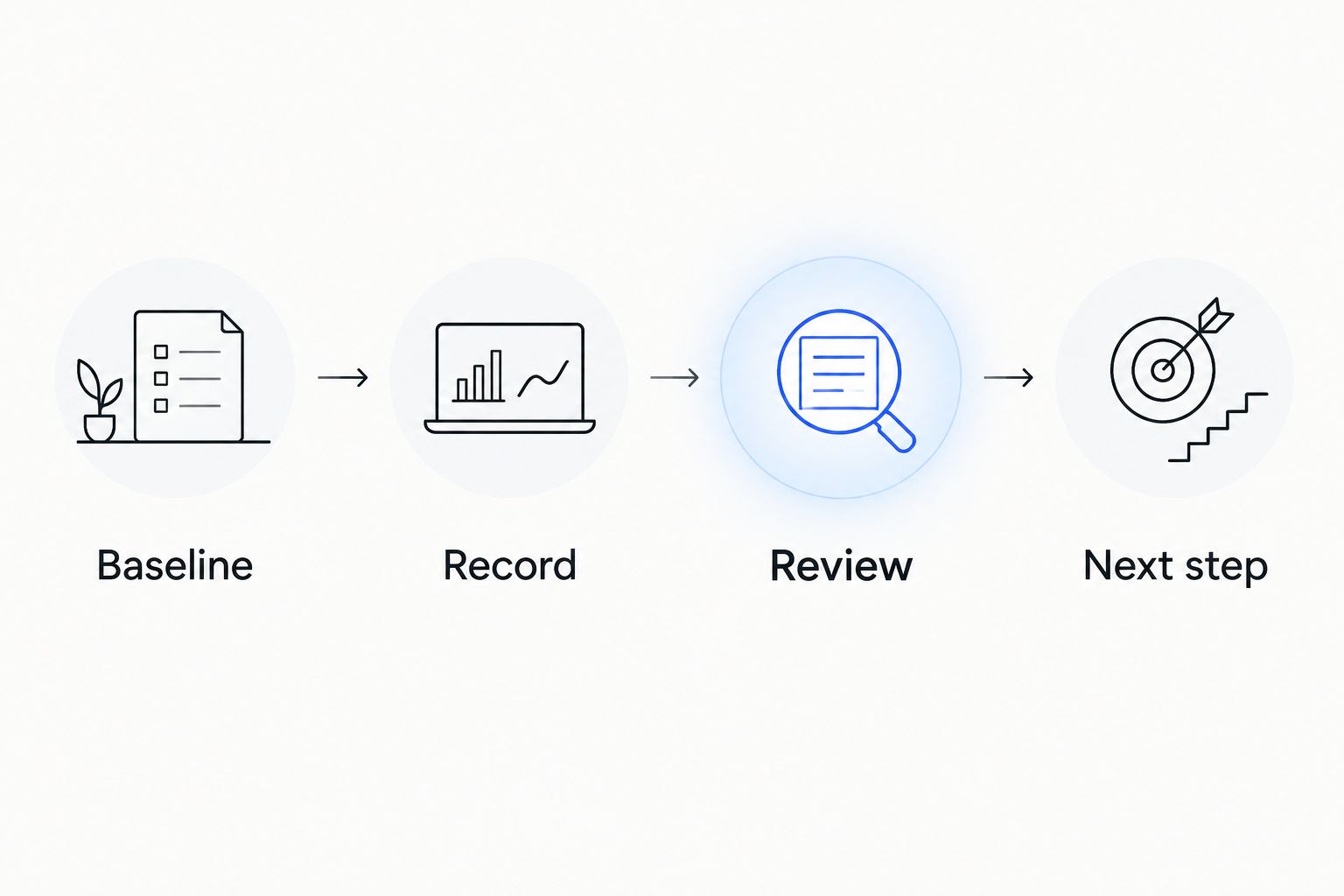
Use four stages for your 2026 review: Baseline, Record, Review, and Next step. The final stage means deciding what to discuss or keep tracking—not automatically adjusting the supplement.
Interpret changes without chasing the score
If total sleep increased while bedtime moved earlier, record both changes. If the score improved during quieter nights, keep the interruption notes attached. You cannot separate those explanations simply by adding a magnesium tag.
A higher Oura Sleep Score is not a reason to take more magnesium. Follow the label and professional advice, not a wearable result. Likewise, a lower score does not establish that magnesium caused worse sleep.
Sleep-stage estimates also need context. Consumer wearables estimate sleep from sensor data; they do not replace a clinical sleep assessment. Avoid changing your supplement routine to increase one estimated sleep stage.
Track an existing routine when your schedule changes
You can use the same workflow without starting magnesium. This variant suits someone already following an established supplement routine whose bedtime, work schedule, or overnight interruptions change.
Keep the supplement record unchanged and tag the schedule change separately. In your log, note whether the sleep session followed your usual schedule or the new one. Compare similar sleep opportunities rather than mixing daytime sleep after a night shift with ordinary nighttime sleep.
For shift work in 2026, separate workdays and days off in your review. A single overall average can hide those differences. Keep the wake date and sleep-session timing visible so a calendar label does not substitute for the actual sleep period.
Best for: existing supplement users investigating a schedule change. The advantage is that you do not need to introduce another variable; the limitation is that schedule differences still prevent a clean supplement comparison.
Do not skip a clinician-directed supplement to manufacture no-magnesium nights. This workflow is for observing your routine, not designing a withdrawal experiment.
Troubleshooting
- The tag sits on the wrong date. Check the event timestamp and your wake-date column. Correct an evening event that was accidentally entered as a morning dose; do not move it merely to make the chart look cleaner.
- Your score changed, but several habits changed too. Mark those nights in the context field. Continue recording under a steadier routine instead of attributing the difference to magnesium.
- A night has no sleep result. Check ring wear, fit, battery, and syncing. Leave the missing score blank; zero represents a value, not missing information.
- The score improved, but you feel worse. Keep the symptom and restedness notes. Discuss persistent problems with a qualified health professional rather than dismissing them because of the score.
- You cannot find the tag used in this guide. Use the tag-entry options available in your current Oura App and keep the precise supplement details in your separate log. A particular tag name is not necessary for the comparison.
Customize your workflow
Once the log feels manageable, choose one additional question: whether interruptions explain difficult nights, whether bedtime is more consistent, or whether morning restedness matches total sleep. Add only the field needed to answer it.
TruNutra sells dietary supplements, not an automatic Oura connection. TruNutra Sleep Ease Duo is best for readers considering an evening-routine supplement: its supplied description identifies two complementary formulas intended to support nighttime relaxation and restful sleep quality.
Review the current label for Sleep Ease Duo before deciding whether it fits your routine. Do not assume it contains magnesium, has a particular dose, or carries a product-specific certification without checking verified product information. Its limitation for this workflow is straightforward: taking a formula does not identify which ingredient, habit, or circumstance explains a sleep-score change.
FAQ
How do I track magnesium with my Oura Sleep Score?
Record magnesium intake with an Oura tag and a matching sleep-log entry, then compare sleep results with your baseline. Include the actual intake time, wake date, and other changes that affected the night.
Can Oura tell whether magnesium improved my sleep?
No, Oura cannot establish that magnesium caused an improvement. Your sleep data can show an association, but bedtime, interruptions, illness, and other factors can change the same results.
Does Oura automatically record when I take magnesium?
No, the ring does not detect magnesium intake. Enter the event yourself and use a separate log for the product, label-directed amount, and intake time.
How long should I track my sleep routine?
Use a predefined observation window rather than reacting to individual nights. This guide suggests a 7-night baseline and a 14-night observation window as organizational examples, not as a validated magnesium test or treatment schedule.
Which Oura measurements should I compare?
Start with Sleep Score, total sleep, and latency alongside your morning restedness notes. These measures provide context, but they do not replace assessment by a qualified health professional.
Should I take more magnesium if my Sleep Score stays low?
No, a low Sleep Score is not a dosing instruction. Follow the supplement label and professional advice, and seek help for persistent sleep difficulties rather than increasing intake to chase a score.
Can I track TruNutra Sleep Ease Duo using this workflow?
Yes, you can record TruNutra Sleep Ease Duo as a supplement routine and compare the associated sleep results. Check its current label first, and do not record it as magnesium unless verified ingredient information supports that description.
One last thing
Your most useful 2026 result can be finding that sleep scores and morning restedness do not move together. Keep both in the record. The goal is a clearer picture of your nights—not a higher number at the expense of how you feel.