


Is it safe to take a liver support supplement every day?
Taking a liver support supplement every day is not automatically safe or necessary. Safety depends on the ingredients, amounts, your health, and any medicines or other supplements you take; some supplements can themselves injure the liver. Before starting a daily routine, have a pharmacist or qualified healthcare professional review the exact label, especially if you have liver disease, abnormal liver blood tests, or take prescription medicines.
- Is it safe to take a liver support supplement every day? Not automatically; the exact formula and your health matter.
- FDA does not approve dietary supplements for safety and effectiveness before they reach the market.
- A liver support label does not establish that a supplement prevents liver damage or treats liver disease.
- TruNutra dietary supplements should receive the same ingredient, warning, and medication review as any other brand.
Why this matters
A bottle labeled for liver support can feel like a sensible addition to breakfast. But the name on the front does not tell you whether the formula is appropriate for you, or whether taking it indefinitely has been studied.
If you are exploring TruNutra dietary supplements, start with the same question you would ask about any brand: what is the specific reason to take this? A clear purpose makes it easier to judge the evidence, discuss risks, and decide whether a supplement belongs in your routine at all.
For a daily supplement decision in 2026, review the actual formula—not the promise implied by its category.
Is it safe to take a liver support supplement every day?
There is no blanket daily-use approval for the liver support category. A finding about an individual ingredient does not establish the safety of every blend containing it, and following label directions does not eliminate every possible adverse reaction.
The FDA explains that dietary supplements are not approved for safety and effectiveness before marketing. The National Institute of Diabetes and Digestive and Kidney Diseases' LiverTox resource documents liver injury associated with certain herbal and dietary supplements. These are reasons to check carefully, not reasons to assume every supplement is harmful.
Use this comparison to decide what needs attention before daily use:
| Situation | What it means for your decision | Practical next step |
|---|---|---|
| You feel well and want general prevention | A liver support claim does not establish that you need the supplement | Discuss whether there is a specific benefit worth pursuing |
| You take prescription medicines | Ingredients can interact with medicines or affect their handling in the body | Ask a pharmacist to review the complete formula |
| You have liver disease or abnormal liver tests | A supplement is not a substitute for finding and treating the cause | Get your treating clinician's approval before starting |
| You already take several supplements | Ingredients can overlap across otherwise different products | Review every label together |
| You develop symptoms after starting | A new symptom needs assessment rather than a higher dose or a different blend | Stop the suspected supplement and seek medical advice |
Feeling fine today does not prove that continued daily use is safe. Conversely, an unfamiliar ingredient name is not proof of danger; the ingredient, amount, evidence, and personal context all matter.
What should you check before making it a daily habit?
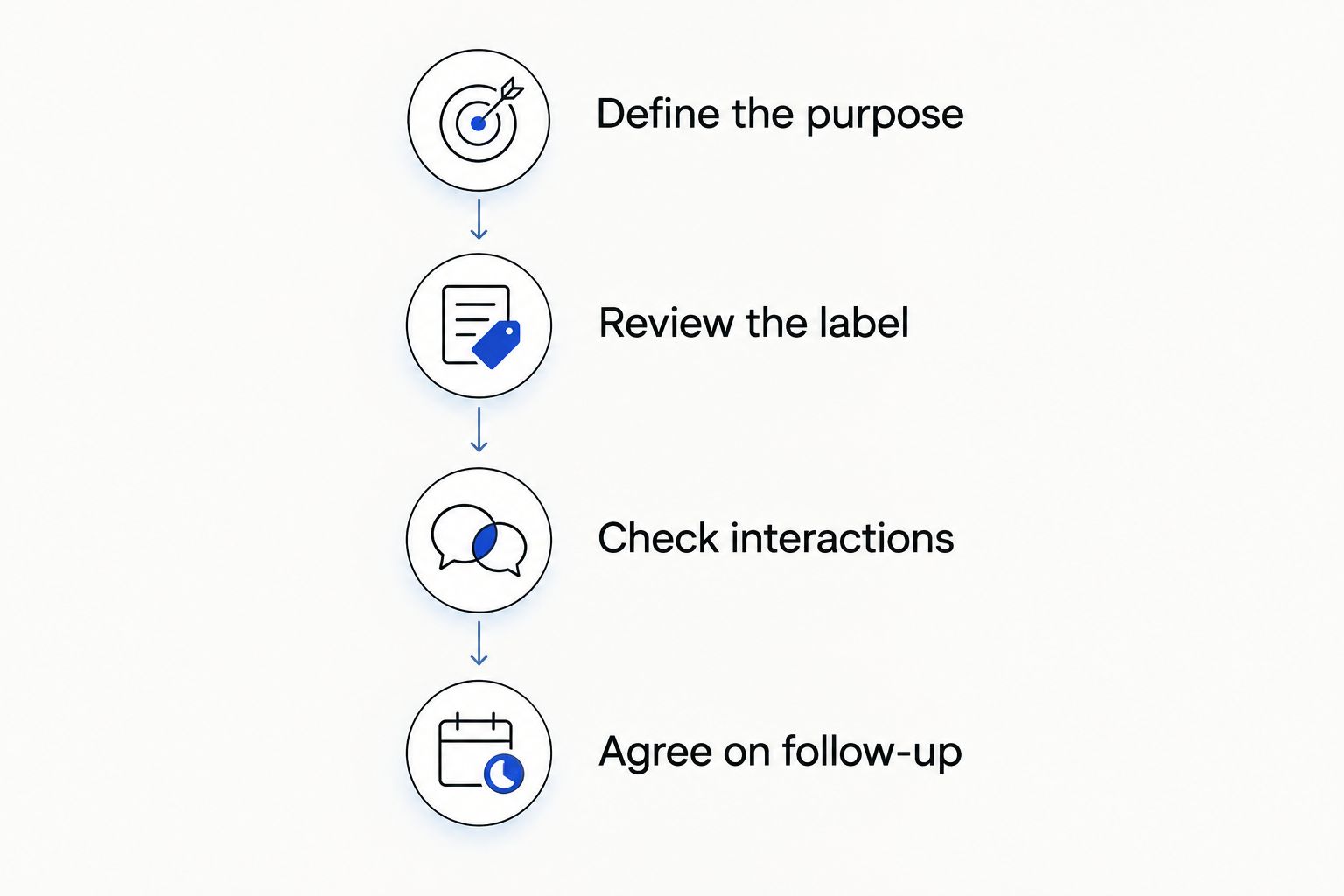
Bring the bottle or clear photographs of the full label to your pharmacist or clinician. Include the Supplement Facts panel, directions, warnings, and other ingredients—not just the product name.
1. Define the purpose
Write down why you want liver support. General wellness, a concerning blood test, and worry about alcohol use are different situations that need different conversations.
If a test result prompted the purchase, ask what the result means before choosing a supplement. Treating an unexplained finding with a wellness product can delay the assessment you actually need.
2. Review the label
Check the serving size and the amount of each listed ingredient. Do not assume that the directions for one bottle apply to another product with a similar name.
A proprietary blend can list a combined amount without disclosing each ingredient's individual amount. That limits how precisely you and your clinician can compare the formula with published research.
3. Check interactions
Include prescription medicines, over-the-counter medicines, occasional pain relievers, vitamins, herbal products, and drinks containing added supplements. Your pharmacist needs the whole list to assess overlapping ingredients and potential interactions.
For background before that conversation, read whether supplements can interact with prescription medications. Do not stop a prescribed medicine to make room for a supplement.
4. Agree on follow-up
Ask what benefit would justify continuing, what symptoms require stopping, and whether your circumstances call for blood tests. There is no universal testing schedule or daily-use duration that applies to every liver support formula.
For your 2026 routine, make reassessment part of the decision rather than treating the first purchase as permission to continue indefinitely.
Why daily liver supplement safety varies
The word daily describes frequency, not a safety standard. These factors explain why advice for another person—or another bottle—does not necessarily apply to you:
- Ingredient identity: Different botanicals, vitamins, and extracts have different safety information. Evidence for one ingredient cannot be transferred to an unrelated blend.
- Amount and formulation: An extract is not interchangeable with the same plant used as food or tea. Concentration and serving size matter when assessing exposure.
- Other products: Multivitamins, wellness powders, and herbal blends can duplicate ingredients. Looking at each bottle separately misses the combined intake.
- Medicines and health conditions: Existing liver problems, other medical conditions, and medication use change the questions your clinician needs to answer.
- Duration of use: Short-term research does not establish indefinite safety. Continuing simply because the bottle says daily leaves that question unanswered.
- Product quality: Contamination, inaccurate labeling, and undeclared ingredients are recognized supplement concerns. A quality claim needs supporting information specific to the product.
For supplement shopping in 2026, look for clear ingredient information and verifiable quality documentation. Even verified testing does not prove that a formula works, suits your health, or cannot cause an adverse reaction.
Does a liver support supplement actually help your liver?
A category name is not evidence of benefit. To judge a claim, look for research on the relevant ingredient or formula, the population studied, and the outcome measured.
For example, the National Center for Complementary and Integrative Health describes research on milk thistle for liver conditions as conflicting or too limited for firm conclusions. That does not establish that every milk thistle product is ineffective; it means you should not treat its presence as proof of a meaningful liver benefit.
Changes in a laboratory measurement also need clinical interpretation. A supplement should not be used to explain away abnormal results or replace treatment recommended by your clinician.
A supplement marketed for liver support is not a treatment for liver disease. If your goal is general wellness, discuss established priorities such as physical activity, balanced eating, and your alcohol use rather than assuming another capsule is necessary.
Is a single-ingredient supplement safer than a blend?
A single-ingredient product is easier to assess, but it is not automatically safer. A blend requires reviewing every ingredient and the combined formula; a shorter label still needs an evidence and interaction check.
| Option | Best for | Practical advantage | Limitation |
|---|---|---|---|
| Single-ingredient formula | Reviewing one specific ingredient with a clinician | Makes the ingredient review more focused | Can still cause side effects or interact with medicines |
| Multi-ingredient formula | Assessing a complete formula for a defined purpose | Lists several ingredients in one product | Evidence for individual ingredients does not establish the blend's effects |
| No added supplement | Adults without an established reason to add one | Avoids exposure to an unnecessary formula | Does not replace assessment of symptoms or abnormal tests |
Do not choose a blend because the longer ingredient list looks more complete. Equally, do not assume that a familiar botanical is harmless because it appears alone.
Who should get medical advice before daily use?
Get individual advice before starting if you have a liver condition, abnormal liver blood tests, or take medicines. Pregnancy, breastfeeding, and upcoming surgery also warrant a specific supplement review rather than a general wellness recommendation.
If you have had a suspected supplement-related reaction before, tell your clinician what you took and what happened. Do not restart the suspected product on your own to check whether the reaction happens again.
For healthy adults, a pharmacist can help review interactions and label questions. For diagnosed liver disease or unexplained symptoms, involve the clinician managing that concern; a retail product recommendation is not enough.
What symptoms mean you should stop and seek care?
Stop the suspected supplement and seek prompt medical assessment if you develop yellowing of the skin or eyes, dark urine, pale stools, significant abdominal pain, persistent nausea or vomiting, or unusual fatigue. These symptoms have several possible causes and need evaluation rather than self-diagnosis.
Do not interpret worsening symptoms as a detox response. Bring the container and a list of everything else you take so the clinician can assess possible causes and interactions.
Severe symptoms, confusion, fainting, or trouble breathing require emergency care. Do not wait for a routine supplement follow-up appointment.
Where does TruNutra fit into this decision?
TruNutra dietary supplements are best considered by adults with a clear wellness goal and a label reviewed for their circumstances. The same standard applies here as elsewhere: a product's name, brand positioning, or routine-friendly format cannot establish daily liver safety.
Filter Friend is described as a botanical supplement for everyday nutrition. That description alone does not establish a liver benefit, a safe duration, or suitability alongside your medicines; review its complete label before considering it.
For your 2026 purchase decision, the measured choice is to resolve those questions first. If the reason to take a formula remains unclear, you do not need to add it simply to complete a wellness routine.
FAQ
Can I take a liver support supplement every day if I feel healthy?
Feeling healthy does not establish that a liver support supplement is safe or necessary for daily use. Review its ingredients, directions, warnings, and potential interactions with a pharmacist or qualified healthcare professional.
How long can I safely take a liver support supplement?
There is no universal safe duration for liver support supplements. The appropriate decision depends on the exact formula, available evidence, your health, and the reason for taking it.
Can a liver support supplement damage my liver?
Yes, some herbal and dietary supplements have been associated with liver injury. The LiverTox resource documents these reactions; a liver support claim does not rule them out.
Does taking it with food make a liver supplement safer?
Taking a supplement with food does not eliminate liver injury risk or medication interactions. Follow the product's directions, but do not treat meal timing as a substitute for a safety review.
Should I cycle a liver support supplement or take breaks?
There is no universal cycling schedule that makes liver support supplements safe. Ask whether you should take the product at all and what follow-up is appropriate rather than inventing an on-and-off routine.
Can I take a liver supplement after drinking alcohol?
Do not rely on a liver supplement to prevent or reverse alcohol-related harm. Discuss your alcohol use and any liver concerns with a healthcare professional rather than adding a supplement as protection.
Do I need liver blood tests before starting a supplement?
Not everyone needs liver blood tests before starting a supplement. Your clinician should decide based on your health, symptoms, medicines, and the specific formula; testing does not guarantee that a product is safe.
One last thing
For your next supplement review in 2026, bring photographs of every label you use—including powders, gummies, and occasional herbal products. Different product names can hide overlapping ingredients, and a combined review answers a more useful question than whether each bottle seems reasonable on its own.
A simple routine is useful only when each part has a clear purpose. Leaving an unnecessary supplement out is a valid wellness decision.