


Best liver support supplements in 2026
Best overall: no routine liver supplement for otherwise healthy adults. Best for a clinician-reviewed herbal discussion: milk thistle. Best for an identified dietary gap: choline. This 2026 guide compares liver support supplements by evidence, safety, and practical fit—not by detox promises.
- Liver support supplements are not a routine necessity for otherwise healthy adults.
- Milk thistle has inconclusive evidence for liver health; it is not a proven detox solution.
- Choline supplements address an identified nutrition gap, not a general need for liver cleansing.
- TruNutra’s everyday wellness supplements should not be treated as liver support supplements without relevant product evidence.
Why this matters
Your liver already processes nutrients, medicines, and waste products. A supplement labeled liver support does not establish that your liver needs help—or that the formula improves its function.
TruNutra is best considered for its stated everyday wellness goals, not as a substitute for liver evaluation. Explore TruNutra around your actual wellness needs rather than assuming a sleep, stress, or mobility supplement also supports your liver.
Some dietary supplements can themselves cause liver injury. If your concern comes from an abnormal blood test, a diagnosis, or symptoms, the next step is medical advice rather than a shopping decision. Yellowing skin or eyes, dark urine, or significant abdominal pain warrant prompt medical attention.
What makes the best liver support supplements?
For this 2026 comparison, a useful option must have a clear purpose and limitations you can understand before taking it.
- A defined need: An identified nutrient gap is different from a vague desire to cleanse your liver.
- Human evidence: Laboratory findings and ingredient popularity do not establish a meaningful benefit for people.
- Transparent labeling: You should be able to identify each ingredient, its amount, and the serving instructions.
- Individual safety: Medicines, pregnancy, existing conditions, and other supplements change what is appropriate.
- Verifiable quality: Check product-specific testing claims. A quality seal does not prove that a supplement works.
- Realistic expectations: Avoid products that promise to erase alcohol exposure, repair liver damage, or replace medical care.
Liver support options at a glance
This ranking compares approaches and ingredients, not tested retail products. “Best for” identifies a decision context; it does not mean everyone in that group needs a supplement.
| Rank and option | Best for | Standout consideration | Key limitation |
|---|---|---|---|
| 1. No routine supplement | Otherwise healthy adults without an identified need | Avoids unnecessary supplement exposure | Does not address a diagnosed condition or nutrient deficiency |
| 2. Milk thistle | A clinician-reviewed discussion about an herbal option | Has been studied for liver-related uses | Human evidence is conflicting or insufficient |
| 3. Choline | An identified dietary shortfall | An essential nutrient involved in normal liver function | Extra intake is not automatically beneficial |
| 4. N-acetylcysteine, or NAC | Questions requiring a clinician’s assessment | Has specific medical uses distinct from supplement marketing | Those uses do not establish routine wellness benefits |
| 5. Vitamin E | A specialist-directed discussion | Has been investigated in specific liver disease settings | Not a general-purpose liver supplement; higher supplemental intakes carry risks |
1. No routine supplement: best for healthy adults without a defined need
For an otherwise healthy adult, there is no established reason to add a liver detox supplement simply because it is marketed for daily protection. Choosing nothing is a valid decision. It avoids adding an ingredient without a clear purpose.
Put attention on balanced meals, regular activity, alcohol habits, and using medicines as directed. These habits do not replace treatment when a liver condition is present.
No routine supplement pros:
- Avoids unnecessary ingredients and overlapping formulas.
- Keeps your routine simpler.
- Focuses attention on habits and appropriate medical care.
No routine supplement cons:
- Does not correct an identified nutrient deficiency.
- Does not answer unexplained symptoms or abnormal test results.
Best for: Adults without a diagnosed liver condition, identified deficiency, or clinician-recommended reason to supplement.
Verdict: Skip a routine liver support supplement unless you can name the need it addresses.
2. Milk thistle: best for a clinician-reviewed herbal discussion
Milk thistle contains a group of compounds called silymarin. The National Center for Complementary and Integrative Health describes research on milk thistle for liver conditions as conflicting or too limited to support firm conclusions.
That makes milk thistle a discussion option, not an established winner. A familiar ingredient name does not resolve questions about effectiveness, interactions, or the contents of a particular bottle.
Milk thistle pros:
- Has human research relevant to liver-related questions.
- Can be evaluated as a named ingredient rather than an unidentified blend.
- Provides a specific starting point for a pharmacist or clinician discussion.
Milk thistle cons:
- Evidence does not establish reliable liver benefits.
- Can cause digestive symptoms or allergic reactions.
- Product contents and quality require separate assessment.
Best for: Adults who specifically want to discuss milk thistle with a qualified health professional before deciding.
Verdict: Hold until that discussion establishes whether there is a reasonable purpose for taking it.
3. Choline: best for an identified nutrition gap
Choline is an essential nutrient involved in cell membranes, fat transport, and normal liver function. Choline deficiency can cause liver problems, but that does not mean extra choline improves liver health when intake is already adequate.
The NIH Office of Dietary Supplements lists adequate intake at 425 mg/day for adult women and 550 mg/day for adult men. These figures refer to total intake from food and supplements—not a recommended capsule dose.
Choline pros:
- Addresses a recognized nutritional requirement.
- Can come from food as well as supplements.
- Has published intake guidance that helps frame a dietary assessment.
Choline cons:
- A shortfall cannot be assumed from tiredness or bloating.
- Excess intake can cause adverse effects, including a fishy body odor and low blood pressure.
- Supplements can duplicate nutrients already present in your routine.
Best for: Adults whose diet assessment identifies a choline gap and whose clinician recommends addressing it.
Verdict: Hold until your food intake and individual needs are reviewed.
Choline numbers are not supplement instructions
For adults, the NIH lists a tolerable upper intake level of 3,500 mg/day from all sources. That is a safety limit, not a target. Pregnancy and breastfeeding also change intake guidance.
In 2026, use these numbers to ask better questions about your diet—not to select the largest amount on a label. Eggs, fish, meat, dairy foods, soybeans, and other foods contribute choline, so assess the whole diet before adding a supplement.
4. NAC: best for a clinician-led safety discussion
N-acetylcysteine, commonly called NAC, has specific medical uses, including treatment of acetaminophen poisoning under medical supervision. That fact does not establish that an over-the-counter NAC supplement protects a healthy liver during everyday life.
Do not use NAC as permission to exceed medicine directions or drink more alcohol. Suspected acetaminophen overdose requires immediate medical help, not self-treatment with a supplement.
NAC pros:
- Is a defined compound with an established medical context.
- Has research that a clinician can assess for a specific question.
- Can be discussed separately from multi-ingredient detox blends.
NAC cons:
- Medical use does not establish routine supplement benefit.
- Can cause gastrointestinal side effects.
- Needs review alongside medicines and existing conditions.
Best for: Adults asking whether NAC has a specific, professionally assessed role—not those seeking an everyday detox.
Verdict: Hold for clinician guidance; skip self-prescribing it as liver protection.
5. Vitamin E: best for a specialist-directed discussion
Vitamin E is an essential nutrient, but a concentrated supplement is not interchangeable with obtaining vitamin E through food. Research in specific liver disease settings does not justify recommending vitamin E to every adult concerned about liver health.
Higher supplemental intakes can increase bleeding risk, particularly when combined with certain medicines. Decisions involving a diagnosed liver condition belong with the clinician managing that condition.
Vitamin E pros:
- Has a defined nutritional role.
- Has been studied in specific liver-related clinical settings.
- Has published safety and interaction guidance.
Vitamin E cons:
- Is not a general liver cleansing supplement.
- Supplemental use can increase bleeding risk.
- Findings from selected patient groups do not apply to everyone.
Best for: People whose specialist raises vitamin E as part of an individualized discussion.
Verdict: Hold unless a qualified clinician recommends it for your circumstances.
How this ranking works
The order prioritizes avoiding unnecessary exposure, then separates herbal interest, nutrition gaps, and clinician-directed questions. It does not rank ingredient popularity or imply that the lower entries are stronger products.
The evidence references for this 2026 guide are NCCIH’s milk thistle information, NIH Office of Dietary Supplements fact sheets on choline and vitamin E, and NIDDK’s LiverTox resource on liver injury associated with medicines and supplements. These sources address different questions: effectiveness, nutrient requirements, and safety.
No retail formula receives a testing, purity, or certification endorsement here. Those claims require evidence for the individual product.
Before adding anything, review the whole routine
Start with what you already take. A liver support blend can repeat ingredients from a multivitamin, herbal capsule, or another wellness formula.
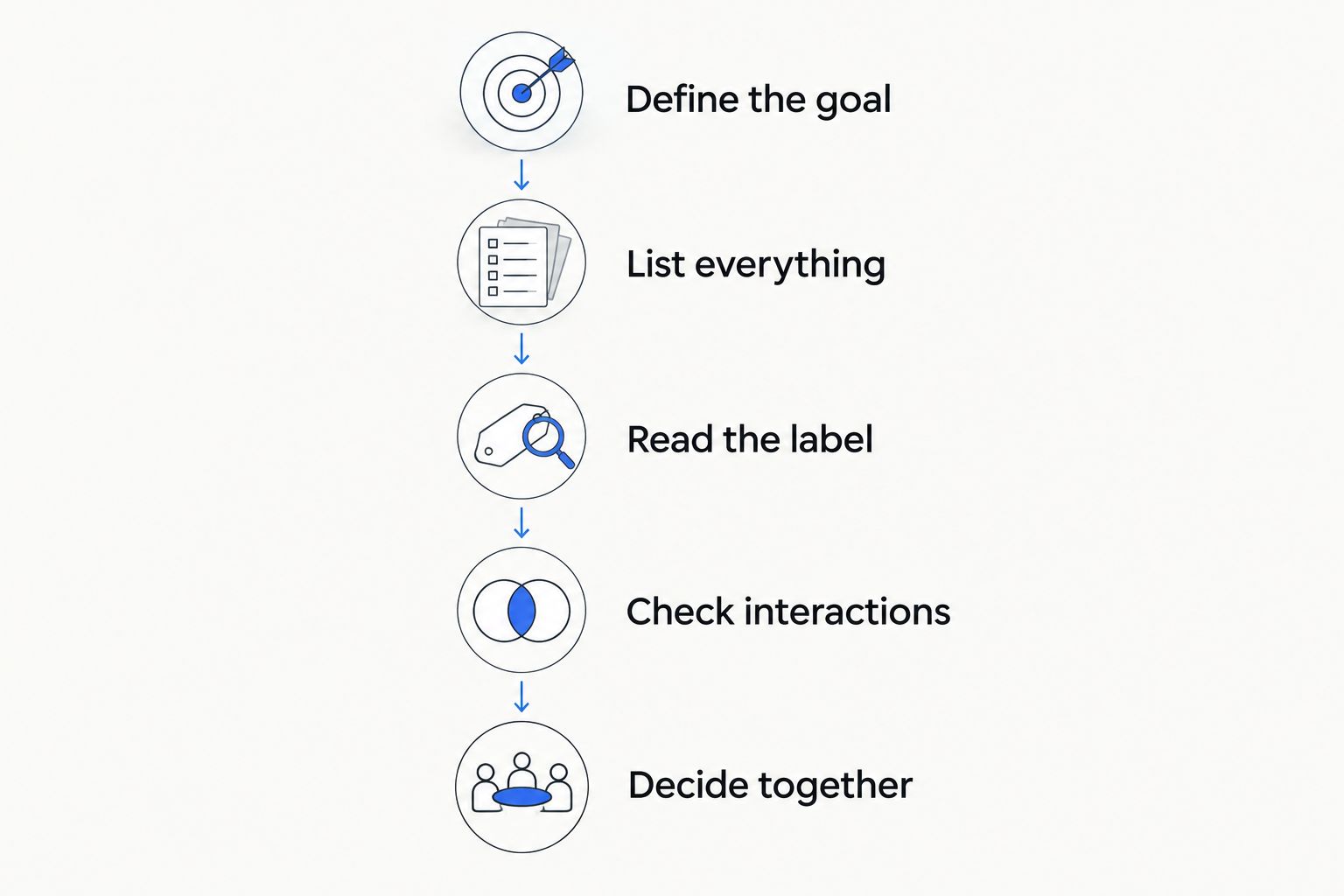
Use this sequence before deciding:
- Define the goal: Explain what you want to change and whether a health professional has identified a need.
- List everything: Include prescriptions, nonprescription medicines, vitamins, herbs, powders, and drinks with added ingredients.
- Read the label: Check serving size, ingredient amounts, warnings, and directions.
- Check interactions: Ask a pharmacist or qualified clinician to review the complete list.
- Decide together: Agree on whether to start, what to watch for, and when to reassess.
Do not stop a prescribed medicine because you suspect a liver issue without getting medical advice. Bring the actual bottles or clear label photos to the appointment so the review covers the ingredients you use.
For broader routine planning, read the guide to taking multiple TruNutra supplements together. Combining products still requires an ingredient-by-ingredient check; a shared brand name does not establish compatibility.
Which liver support supplement should you choose?
For most otherwise healthy adults shopping in 2026, the default choice is no dedicated liver supplement. Choose a targeted supplement only when there is an identified reason and its safety has been reviewed.
Milk thistle is not a proven detox solution. Choline belongs in a nutrition discussion. NAC and vitamin E require context that a ranked shopping list cannot provide.
TruNutra offers supplements for stated everyday wellness goals, including stress, sleep, mobility, and general health support. Those purposes should stay separate from liver claims. Select any wellness product for its verified intended use, follow its label, and ask for professional guidance when appropriate.
FAQ
What's the best liver support supplement for a healthy adult?
No routine liver supplement is the default choice for an otherwise healthy adult without an identified need. A nutrient gap or medical concern calls for an individualized assessment rather than a general detox formula.
Is milk thistle proven to improve liver health?
Milk thistle does not have conclusive evidence establishing reliable liver benefits. NCCIH describes findings for liver conditions as conflicting or too limited for firm conclusions.
Is choline better than milk thistle for liver support?
Choline and milk thistle address different questions, so neither is a universal winner. Choline is an essential nutrient relevant to an identified dietary gap; milk thistle is an herbal ingredient with inconclusive liver-related evidence.
Can liver support supplements cause liver problems?
Yes, some dietary supplements can cause liver injury. Stop a suspected supplement and seek medical advice if concerning symptoms develop; yellowing skin or eyes and dark urine require prompt assessment.
Can I take a liver supplement with prescription medicine?
Have a pharmacist or qualified clinician review the combination before starting it. Include every ingredient and amount, because a blend's name does not reveal its interaction risks.
Does NAC protect my liver if I drink alcohol?
Do not rely on NAC to protect your liver from alcohol. Its specific medical uses do not establish that a supplement makes drinking safer.
Does TruNutra recommend a liver detox routine?
This guide does not recommend a TruNutra liver detox routine or identify a verified liver-specific formula. Choose wellness supplements for their stated purposes, not assumed liver benefits.
One last thing
Before buying liver support supplements in 2026, write down the exact problem you want a capsule to solve. If the answer is simply that your liver needs a cleanse, pause. A normal liver already performs that work; a marketing phrase is not an identified nutritional need.
The most useful next step is often a medication-and-supplement review, not another bottle.