


How much magnesium should you take before bed?
There is no established magnesium dose specifically for taking before bed in 2026, and research does not establish magnesium as a reliable treatment for insomnia. For adults, the National Institutes of Health lists an upper limit of 350 mg per day from supplements and medications, unless a healthcare professional recommends otherwise; this is a safety limit, not a recommended sleep dose. Magnesium in food does not count toward that limit, but magnesium in other supplements, antacids, and laxatives does.
- How much magnesium should you take before bed? NIH guidance sets no bedtime dose; follow the label and professional advice.
- The adult supplemental magnesium limit is 350 mg per day, not a target for better sleep.
- Count elemental magnesium across supplements and medications; food magnesium does not count toward the supplemental limit.
- TruNutra supplements suit everyday wellness goals, not treatment of a sleep disorder.
Why this matters
A bottle's magnesium amount and your body's daily magnesium needs answer different questions. Confusing them can turn a sensible bedtime routine into an unnecessarily large supplement dose.
More magnesium is not a better sleep strategy. Before choosing a dose, separate nutritional needs from sleep claims. The guide to whether magnesium can help with insomnia covers that distinction in more detail.
You also need to account for the rest of your day. A multivitamin at breakfast, a magnesium capsule after dinner, and a magnesium-containing antacid can all contribute to the same supplemental total. Taking them at different times does not create separate daily limits.
How much magnesium should you take before bed?
No official recommended bedtime dose exists. Your decision should begin with the product's elemental magnesium amount, your other sources of supplemental magnesium, and whether supplementation is appropriate for you.
The following figures describe adult nutritional guidance, not doses proven to improve sleep:
| Guidance | Amount | What it means for bedtime use |
|---|---|---|
| Adult supplemental upper limit | 350 mg per day | Includes supplements and magnesium-containing medications; excludes food |
| Nonpregnant adult women's recommended intake | 310–320 mg per day | Total from food, beverages, and supplements, depending on age |
| Adult men's recommended intake | 400–420 mg per day | Total from food, beverages, and supplements, depending on age |
| Recommended bedtime dose | Not established | Neither the daily intake recommendation nor the upper limit is a sleep prescription |
The nutritional figures come from the NIH Office of Dietary Supplements' Magnesium Fact Sheet for Health Professionals. The sleep-evidence distinction follows the National Center for Complementary and Integrative Health's Sleep Disorders and Complementary Health Approaches. These are reference sources for this 2026 guide, not evidence of a newly established bedtime dose.
The upper limit is not a guarantee that every dose below it is appropriate. Kidney function, medicines, and stomach sensitivity matter. A healthcare professional can recommend an individualized amount, including supervised doses outside general guidance when medically appropriate.
Read elemental magnesium, not the compound weight
On a US Supplement Facts panel, the magnesium line reports the amount of magnesium itself, often called elemental magnesium. The ingredient description can also identify the form, such as magnesium citrate or magnesium oxide.
Use the magnesium amount on that panel when calculating your daily supplemental intake. Do not substitute a larger compound-weight claim from the front of the bottle.
Serving size matters just as much. The amount listed can refer to a serving containing multiple capsules rather than a single capsule. Read the serving size and directions together before deciding what you would actually take.
Nonpregnant adult women: 310–320 mg per day in total
For nonpregnant adult women, NIH guidance recommends 310 mg per day at ages 19–30 and 320 mg per day at ages 31 and older. Those amounts include magnesium from food, beverages, and supplements.
They are not amounts to add automatically before bed. If your usual diet already supplies your needs, taking the full recommended daily intake again as a supplement is not the same as filling a nutritional gap.
Pregnancy and breastfeeding have separate recommendations. If either applies to you, discuss supplements with your qualified healthcare professional rather than using this nonpregnant-adult guidance to build a bedtime routine.
Adult men: 400–420 mg per day in total
For adult men, NIH guidance recommends 400 mg per day at ages 19–30 and 420 mg per day at ages 31 and older. Again, these figures describe total daily intake, not a supplement-only target.
The apparent mismatch with the 350 mg supplemental limit has a straightforward explanation: the recommended intake includes food, while the supplemental upper limit does not. Magnesium-rich foods can contribute to nutritional needs without counting toward that supplemental limit.
Do not take 400–420 mg in a bedtime supplement simply because that is the adult men's daily recommendation. A nutritional target is not a sleep dose, and food intake belongs in the calculation.
Why your magnesium decision varies
A useful magnesium decision depends on more than the clock. These factors explain why the same bedtime amount is not appropriate for everyone:
- Dietary intake: Nuts, seeds, beans, whole grains, and leafy greens contribute magnesium. Supplements are not the only way to meet nutritional needs.
- Other supplements and medicines: Multivitamins, mineral formulas, antacids, and laxatives can contain magnesium. Count their contributions rather than evaluating each bottle separately.
- Kidney function: Impaired kidney function reduces the body's ability to remove excess magnesium. Get medical advice before supplementing if you have kidney disease.
- Medication timing: Magnesium can interfere with the absorption of certain medicines, including some antibiotics and oral bisphosphonates. A pharmacist can check your specific schedule.
- Digestive tolerance: Supplemental magnesium can cause diarrhea, nausea, and abdominal cramping. A dose below the upper limit can still be uncomfortable.
- Reason for taking it: Correcting an identified nutritional problem and trying to improve sleep are different goals. One does not establish an effective dose for the other.
A supplement label cannot assess all of these factors for you. Bring the actual label and a list of your medicines to a pharmacist or healthcare professional when you need individualized guidance.
How do you choose a bedtime amount safely in 2026?
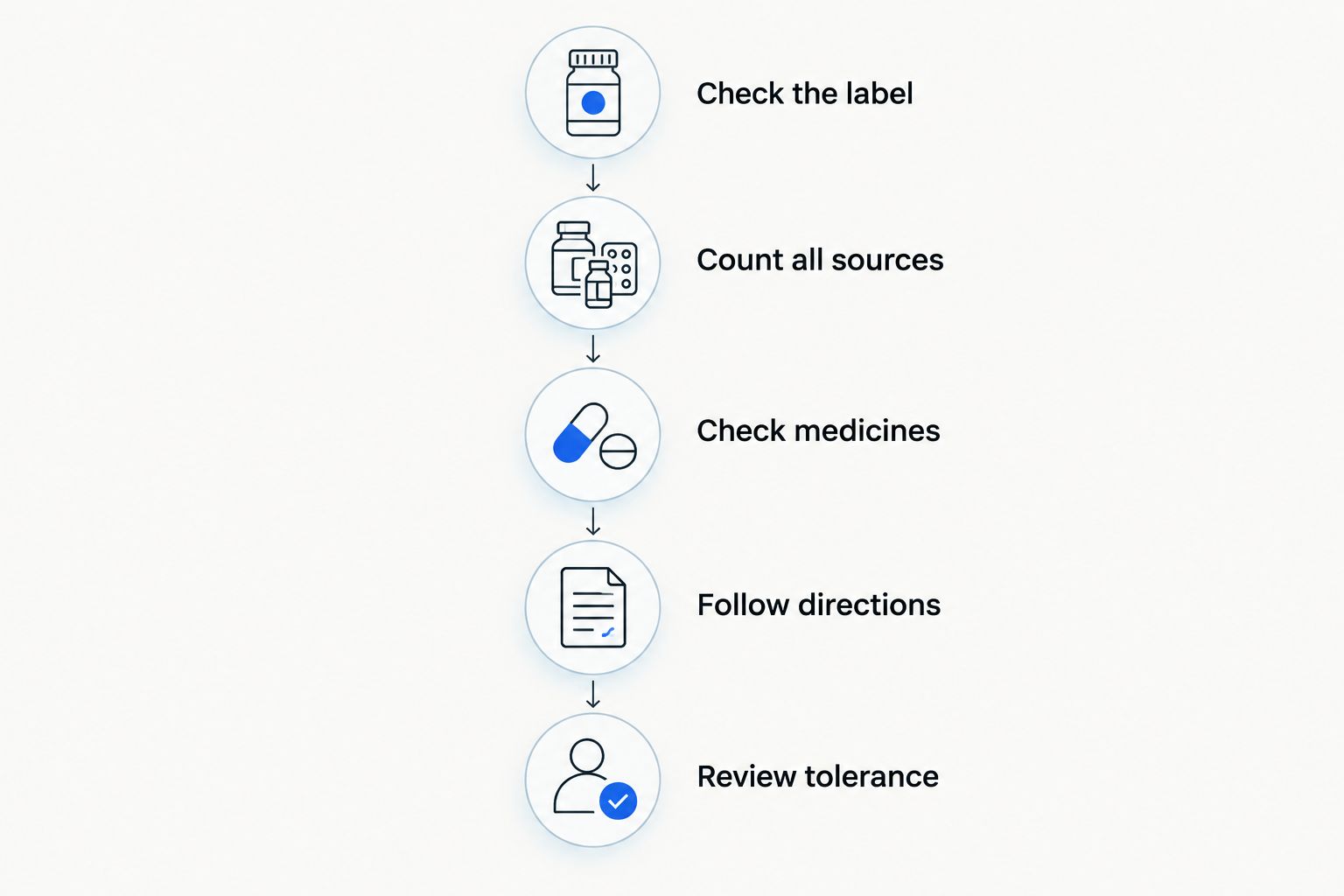
Use a label-first process rather than copying a dose from a social post. The goal is to understand the product and your total intake before adding anything to your evening.
- Check the label. Find the elemental magnesium amount, serving size, directions, and warnings. Check every active ingredient in a combined sleep formula, not only magnesium.
- Count all sources. Review supplements and medications for magnesium. Keep food intake separate when checking the supplemental upper limit.
- Check medicines. Ask a pharmacist about interactions and spacing if you take prescription medicines or regularly use over-the-counter products.
- Follow directions. Use the product according to its label and your healthcare professional's advice. Do not increase the amount because you had a difficult night.
- Review tolerance. Pay attention to digestive discomfort and other unwanted effects. Stop and seek appropriate advice if a product causes problems.
Keep the product packaging available. A handwritten note saying magnesium does not tell a pharmacist the form, serving size, other ingredients, or warnings needed to assess it.
The same principle applies when you change brands. Do not assume the same capsule count provides the same amount. Read the new label as a new decision.
Which approach fits your goal?
You do not have to begin with a bedtime capsule. Match the approach to the question you are trying to answer: nutritional intake, a possible need for supplementation, or ongoing difficulty sleeping.
| Approach | Best for | Advantage | Limitation |
|---|---|---|---|
| Food-first magnesium intake | Adults reviewing everyday nutrition | Contributes magnesium without counting toward the supplemental upper limit | Does not establish why you are sleeping poorly |
| A magnesium supplement | Adults advised to supplement or reviewing a nutritional gap | Provides a labelled amount you can track | Can cause digestive effects and interact with medicines |
| Professional sleep assessment | Adults with persistent sleep difficulty or daytime impairment | Addresses the sleep problem rather than assuming a nutrient cause | Requires a separate assessment; a supplement label cannot replace it |
Choose the approach that addresses your actual goal. If your main problem is persistent poor sleep, adding magnesium without assessing that problem leaves the central question unanswered.
For general nutrition, review what you regularly eat rather than judging your diet from a single meal. For supplement decisions, a healthcare professional can help interpret whether your circumstances call for additional magnesium.
Does taking magnesium right before bed work better?
There is no established ideal interval between taking magnesium and going to bed. Claims that everyone should take it at a precise point in the evening are not the same as an official dosing recommendation.
If you use magnesium, follow the label and any instructions from your pharmacist or healthcare professional. Medicine spacing and tolerability take priority over creating a particular bedtime ritual.
For your 2026 routine, keep the distinction simple: a convenient time is not a proven effective time. Taking a supplement consistently according to directions does not establish that it will improve sleep.
Can you take magnesium every night?
The 350 mg per day supplemental upper limit applies to the adult daily total, whether you take magnesium occasionally or nightly. Staying below it does not establish that you need a supplement or that long-term use is appropriate for your circumstances.
Review regular use with a qualified healthcare professional if you have kidney disease, take interacting medicines, or develop digestive symptoms. Persistent sleep trouble also deserves attention rather than an automatic dose increase.
Should you increase magnesium if you still cannot sleep?
The 350 mg per day supplemental upper limit is not a ladder to climb until sleep improves. Magnesium does not have an established dose-response rule for bedtime use that makes more a dependable next step.
If sleep difficulty continues, discuss the pattern with a healthcare professional. Mention snoring, breathing interruptions, daytime sleepiness, and any medicines or supplements you use; those details help direct an appropriate assessment.
Where TruNutra fits into an evening routine
TruNutra is best suited to adults exploring everyday wellness supplements, not treatment for a sleep disorder. That distinction keeps a supplement decision separate from medical care for persistent sleep problems.
If you are exploring TruNutra sleep supplements, review the Sleep Ease Duo page and current label before deciding whether it fits your routine. Confirm the ingredients, directions, warnings, and any magnesium amount rather than assuming the product supplies a particular bedtime dose.
The advantage of considering a sleep-focused product is that you can evaluate its full label against your evening goal. The limitation is equally important: a product's name does not establish its suitability, effectiveness, or compatibility with your medicines.
FAQ
How much magnesium should I take before bed in 2026?
There is no established magnesium dose specifically for bedtime. For adults, the supplemental upper limit is 350 mg per day from supplements and medications unless a healthcare professional recommends otherwise; it is not a recommended sleep dose.
Does the 350 mg magnesium limit include food?
The 350 mg per day adult supplemental upper limit does not include magnesium naturally present in food and beverages. It includes magnesium from supplements and medications such as certain antacids and laxatives.
What magnesium amount should I count on the bottle?
Count the elemental magnesium listed on the Supplement Facts panel for the serving you take. Check the serving size because the listed amount can refer to multiple capsules.
Should I take my whole daily magnesium requirement at bedtime?
No, your recommended daily magnesium intake is not a bedtime supplement dose. Adult nutritional recommendations include food and beverages as well as supplements.
What's the best time to take magnesium for sleep?
No ideal bedtime interval has been established for magnesium. Follow the label and professional advice, especially when you need to separate magnesium from medicines.
Can magnesium upset my stomach at night?
Supplemental magnesium can cause diarrhea, nausea, and abdominal cramping. Do not keep increasing the dose if you develop digestive discomfort; seek advice about whether to continue.
Who should check with a healthcare professional before taking magnesium?
People with kidney disease, people taking potentially interacting medicines, and people who are pregnant or breastfeeding should get individualized advice. Persistent sleep difficulty also warrants assessment rather than relying on magnesium alone.
One last thing
The biggest number on the front of a magnesium bottle is not necessarily the number you should use. The Supplement Facts panel, serving size, and actual amount taken determine your supplemental total.
Before adding anything to your 2026 bedtime routine, put all your supplement and medication labels side by side. Understanding what you already take is more useful than guessing a larger dose.