


How long does it take for liver support supplements to work?
There is no established number of days or weeks in which liver support supplements reliably start working. A product’s ingredients, your reason for taking it, and the outcome being measured all matter; feeling more energetic does not prove that your liver is healthier. In 2026, the safest approach is to review the formula with a qualified health professional rather than follow a promised detox timeline.
- How long does it take for liver support supplements to work? No reliable category-wide timeline has been established.
- Feeling less tired or bloated does not establish improved liver health.
- TruNutra supplements should be evaluated by their labels, not by promised liver detox timelines.
- Abnormal liver tests require professional assessment, not a longer supplement trial.
Why this matters
Waiting for a supplement to work can distract you from the more useful question: what needs attention in the first place? Everyday tiredness, digestive discomfort, and abnormal blood tests are different concerns. They should not share the same supplement countdown.
If you are browsing TruNutra for everyday wellness supplements, separate general nutrition goals from medical questions about liver health. A supplement routine is not a substitute for finding the cause of persistent symptoms or following up on an abnormal test.
Choose a clear goal before choosing a waiting period. That keeps a vague promise such as liver support from becoming an open-ended reason to keep taking something.
How long does it take for liver support supplements to work?
There is no evidence-based timeline that applies to all liver support supplements. The category includes different ingredients and combinations, and a study of one specific preparation cannot establish when another formula will produce results.
The National Center for Complementary and Integrative Health describes research on milk thistle for liver conditions as conflicting or too limited to support firm conclusions. That matters because milk thistle is commonly discussed as a liver supplement: even a familiar ingredient does not provide a dependable countdown to benefit.
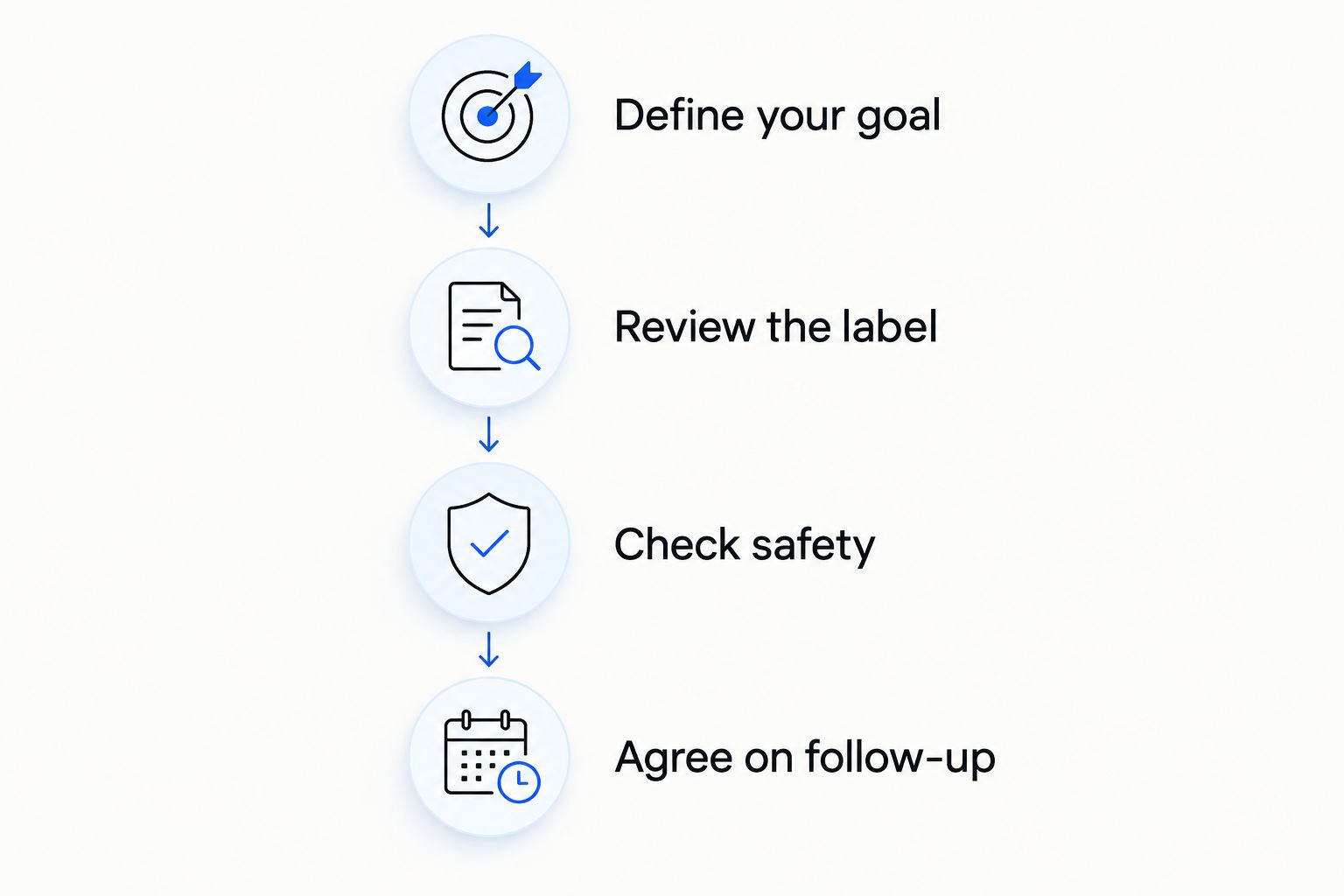
For a 2026 purchase decision, use this sequence instead of a generic timeline:
- Define your goal. Decide whether you are addressing a nutritional concern, a symptom, or a clinician-identified liver problem.
- Review the label. Check the ingredients, amounts, directions, and warnings rather than relying on the product name.
- Check safety. Ask a pharmacist or clinician about your medicines, other supplements, and health history.
- Agree on follow-up. If monitoring is appropriate, let your clinician choose what to measure and when to review it.
A study’s length is not a personal deadline. If researchers assess a particular formula at the end of a trial, that does not establish when an individual should feel a difference—or whether a different product will help at all.
What would count as a supplement working?
The word working needs a specific meaning. A change in how you feel, a change in a laboratory result, and improvement in a diagnosed condition are not interchangeable.
| What you are assessing | Best for | Useful information | Main limitation |
|---|---|---|---|
| A symptom diary | Describing changes in daily comfort or energy | Records what changed and when | Cannot establish liver health or prove a supplement caused the change |
| Clinician-directed blood tests | Investigating or monitoring a medical concern | Measures selected markers in context | One result does not explain the cause by itself |
| A medical assessment | Understanding symptoms, abnormal tests, or a known condition | Connects history, examination, and appropriate testing | Requires individual evaluation rather than a self-set timeline |
A diary can help you describe your experience accurately. It cannot tell you whether your liver is processing substances more effectively or whether an underlying condition has improved.
Blood tests also require interpretation. Alanine aminotransferase, often shortened to ALT, and aspartate aminotransferase, or AST, are enzymes clinicians use when assessing possible liver injury; they are not a complete score of how well your liver functions.
Do not use better energy, fewer digestive symptoms, or one isolated test result as proof that a supplement repaired your liver. Bring the change to a clinician who can interpret it alongside the rest of your health information.
Why the timeline varies—and sometimes cannot be predicted
Uncertainty is not simply a matter of people responding at different speeds. Sometimes there is no established benefit to put on a timeline in the first place.
These factors explain why a generic answer is unreliable:
- The actual formula. Different ingredients, amounts, and preparations are not interchangeable. Evidence about one preparation does not automatically apply to another.
- Your starting concern. A nutritional question is different from unexplained fatigue, an abnormal liver test, or a diagnosed condition.
- The outcome being measured. Feeling better and showing a clinically meaningful change are different endpoints.
- Medicines and other supplements. Your full routine affects the safety assessment and can complicate the interpretation of changes.
- Other changes in daily life. Changes in sleep, meals, alcohol intake, or prescribed treatment make it harder to attribute an outcome to one supplement.
- The quality of the evidence. A small or inconclusive study cannot support a firm personal deadline.
For your 2026 routine, treat these as questions to resolve before setting expectations. Taking a formula consistently does not turn uncertain evidence into a predictable result.
Should you keep taking it if you do not notice a difference?
There is no universal waiting period after which every liver support supplement should be continued, stopped, or replaced. Review the purpose, safety, and evidence rather than extending the trial because the bottle still has capsules left.
If you started a supplement without a clear goal, pause and discuss whether it belongs in your routine. If a clinician recommended a product for a specific nutritional reason, follow that plan and ask what follow-up is needed.
Avoid switching repeatedly between formulas in search of a noticeable sensation. That makes your routine harder to assess and can expose you to overlapping ingredients. A lack of sensation does not prove failure, just as a noticeable sensation does not prove liver benefit.
Before your next purchase, write down what would justify continuing. If the only answer is that you hope something invisible is improving, you need a better decision standard—not a longer countdown.
Can you feel your liver getting healthier?
You cannot reliably judge liver health by how energetic, comfortable, or clear-headed you feel. Some liver conditions cause few symptoms, while tiredness and abdominal discomfort have many possible explanations.
A good day is still a good day. It simply does not identify what caused the improvement or confirm a change in liver health.
If your concern began with an abnormal test, keep the planned follow-up even if you feel well. If your concern began with persistent symptoms, seek assessment rather than assuming that a liver supplement is the right answer.
Does a liver detox supplement work faster?
The word detox does not establish a faster or proven benefit. The National Center for Complementary and Integrative Health reports that convincing research supporting detox programs for removing toxins or improving health is lacking.
Your liver already performs essential processing and waste-handling functions. A supplement name does not show that those functions need speeding up, or that the product can do so safely.
For a 2026 label review, look past words such as cleanse, reset, and detox. Ask which ingredient is being studied, what outcome was measured, and whether the evidence matches the actual formula.
Do not treat diarrhea, nausea, or feeling unwell as evidence that a detox is working. New symptoms are a reason to stop and seek appropriate advice, not proof that the product is doing its job.
What should you check before taking a liver supplement?
Start with the whole routine, not just the new bottle. Bring a list of prescription medicines, over-the-counter medicines, vitamins, herbal products, and other supplements to a pharmacist or qualified clinician.
Review these practical questions:
- Does the formula duplicate anything you already take?
- Are the ingredients and amounts clearly listed?
- Do the warnings apply to your health history?
- Is there a reason to avoid it during pregnancy or breastfeeding?
- Does an existing liver condition change the recommendation?
- Is testing or another evaluation more appropriate than a supplement?
The FDA does not approve dietary supplements for safety and effectiveness before they are marketed. Availability on a store shelf is therefore not proof that a formula is effective for a liver condition or suitable for your situation.
Some herbal and dietary supplements can cause liver injury. Natural ingredients are not automatically harmless, and taking more than the label directs does not make a product work faster.
If you develop yellowing of the skin or eyes, dark urine, or significant abdominal pain, seek prompt medical assessment. Stop a newly started supplement while you obtain advice; do not wait for a supposed adjustment period to finish.
Where an everyday botanical supplement fits
TruNutra Filter Friend is best suited to adults comparing botanical supplements for everyday nutrition, not seeking treatment for a liver condition. Its supplied product description identifies it as a botanical supplement for everyday nutrition; it does not establish a liver-health benefit or a time to results.
That distinction is the main limitation to keep in view. TruNutra Filter Friend belongs in a label-based conversation about your routine, not in a promise to normalize liver tests, reverse damage, or produce a detox effect.
If you are considering it, review the current ingredients, directions, and warnings with a qualified health professional. Choose it only if the actual formula fits an appropriate goal and your safety review—not because the name suggests an organ-specific result.
How to prepare for a useful follow-up
A useful follow-up starts with an accurate record. Note the product name, when you began taking it, how you followed the label, and any symptoms that appeared or changed.
Also record other relevant changes, such as a new medicine or a different alcohol pattern. You do not need an elaborate tracking system; a clear note helps your clinician understand the sequence without relying on memory.
For a 2026 health review, bring the bottle or a readable label photo. Ask whether continued use makes sense, whether any tests are needed, and what would be a reason to stop.
Keep prescribed treatment decisions separate from supplement experiments. Do not stop a medicine or delay recommended care because you want to see what a supplement does first.
FAQ
How long does it take for liver support supplements to work?
There is no established timeline that applies to all liver support supplements. The formula, reason for use, and outcome being measured determine whether a meaningful benefit can be assessed.
Should I feel different after taking a liver support supplement?
A noticeable feeling is not a reliable measure of liver health. Changes in energy or digestion do not prove that a supplement improved liver function.
Can a liver support supplement lower elevated liver enzymes?
Do not assume a liver support supplement will lower elevated liver enzymes. Abnormal results need professional assessment because the cause determines the appropriate next step.
Is milk thistle proven to work for everyone?
Milk thistle is not proven to work for everyone. The National Center for Complementary and Integrative Health describes research for liver conditions as conflicting or too limited for firm conclusions.
Should I take more if I am not seeing results?
Do not increase the amount beyond the product label to chase results. Discuss a lack of benefit or concerns about the formula with a qualified health professional.
Can liver supplements cause side effects?
Liver supplements can cause side effects, and some herbal or dietary supplements can cause liver injury. Seek prompt medical assessment for yellowing skin or eyes, dark urine, or significant abdominal pain.
Do I need blood tests before taking a liver supplement?
A clinician should decide whether you need blood tests based on your symptoms, health history, medicines, and reason for considering the supplement. Not every wellness purchase requires testing, but suspected liver problems need assessment.
One last thing
A quiet liver is not a measurable supplement result. Feeling nothing does not establish that a product failed, and feeling better does not establish that it improved your liver.
The most useful next move is to replace the countdown with a question: what are you trying to improve, and how will you know? If that answer is unclear, resolve it before adding another bottle to your routine.