


Does magnesium interact with blood pressure medication?
Yes, magnesium supplements can affect blood pressure management, but the concern depends on your medication, supplement dose, and kidney function. Some blood pressure medicines change how much magnesium your body loses, while magnesium supplements can also lower blood pressure modestly. Before adding magnesium, ask your pharmacist to check your exact prescription and the supplement label; do not stop or reduce prescribed medication yourself.
- Does magnesium interact with blood pressure medication? Yes; medication type, magnesium dose, and kidney function determine the concern.
- Loop and thiazide diuretics can increase magnesium loss; potassium-sparing diuretics reduce magnesium excretion.
- Separating doses does not solve every interaction or prevent magnesium buildup when kidney function is reduced.
- Consider TruNutra wellness supplements only after checking the specific label and your medication list with a pharmacist.
Why this matters
Adding a supplement to your evening routine can feel separate from taking a prescription each morning. Your body does not treat those routines as separate: the total daily dose and the medicines you take still matter.
Whether you shop at TruNutra or elsewhere, check the ingredients before choosing a supplement for sleep, stress, or daily wellness. A product's intended benefit does not establish whether it fits your blood pressure treatment.
For your 2026 supplement review, bring the actual label rather than relying on the product name. Magnesium can appear in a standalone supplement, a multivitamin, or a nonprescription medicine.
Does magnesium interact with blood pressure medication?
Yes, but there is no single interaction that applies to every blood pressure medicine. The NIH Office of Dietary Supplements identifies diuretics as medicines that can change magnesium balance. Its magnesium guidance also describes a modest blood-pressure-lowering effect from supplementation, not a replacement for prescription treatment.
The distinction matters: a medicine that increases magnesium loss creates a different question from one that reduces magnesium excretion.
| Medication group | Examples | Magnesium-related concern | What to discuss |
|---|---|---|---|
| Loop diuretics | Furosemide | Can increase urinary magnesium loss | Whether magnesium testing is appropriate |
| Thiazide diuretics | Hydrochlorothiazide, chlorthalidone | Can increase urinary magnesium loss | Whether your results and symptoms justify supplementation |
| Potassium-sparing diuretics | Spironolactone, amiloride | Reduce magnesium excretion | Whether extra magnesium is appropriate, especially with reduced kidney function |
| Other blood pressure medicines | ACE inhibitors, ARBs, calcium channel blockers, beta blockers | The medicine name alone does not establish a magnesium restriction | Your full prescription list, blood pressure readings, kidney function, and supplement dose |
These are medication categories, not recommendations to switch treatment. Combination tablets can contain more than one medicine, so give your pharmacist the full prescription name rather than saying only that you take a water pill.
Loop and thiazide diuretics: check for magnesium loss
Loop and thiazide diuretics help your body remove fluid, but they can also increase magnesium loss through urine. That does not mean everyone taking them needs a magnesium supplement.
Ask whether you need a magnesium blood test before treating a presumed deficiency. Your clinician can interpret the result alongside kidney function, other electrolytes, symptoms, and your medication history. Cramps or tiredness alone do not establish that magnesium is low.
Potassium-sparing diuretics: check before adding magnesium
Potassium-sparing diuretics reduce magnesium excretion. Adding magnesium without reviewing kidney function and the full medication list can therefore create a different concern from magnesium loss.
Do not assume that advice given to someone taking hydrochlorothiazide also applies to someone taking spironolactone. The medicines handle minerals differently, even when both are described as diuretics.
Other blood pressure medicines: review the whole routine
Taking an ACE inhibitor, ARB, calcium channel blocker, or beta blocker does not automatically mean that every magnesium supplement is prohibited. It also does not establish that a particular dose is suitable for you.
Ask about your actual combination of medicines. Low blood pressure readings, dizziness, reduced kidney function, and other supplements all belong in that discussion; a broad medication category is not enough to make the decision.
Why magnesium interaction risk varies
A useful 2026 medication review focuses on your circumstances rather than a blanket yes or no. These factors explain why advice differs between people:
- Medication type: Some diuretics increase magnesium loss, while potassium-sparing diuretics reduce magnesium excretion.
- Kidney function: Your kidneys remove excess magnesium. Reduced kidney function increases the risk of magnesium buildup from supplements or magnesium-containing medicines.
- Elemental magnesium dose: The Supplement Facts panel lists the magnesium amount that counts toward your daily supplemental intake.
- Other magnesium sources: Multivitamins, antacids, and laxatives can add to the amount you take.
- Your blood pressure pattern: Dizziness or unusually low readings require attention, especially after a change in your routine.
- Digestive effects: Supplemental magnesium can cause diarrhea, nausea, and abdominal cramping; diarrhea can also contribute to dehydration.
The main question is not simply whether two products can be swallowed together. It is whether your total routine fits your treatment and health needs.
How much magnesium should you check on the label?
For adults, the NIH Office of Dietary Supplements lists an upper limit of 350 mg per day from supplements and magnesium-containing medicines, unless a healthcare professional recommends otherwise. This limit does not include magnesium naturally present in food, and it is not a personal dose recommendation.
The adult recommended total intake is 400–420 mg per day for men and 310–320 mg per day for women, depending on age. Those totals include food, beverages, and supplements; they are not instructions to take that amount as a supplement. Pregnancy has separate intake recommendations.
A serving size matters as much as the amount on the front of a bottle. Read the Supplement Facts panel to see whether the listed magnesium amount applies to a capsule, multiple capsules, or another serving.
Do not use the 350 mg daily upper limit as proof that a dose is safe for you. Kidney disease and medication-related concerns can require individualized advice even below that amount. A clinician can also prescribe a different amount for a specific reason.
For a 2026 label check, distinguish elemental magnesium from the weight of the magnesium compound. The elemental amount on the Supplement Facts panel is the useful number to record and discuss with your pharmacist.
How do I check my magnesium and medication routine?
You do not need to work out the interaction yourself. Give your pharmacist enough information to review the combination accurately, including products you take only occasionally.
- List medicines. Record prescription names, doses, and when you take them. Include combination blood pressure tablets.
- Read labels. Bring the Supplement Facts panel and the ingredient list, not just a product photo showing the front label.
- Add magnesium. Include magnesium from every supplement and magnesium-containing nonprescription medicine.
- Ask a pharmacist. Ask about your medication combination, kidney function, dose, and whether testing is needed.
- Follow the plan. Use the approved dose and follow any instructions about blood pressure checks or follow-up.
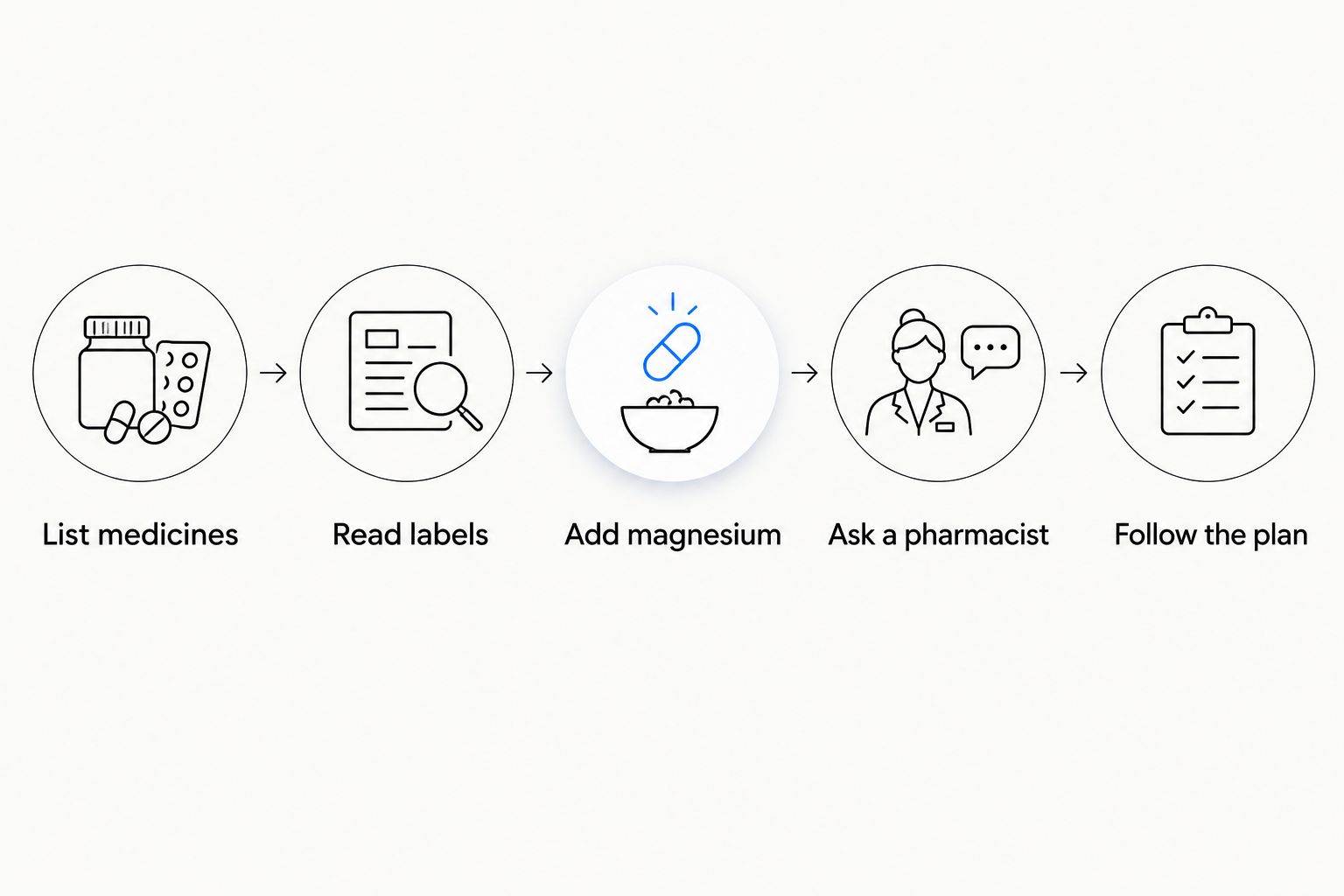
Keep your approved plan with your medication list. If your prescription changes, review the supplement again rather than assuming the previous advice still applies.
For home blood pressure monitoring, use the schedule and technique your clinician recommends. Record symptoms as well as readings, and do not change a prescription dose in response to a single result unless your clinician has given you specific instructions.
Can I take magnesium at a different time from my blood pressure pill?
Spacing doses does not resolve every magnesium-related concern. Taking magnesium at night and your prescription in the morning does not prevent changes in magnesium balance, magnesium buildup, or overlapping effects on blood pressure.
Some other medicines, including certain antibiotics and osteoporosis medicines, do have specific magnesium spacing instructions. Ask your pharmacist for the timing that applies to each medicine rather than using one separation rule for your entire routine.
If your pharmacist approves magnesium, choose a time that follows the product label and your treatment plan. Convenience comes after checking the combination.
Is magnesium from food different from a supplement?
Magnesium from food is not included in the adult supplemental upper limit of 350 mg per day. Beans, nuts, seeds, whole grains, and leafy green vegetables are established food sources.
A varied diet can contribute magnesium without adding a concentrated supplement. Food still needs to fit any kidney-related or other dietary restrictions your clinician has given you.
A supplement offers a measurable supplemental amount, but it also adds a dose that needs review. Neither approach justifies replacing blood pressure medicine or treating a suspected deficiency without appropriate assessment.
What symptoms should make me seek help?
Dizziness, lightheadedness, or unusual weakness after changing your routine deserve attention. These symptoms do not identify magnesium as the cause, but they are a reason to contact your healthcare professional rather than continuing to experiment with doses.
Seek emergency care for fainting, chest pain, trouble breathing, or severe confusion. Do not wait for an online interaction check to explain serious symptoms.
If you accidentally take more magnesium than intended, contact Poison Control or seek medical advice promptly. Keep the container available so the professional can identify the ingredient, amount, and serving size.
Where does TruNutra fit into this decision?
TruNutra is best suited to adults exploring everyday wellness supplements, not replacing prescribed blood pressure care. For someone taking medication, the relevant product is the one whose actual label a pharmacist has reviewed—not simply one described for sleep, stress, or general wellness.
The limitation is straightforward: a brand name or wellness goal cannot establish compatibility with your prescription. Before choosing TruNutra wellness supplements, check the specific ingredients, serving size, directions, and warnings with a qualified health professional.
FAQ
Can I take magnesium if I take blood pressure medicine every day?
Daily blood pressure medicine does not automatically rule out magnesium, but your pharmacist should check the exact combination before you start. Medication type, kidney function, total magnesium intake, and your blood pressure readings affect the advice.
Does magnesium make blood pressure medicine work too strongly?
Magnesium supplements can lower blood pressure modestly, so overlapping effects deserve review when you already take blood pressure medicine. Do not reduce your prescription yourself; ask about your specific supplement dose and readings.
Should I take magnesium if my water pill lowers magnesium?
Do not automatically add magnesium because you take a water pill. Loop and thiazide diuretics can increase magnesium loss, but testing and your clinical situation determine whether supplementation is appropriate.
Is magnesium glycinate safe with blood pressure medication?
Magnesium glycinate still requires a medication check; its form does not remove concerns about elemental magnesium dose or kidney function. Ask your pharmacist to review the actual label and your prescription list.
Is 350 mg of magnesium safe with my prescription?
350 mg per day is the adult upper limit for magnesium from supplements and magnesium-containing medicines, not a guarantee of safety with your prescription. Your clinician can recommend a different plan based on kidney function, medication use, and the reason for supplementation.
Can I replace my blood pressure medicine with magnesium?
Do not replace prescribed blood pressure medicine with magnesium. Magnesium supplementation has a modest blood-pressure-lowering effect and is not a substitute for your prescribed treatment.
What should I ask my pharmacist about magnesium in 2026?
Ask your pharmacist to check the magnesium amount, your exact blood pressure medicines, kidney-related concerns, and any timing instructions. Bring every supplement and nonprescription medicine label so the review includes your complete routine.
One last thing
The magnesium product easiest to overlook might not be a supplement bottle. Some antacids and laxatives contain magnesium, so include those products in your 2026 medication review—even if you take them only occasionally.
Bring the labels and leave with a clear plan. That is more useful than choosing a magnesium form first and checking your medicines afterward.