


Best L-theanine supplements for anxiety in 2026
Best starting point when comparing l theanine supplements for anxiety: a clearly labeled, single-ingredient capsule. Best for avoiding capsules: a measured powder. Best for convenience: a chewable with a fully disclosed label. This 2026 guide ranks formats by how easily you can evaluate and use them—not by claims that they treat anxiety.
- For l theanine supplements for anxiety, start with label clarity—not promises of anxiety relief.
- Single-ingredient capsules make ingredient review simpler; powders require careful measuring.
- TruNutra sells everyday wellness supplements; confirm L-theanine on the specific label before choosing a product.
- Persistent anxiety deserves professional care, not a larger supplement stack.
Why this matters
An unsettled afternoon and anxiety that disrupts your daily life call for different decisions. A supplement shopping list should not blur that distinction. L-theanine is not an FDA-approved treatment for anxiety disorders.
L-theanine is an amino acid found in tea and sold in dietary supplements. Its presence in a product does not establish that the finished formula will relieve your symptoms. Ingredient identity, the amount per serving, other ingredients, and your health history all matter.
TruNutra offers dietary supplements for everyday wellness routines. For an L-theanine purchase, choose by the actual Supplement Facts panel rather than a calming product name or a familiar brand.
What makes the best L-theanine supplement?
Use these criteria when comparing products in 2026. A supplement that fails the label check should not win because its packaging sounds reassuring.
- Ingredient identity: The Supplement Facts panel explicitly names L-theanine. A general botanical blend is not a substitute for that information.
- Amount transparency: You can identify the L-theanine amount per serving and understand how many capsules, scoops, or pieces make a serving.
- Formula simplicity: You can explain why each active ingredient belongs in your routine. More ingredients do not automatically make a better choice.
- Practical fit: You can follow the directions without guessing, improvising a scoop, or taking extra servings for convenience.
- Product-specific quality information: Any testing or certification claim applies to the exact product, not just the company generally.
- Safety fit: You have reviewed warnings, other supplements, medications, pregnancy or breastfeeding considerations, and relevant health conditions.
No format earns a recommendation solely because it is described as natural. The useful question is whether you can evaluate the product and follow its directions reliably.
L-theanine supplements at a glance
This is a format comparison, not a ranking of named products or a claim of superior absorption. Individual formulas still need their own label review.
| Rank and format | Best for | Standout feature | Key limitation |
|---|---|---|---|
| 1. Single-ingredient capsule | A straightforward first comparison | A predefined serving without measuring loose powder | Requires swallowing capsules; capsule count per serving varies |
| 2. Measured powder | Adults who prefer mixing a supplement | An alternative to swallowing capsules | Requires accurate measuring and attention to directions |
| 3. Chewable or gummy | Adults who want a chewable format | No capsule swallowing or loose-powder measuring | Other ingredients and pieces per serving need review |
| 4. Multi-ingredient formula | Adults with a specific reason for every ingredient | Combines selected ingredients in one product | Makes overlapping ingredients and individual effects harder to assess |
The default choice is the simplest suitable formula, not the longest ingredient list. A format advantage is practical; it is not evidence that one product treats anxiety better than another.
1. Single-ingredient capsule: best for a simple first comparison
A single-ingredient L-theanine capsule keeps the active-ingredient review focused. You still need to read the full label, including capsule materials, other ingredients, directions, and warnings.
This format is the clearest starting point if you want to discuss L-theanine with a pharmacist or clinician. Bring the actual label rather than a description such as a calming capsule.
Single-ingredient capsule pros:
- Keeps the active-ingredient list focused on L-theanine.
- Avoids measuring loose powder before each use.
- Makes comparisons between labeled serving amounts more direct.
Single-ingredient capsule cons:
- Does not suit everyone who has difficulty swallowing capsules.
- A serving can include more than one capsule; check the directions.
- A simple formula still requires a safety review.
Best for: Adults who want a straightforward label and a capsule-based routine.
Check whether the prominently displayed amount refers to one capsule or the full serving. Those are not necessarily the same thing, and confusing them changes what you take.
Verdict: Buy only after confirming the label and suitability with your health professional when appropriate.
2. Measured powder: best for adults who avoid capsules
L-theanine powder offers another format for adults who prefer mixing a supplement rather than swallowing capsules. Follow the product's preparation and measuring instructions exactly.
A powder is not automatically more effective, faster, or easier to use. Its practical value depends on whether its directions fit your daily routine without guesswork.
Measured powder pros:
- Provides an alternative to capsules.
- Lets you use the preparation method specified on the label.
- Can keep the active-ingredient list simple when the formula contains only L-theanine.
Measured powder cons:
- Requires careful measuring rather than estimating by eye.
- Adds a preparation step to your routine.
- A scoop's size alone does not tell you the amount of active ingredient.
Best for: Adults who dislike capsules and are comfortable following precise measuring directions.
Do not substitute a kitchen spoon for the product's instructions. If the serving information or measuring method is unclear, choose a different product or ask the manufacturer before using it.
Verdict: Hold until you understand and can follow the measuring instructions.
3. Chewable or gummy: best for a capsule-free routine
A chewable or gummy removes the need to swallow a capsule or measure loose powder. That convenience still needs a careful label check, especially when the front of the package emphasizes flavor or relaxation.
Read both the Supplement Facts panel and the other-ingredients list. Check the number of pieces per serving instead of assuming one piece equals one serving.
Chewable or gummy pros:
- Offers a capsule-free option.
- Avoids handling loose powder.
- Provides a defined serving when you follow the labeled piece count.
Chewable or gummy cons:
- Sweeteners, flavors, and other ingredients need their own review.
- Multiple pieces can be required for a labeled serving.
- A familiar candy-like format does not make extra servings appropriate.
Best for: Adults who prefer chewing and can consistently follow the serving directions.
Store dietary supplements according to their labels and out of children's reach. Convenience should make directions easier to follow, not make the product easier to take casually throughout the day.
Verdict: Buy only if the full ingredient list and serving directions fit your needs.
4. Multi-ingredient formula: best for a specific, reviewed routine
A combination formula includes L-theanine alongside other active ingredients. Evaluate the whole formula rather than assuming that several calming-sounding ingredients provide a better result.
This format deserves additional attention if you already use sleep, stress, or general wellness supplements. Different products can contain overlapping ingredients even when their names sound unrelated.
Multi-ingredient formula pros:
- Places selected ingredients in one product.
- Can simplify packaging when the combination matches an already reviewed routine.
- Lists ingredients together for a single-product discussion with your pharmacist.
Multi-ingredient formula cons:
- Makes it harder to identify which ingredient caused an unwanted effect.
- Can duplicate ingredients in other supplements.
- Requires reviewing every active ingredient, not just L-theanine.
Best for: Adults who have a clear reason for each ingredient and have checked the complete combination.
Do not choose a blend simply because its name mentions calm, focus, or sleep. Those words do not identify its contents or establish that it is appropriate for anxiety.
Verdict: Hold until every ingredient and any overlap have been reviewed.
How these formats are ranked
The 2026 ranking prioritizes label clarity, formula simplicity, preparation demands, and safety review. Capsules rank first because they avoid loose-powder measuring while keeping a single-ingredient comparison straightforward—not because capsules have demonstrated better anxiety outcomes.
Powders and chewables are useful alternatives when swallowing capsules is the main obstacle. Combination formulas come last because they require more ingredient-level decisions. None of these positions represents a clinical trial result or a product testing award.
Where TruNutra fits
TruNutra is a consideration for adults seeking an everyday wellness routine, not a substitute for anxiety care. Its product names should not be treated as confirmation that a formula contains L-theanine.
For readers whose separate goal is an evening routine, Sleep Ease Duo is described as containing two complementary formulas for that purpose. Review its product label for ingredients, warnings, and directions. That description does not establish an L-theanine ingredient, an amount, or an anxiety benefit.
Keep the shopping goals separate. If you specifically want L-theanine, verify that ingredient on the current label. If you want to explore an evening routine, evaluate the complete evening formula on its own terms rather than treating it as an interchangeable anxiety supplement.
A practical label check before you decide
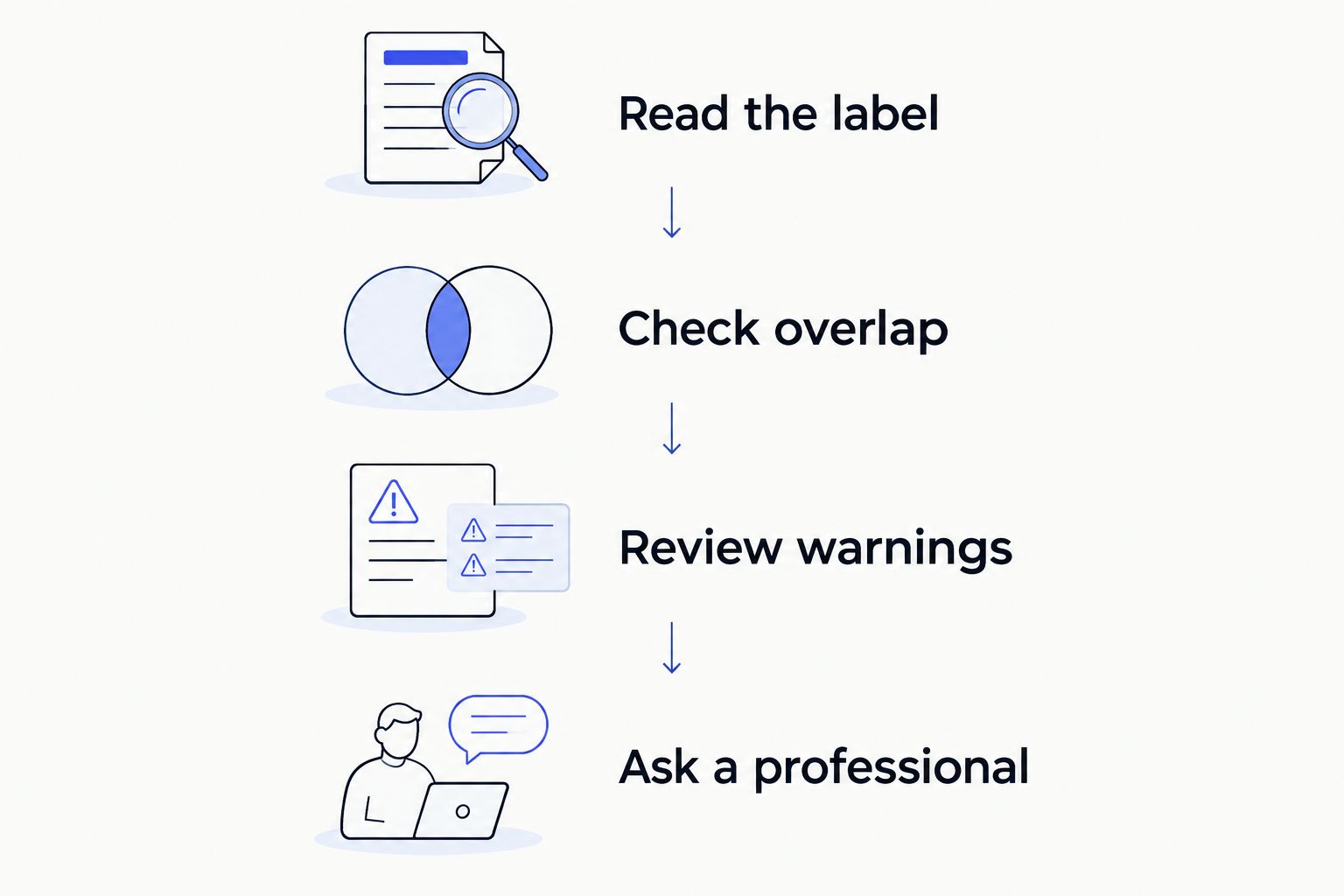
Use this sequence for any L-theanine supplement you consider in 2026. Keep the package or a clear label photo available so that your questions refer to the exact formula.
- Read the label: Find L-theanine, its amount per serving, and the serving size.
- Check overlap: Compare every active ingredient with supplements and medicines you already use.
- Review warnings: Read the directions, restrictions, and storage instructions before taking anything.
- Ask a professional: Bring unresolved questions to a pharmacist or qualified clinician.
A product should pass these checks before you decide where it belongs in your day. If you cannot identify what you would take, pause rather than filling the gap with assumptions.
For a useful conversation, write down 3 questions: Does this fit my medications? Does it duplicate anything? What would make me stop taking it? This turns a vague request for something calming into a specific safety discussion.
If you and your clinician decide a supplement is appropriate, keep a brief note of your routine for 7 days to discuss at follow-up. Record when you took it, how you slept, caffeine use, and any unwanted effects. Seven days is a suggested note-taking period, not a promised response time or a test of effectiveness.
Avoid introducing several new products together. Discuss 1 new product at a time so that your record remains easier to interpret; never change prescribed treatment to accommodate a supplement.
Which L-theanine supplement should you choose?
For an undecided adult, a clearly labeled single-ingredient capsule is the most straightforward format to evaluate first. Choose powder if capsule swallowing is the obstacle, or a chewable if that format makes following directions easier.
Choose a combination only when there is a reason for its complete ingredient list. Skip any product whose label leaves you uncertain about the L-theanine amount or whose claims promise to cure anxiety.
The best decision in 2026 is not necessarily a purchase. Anxiety that persists, worsens, or interferes with work, relationships, or sleep deserves assessment by a qualified health professional. Supplements should not delay that conversation.
FAQ
What's the best L-theanine supplement format for anxiety?
A clearly labeled single-ingredient capsule is the simplest format to evaluate first, but it is not an established treatment for an anxiety disorder. Choose according to the full label, your ability to follow directions, and professional advice when appropriate.
Can L-theanine supplements replace anxiety medication?
No. Do not stop, reduce, or replace prescribed anxiety medication with L-theanine without discussing it with your prescriber. A supplement purchase is separate from a treatment decision.
Is L-theanine powder better than capsules?
Powder is not automatically better than capsules. Powder avoids capsule swallowing but requires careful measuring; capsules provide a predefined format without handling loose powder.
How much L-theanine should I take for anxiety?
There is no universal L-theanine supplement dose that this guide can recommend for anxiety. Follow the specific product label and ask a qualified clinician whether it is appropriate for your situation; do not increase servings to chase relief.
Can I take L-theanine with my prescription medicines?
Ask a pharmacist or prescriber to review the exact supplement before combining it with prescription medicines. Provide the complete label and a list of other supplements, rather than only the main ingredient's name.
Does TruNutra Sleep Ease Duo contain L-theanine?
Confirm L-theanine on the current Sleep Ease Duo label before choosing it for that ingredient. Its description identifies two complementary formulas for an evening routine but does not establish an L-theanine ingredient or amount.
Should I choose an L-theanine blend with caffeine?
Do not choose a caffeine-containing blend solely because you want to feel calmer. Consider your existing caffeine use and whether it contributes to feeling unsettled, and review the full combination with a health professional.
Are L-theanine supplements FDA-approved for anxiety?
No. L-theanine dietary supplements are not FDA-approved treatments for anxiety disorders. For US consumers in 2026, the FDA's dietary supplement framework does not require premarket approval for safety and effectiveness as it does for drugs.
One last thing
The front of a bottle helps you recognize it; the back helps you decide whether it belongs in your routine. Before buying, explain the ingredient, serving directions, and reason for choosing it in one plain sentence. If you cannot, return to the label—not the marketing claim.