


Can stress supplements help with panic attacks?
Stress supplements are not an established treatment for panic attacks and should not replace professional care. Some ingredients have been studied for everyday stress, but that does not show they can stop an attack or prevent recurring panic; this 2026 guide explains the distinction and your next steps.
- Can stress supplements help with panic attacks? They are not an established treatment or a reliable rescue option.
- The National Institute of Mental Health identifies psychotherapy and medication as treatments for panic disorder.
- Trunutra stress supplements belong in an everyday wellness discussion, not a panic-attack treatment plan.
- New chest pain, fainting, or severe breathing difficulty needs urgent medical evaluation, not a supplement.
Why this matters
A stressful afternoon and a sudden episode of intense fear call for different decisions. A supplement marketed for relaxation does not become a panic treatment because its label uses words such as calm or balance.
Separate everyday stress support from care for panic attacks. That distinction helps you avoid taking extra capsules during an episode, combining products without checking interactions, or delaying an assessment while waiting for a supplement to work.
Questions about how long stress supplements take to work concern routine use, not emergency relief. A timeline for everyday stress support is not a timeline for stopping panic.
Can stress supplements help with panic attacks?
Stress supplements are not a proven substitute for panic-focused treatment. Research on feeling less stressed cannot establish that the same ingredient treats panic attacks. The study must address the condition and outcome you actually want help with.
For a 2026 treatment discussion, the National Institute of Mental Health's public guidance on panic disorder is a sound starting point: it identifies psychotherapy, medication, or both as treatment approaches. Cognitive behavioral therapy, often called CBT, is a well-studied psychotherapy for panic disorder.
| Approach | Best for | Main strength | Important limitation |
|---|---|---|---|
| Cognitive behavioral therapy | People seeking skills for recurring panic and related avoidance | Addresses responses to frightening sensations and situations | Requires participation and practice; it is not an instant fix |
| Clinician-prescribed medication | People whose clinician recommends medication for panic disorder | Offers an established treatment pathway | Selection, side effects, and monitoring need professional oversight |
| Stress supplements | Adults considering optional everyday wellness support | Can be discussed as part of a broader routine | Not established as a way to stop or prevent panic attacks; interactions matter |
| Sleep, movement, and regular meals | People building a steadier daily routine | Supports general well-being alongside care | Does not replace assessment or panic-focused treatment |
These approaches are not interchangeable. A clinician can help you decide whether you need treatment for panic disorder, assessment for another cause of symptoms, or support for everyday stress without a panic disorder diagnosis.
What does supplement research actually tell you?
Look at what researchers measured. A change in a stress questionnaire is different from a reduction in diagnosed panic attacks, and feeling sleepy is different from treating panic.
The National Center for Complementary and Integrative Health describes limited research supporting some ashwagandha preparations for stress and insomnia, while evidence for anxiety remains unclear. That is not evidence that every ashwagandha product works, and it does not establish ashwagandha as a panic-attack treatment.
Magnesium also needs a careful distinction: addressing a nutritional deficiency is not the same as treating panic disorder. Do not assume that a symptom means you have a deficiency or that taking more will help.
Why responses to stress supplements vary
A friend's experience cannot tell you what a supplement will do for you. In 2026, the most useful questions still concern the actual ingredient, the person taking it, and the outcome being measured.
- The symptom being addressed: Everyday tension, trouble winding down, and recurring panic are different concerns. Improvement in one does not establish improvement in another.
- The exact preparation: An ingredient name alone does not identify the extract, amount, or combination studied. Findings from one preparation do not automatically apply to another.
- Your medicines and other supplements: Combinations can change side effects or introduce interactions. A pharmacist needs the full list, including products you take only occasionally.
- Your health history: Pregnancy, breastfeeding, and conditions affecting organs such as the liver, kidneys, or thyroid can change whether a supplement is appropriate.
- Other changes in your routine: Sleep, caffeine, alcohol, and ongoing treatment can affect how you feel. Starting several changes together makes it harder to identify what helped or caused a problem.
A stronger sensation is not proof of a better result. Drowsiness, stomach upset, or a noticeable physical effect does not show that a supplement is treating the cause of panic.
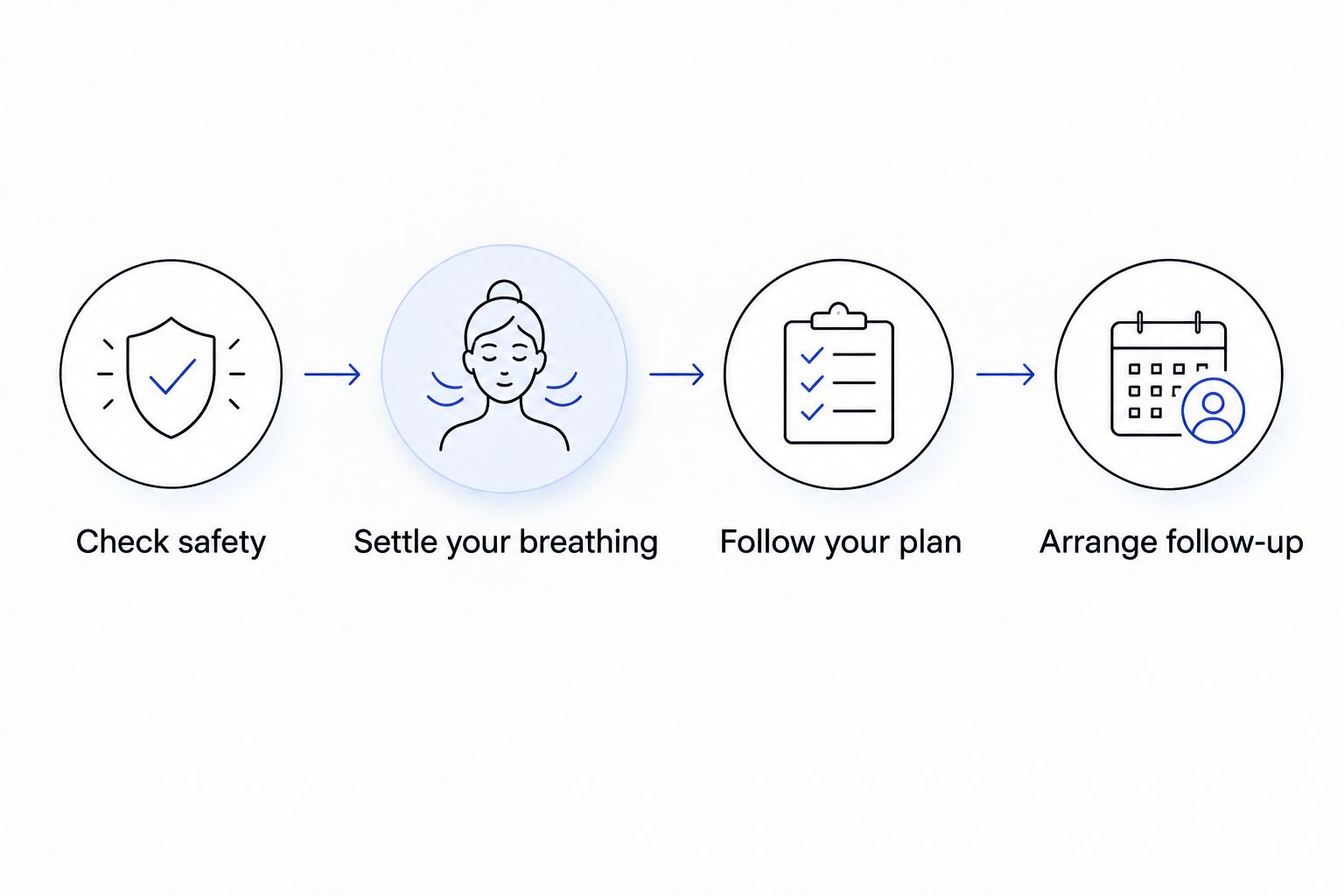
What should you do during a suspected panic attack?
If a clinician has previously identified your episodes as panic attacks, follow the plan you agreed on. If the symptoms are new, different, or severe, do not diagnose them yourself from an article.
Check safety
Call 911 for symptoms that could signal a medical emergency, including new or severe chest pain, fainting, or severe difficulty breathing. Panic can involve frightening physical sensations, but a familiar label should not make you dismiss a new warning sign.
If you are driving or operating equipment, stop safely. Get help from someone nearby when you need it rather than trying to manage everything alone.
Settle your breathing
If you are safe and the episode matches previously assessed panic, try gentle, unforced breathing. Avoid repeatedly taking very large breaths, and do not breathe into a paper bag.
Notice the support of the chair or floor beneath you. Naming what you can see and feel can help bring your attention back to your surroundings, although this is a coping strategy rather than a guaranteed way to end an attack.
Follow your plan
Use prescribed treatment only as directed. Do not improvise with extra supplement doses, someone else's medicine, alcohol, or a new combination of calming products.
A supplement is not a reliable rescue tool. Keep that boundary clear even if the product normally forms part of your evening routine.
Arrange follow-up
Arrange an appointment if episodes recur, leave you worried about another attack, or lead you to avoid work, travel, exercise, or social plans. You do not need to wait until your life feels unmanageable before asking for help.
Bring a description of the episodes and a list of everything you take. That gives the clinician something more useful than a guess about which ingredient you need.
Can a supplement replace therapy for panic attacks?
No—stress supplements should not replace therapy for panic attacks. CBT addresses the cycle between frightening sensations, interpretations, and avoidance; a wellness capsule is not an equivalent intervention.
Therapy also involves work between appointments. Your clinician can explain what practice is appropriate and how to respond when symptoms return, rather than leaving you to judge progress by whether you feel calm all day.
For your 2026 care plan, ask what improvement should look like in daily life. Being able to attend an appointment or return to an avoided activity can matter more than expecting never to feel anxious.
How can you prepare for a conversation about recurring panic?
Write a short account of what happened, using everyday language. Describe where you were, what you noticed first, what you did next, and whether anything about the episode differed from earlier experiences.
A brief record can make an appointment easier, especially when remembering the episode feels upsetting. Keep it practical; you do not need a detailed analysis of every heartbeat or sensation.
Use these questions to organize your notes:
- What was happening before the episode began?
- Which symptoms appeared, and were any new or different?
- What medicines, supplements, caffeine, or alcohol had you used?
- Did you leave a situation or begin avoiding it afterward?
- What would you like to feel able to do again?
Structured journal prompts for mental health can give your notes a starting point, but the aim here is to describe your experience—not to diagnose yourself or search endlessly for a trigger. If writing makes you more distressed or absorbed in checking symptoms, stop and discuss that response with your clinician.
Bring the notes to your appointment rather than treating them as a verdict. A pattern in a journal does not prove that a food, supplement, or stressful event caused an attack.
What should you check before trying an everyday stress supplement?
Start with your reason for taking it. If your goal is to prevent another panic attack, the next step is a treatment discussion, not a supplement experiment. If your goal is optional support for ordinary daily stress, a label and safety review comes first.
Read the complete label
Check the Supplement Facts panel, serving directions, warnings, and other ingredients. Similar product names do not mean similar formulas, and a blend can contain ingredients you already take elsewhere.
Do not infer product-specific testing, certification, or benefits from general brand language. Look for evidence that applies to the exact product you are considering.
Ask about interactions
Show a pharmacist the actual label alongside your medication list. This is especially important if you take medicines that affect alertness or receive treatment for a mental health condition.
Do not stop an antidepressant or other prescribed medicine to make room for a supplement. Changes to prescribed treatment belong with the prescriber.
Set a narrow goal
Choose an everyday goal you can explain without making a treatment claim, such as keeping a consistent wind-down routine. Do not use a supplement trial to postpone care for recurring episodes.
Avoid adding several new products together. If an unwanted effect appears, a simpler routine makes the conversation with your pharmacist or clinician clearer.
Know when to stop and ask
Follow the label rather than increasing the amount because you still feel distressed. Stop the product and seek advice if you develop an unexpected reaction; severe symptoms need urgent care.
Keep the container or a clear label photo available. The exact ingredients matter more than describing the product as a calming supplement.
Where does Trunutra fit in an everyday stress routine?
Trunutra is best for adults shopping for everyday wellness supplements, not for treating panic attacks. Its Purely Calm product page is a place to review the current label before deciding whether the product belongs in a routine discussed with your health professional.
The practical value of considering Trunutra stress supplements is having a specific product to assess rather than guessing from a category name. The limitation is equally clear: a wellness positioning does not establish panic-treatment benefits, suitability with your medicines, or safety for your health circumstances.
For a 2026 purchase decision, keep the recommendation measured. Review the exact label, ask about interactions, and keep any supplement separate from decisions about evidence-based panic care.
FAQ
Can stress supplements stop a panic attack once it starts?
Stress supplements are not an established way to stop a panic attack. Follow your clinician's plan for previously assessed episodes, and seek urgent care for new, severe, or different symptoms.
Is ashwagandha a treatment for panic attacks?
Ashwagandha is not an established treatment for panic attacks. Research on certain preparations for everyday stress does not prove that they prevent or treat panic.
Can magnesium help if I keep having panic attacks?
Magnesium is not an established treatment for recurring panic attacks. A clinician can assess whether a deficiency or another health issue needs attention without assuming magnesium is the answer.
Can I take a stress supplement with an antidepressant?
Ask your prescriber or pharmacist before combining a stress supplement with an antidepressant. Safety depends on the exact ingredients and medicines; do not stop prescribed treatment on your own.
When should I get medical help instead of taking a supplement?
Get urgent medical help for new or severe chest pain, fainting, or severe difficulty breathing. Arrange an appointment for recurring episodes, ongoing fear of another attack, or avoidance that affects daily life.
Are natural stress supplements automatically safe?
Natural stress supplements are not automatically safe. Ingredients can cause side effects or interact with medicines, and suitability depends on your health history and the exact product.
What should I bring to an appointment about panic attacks?
Bring a description of your episodes and the labels of your medicines and supplements. Include occasional products and describe any activities you have started avoiding.
One last thing
Choose a goal based on what you want to do again, not just what you want to stop feeling. Tell your clinician if panic has made you avoid a commute, a grocery store, or time alone; those changes help explain how much the episodes affect your life.
Keep everyday wellness choices in their proper place. A calm routine can support you, but you deserve a care plan that addresses recurring panic directly.