


Sleep supplements for frequent travelers: Plan first, 2026
Frequent travelers’ sleep supplementation is the use of dietary supplements alongside an evening routine to support rest away from home. This guide explains how to choose sleep supplements for frequent travelers without confusing bedtime relaxation with adjustment to a new time zone.
- Choose sleep supplements for frequent travelers around your itinerary, safety needs, and evening routine—not a promise to eliminate jet lag.
- TruNutra is best for travelers seeking routine-focused sleep supplements rather than jet-lag treatment.
- Melatonin timing matters; magnesium is not a substitute for adequate sleep or a travel schedule.
- Review labels and medication interactions before departure, and avoid trying unfamiliar sleep supplements during a flight.
Why sleep supplements matter for frequent travelers
Travel changes more than your pillow. Overnight flights, unfamiliar rooms, early departures, and work messages from another time zone can interrupt the habits that usually help you wind down.
Start your 2026 travel sleep plan with the problem, not the bottle. Difficulty settling after a busy day is different from trying to sleep when your body expects daylight. Neither problem is solved by simply choosing a stronger-looking formula.
The sleep supplement guide for shift workers covers a related challenge: resting when your schedule and usual sleep window do not align. Frequent travelers also need to account for transport, destination rules, and next-day responsibilities.
For adults, the CDC recommends at least 7 hours of sleep per night. That recommendation is a useful planning baseline, not a promise that any supplement will deliver it. Leave room in your itinerary for sleep before deciding what belongs in your bag.
Build your travel sleep routine for 2026
Identify what keeps you awake
Start with a brief written note about your last trip. Describe when you tried to sleep, what interrupted you, and how you felt the following morning. A simple notebook is enough; you do not need a sleep tracker to recognize that a late meeting left no room to unwind.
Separate environmental disruptions from schedule disruptions. A bright hallway, unfamiliar noise, and a restless travel companion call for different changes than a substantial time-zone shift. Supplements do not darken a room or create a missing sleep opportunity.
Best for: travelers who are unsure whether they need a supplement at all. Keep the description specific enough to guide a decision, rather than labeling every difficult night as jet lag.
- Record your intended bedtime and actual wake-up time.
- Note light, noise, temperature, and interruptions.
- Write down caffeine and alcohol use without guessing their effects.
- Identify whether the problem started before departure or after arrival.
Protect your sleep opportunity first
Use practical changes before adding a supplement. Pack an eye mask and earplugs, silence nonessential notifications, and arrange the room before you are exhausted. These steps address travel conditions directly, although they cannot remove every disruption.
Build your schedule around a realistic sleep window. A bedtime product cannot compensate for an itinerary that leaves only a short gap between dinner and an airport transfer. The CDC also recommends turning off electronic devices at least 30 minutes before bedtime; use that time for a quieter transition.
Best for: travelers whose sleep is disrupted by hotel conditions or an overloaded itinerary. For a major time-zone change, seek itinerary-specific advice about light exposure and sleep timing rather than applying the same routine to every route.
- Check your wake-up deadline before accepting late plans.
- Darken the room and reduce avoidable noise.
- Keep work messages outside your planned wind-down period.
- Prepare morning essentials before starting your evening routine.
Match the supplement to your actual goal
Once you have protected time for sleep, decide whether you are looking for evening relaxation or advice about adjusting to destination time. Those are separate goals. Do not assume that a product marketed for sleep also addresses jet lag.
TruNutra Sleep Ease Duo is designed for a consistent evening routine. Its supplied description states that two complementary formulas support nighttime relaxation and restful sleep quality. That makes the routine—not an in-flight rescue—the appropriate frame for considering it.
TruNutra is best for travelers seeking routine-focused sleep supplements rather than jet-lag treatment. The product description does not establish travel-specific results, next-morning alertness, or suitability for your medications; review the current label before choosing it.
Melatonin belongs in a different discussion because it relates to sleep timing. Ask a qualified health professional whether it fits your itinerary and health circumstances rather than treating it as interchangeable with any bedtime blend.
- Define your goal as relaxation, sleep timing, or environmental comfort.
- Read the current ingredient list and directions.
- Check whether the product’s stated purpose matches your goal.
- Reject claims that imply a supplement replaces adequate sleep.
Review safety before you pack
Make a list of your medicines and supplements, then ask a pharmacist or other qualified health professional to check it. Include occasional medicines, not just daily prescriptions. A product sold without a prescription still needs an interaction review.
Do not combine sleep supplements with alcohol or sedating medicines unless a qualified health professional has specifically advised you. If you are pregnant, breastfeeding, managing a health condition, or preparing for surgery, get advice before starting a new supplement.
Best for: travelers taking other products or facing safety-sensitive duties. Avoid experimenting before driving, navigating an unfamiliar airport, or being responsible for a child overnight. Familiarity with a product does not guarantee that you will feel alert after a disrupted night.
- Share the full labels of every product you take.
- Check warnings about drowsiness and interactions.
- Ask about your next-day driving or work responsibilities.
- Keep supplements out of children’s reach during the trip.
Plan timing around the destination
Write your itinerary in local time, including arrival, your intended bedtime, and the next required wake-up. This makes conflicts visible before departure. It is more useful than deciding to take something whenever the cabin lights dim.
For ordinary bedtime routines, follow the product label and your clinician’s advice. For melatonin used around a time-zone change, obtain specific guidance: timing affects how it relates to your body clock. There is no universal departure-time instruction that fits every traveler and route.
Best for: travelers crossing time zones or arriving shortly before an important commitment. Your 2026 timing plan should also account for delays. If the itinerary changes, do not improvise extra servings or combine products to force sleep.
- Write down destination bedtime and wake-up obligations.
- Include airport transfers and any driving after arrival.
- Ask for timing advice before an overnight flight.
- Follow label directions instead of adjusting servings on the fly.
Pack clearly and review the outcome
Keep supplements in their original labeled packaging when practical. Check official destination rules before departure, especially when carrying products across borders. Familiarity at home does not establish permission to bring an ingredient into another country.
After the trip, review both the routine and how you felt. Note whether you had enough time to sleep, whether the room was comfortable, and whether you experienced unwanted effects. A difficult night does not automatically mean you need another product.
Best for: frequent travelers building a repeatable packing and bedtime checklist. If sleep problems persist at home as well as away, discuss them with a qualified health professional instead of continually changing supplements.
- Keep labels and directions available during travel.
- Verify destination requirements through official sources.
- Record changes in your routine alongside supplement use.
- Seek advice about unwanted effects or persistent sleep difficulty.
Compare your travel sleep options in 2026
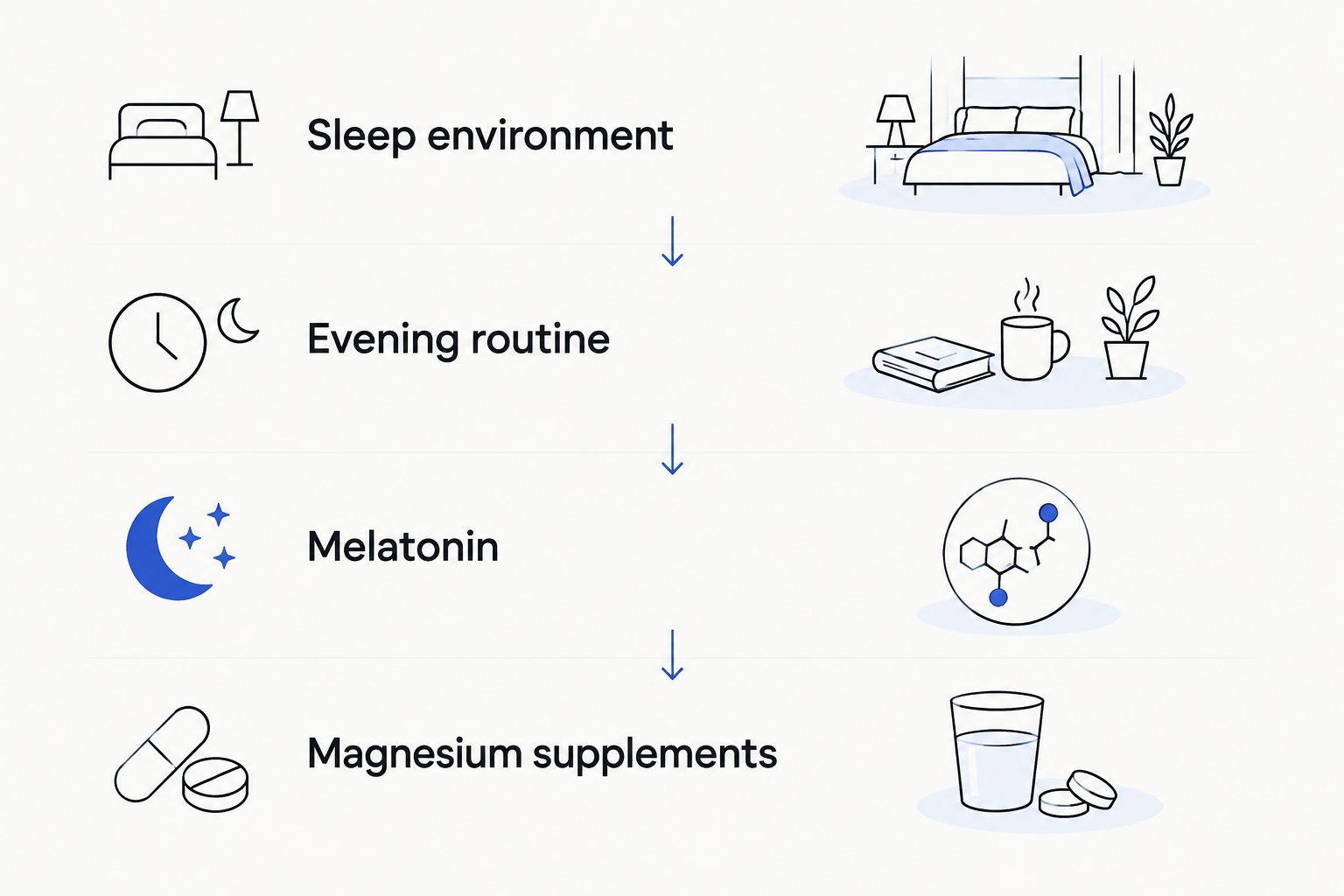
There is no single best option for every traveler. Choose by the problem you are addressing, then check the limitations. The table separates routine support, sleep-timing questions, and practical changes rather than ranking unlike options as if they do the same job.
| Option | Best for | Main advantage | Key limitation |
|---|---|---|---|
| Sleep environment and schedule changes | Travelers dealing with noise, light, or insufficient sleep time | Directly address conditions that interfere with rest | Cannot remove every disruption or immediately resolve a time-zone mismatch |
| TruNutra Sleep Ease Duo | Adults considering supplement support for a consistent evening routine | Described as supporting nighttime relaxation and restful sleep quality | Requires a label and safety review; the supplied description does not establish jet-lag benefits |
| Melatonin | Travelers discussing time-zone adjustment with a qualified health professional | Has a role in sleep-timing guidance | Timing matters, and suitability depends on individual circumstances |
| Magnesium supplements | Adults with a nutrition-related reason to consider magnesium | Address magnesium intake when appropriate | Research does not establish magnesium as a reliable travel sleep solution |
Choose the option that matches the problem, not the one with the broadest promise. A quieter room is the relevant first move when noise keeps waking you. A sleep-timing discussion is more relevant when your destination bedtime feels like daytime to your body.
Magnesium deserves particular caution when shopping by ingredient reputation. The National Center for Complementary and Integrative Health describes research on magnesium for insomnia as limited. That is not a basis for promising better sleep on a flight or after arrival.
For any supplement, inspect the actual label rather than relying on the category name. A blend’s ingredients, directions, and warnings determine what you need to discuss with a health professional. Product names alone do not establish dosage, interactions, testing, or suitability.
Common mistakes frequent travelers make
Treating a flight as a product trial
An unfamiliar supplement adds uncertainty when you cannot easily change your surroundings. You also need to respond to crew instructions and manage connections after landing. Review suitability before travel, and do not make an overnight flight your first experiment with a sleep product.
Expecting a bedtime formula to reset the body clock
Relaxation and time-zone adjustment are not the same outcome. A product described as supporting an evening routine should not be presented as a jet-lag treatment without supporting evidence. Match the stated purpose to your actual need.
Combining products with overlapping ingredients
A bedtime blend, a separate capsule, and an occasional sleep medicine can complicate the same routine. Compare labels before combining anything, and let a pharmacist review the complete list. More ingredients do not establish a better result.
Ignoring the morning after
A plan that focuses only on falling asleep misses airport transfers, unfamiliar roads, and early work commitments. Review warnings and protect enough time for rest. Do not drive or perform safety-sensitive work if you feel drowsy, regardless of what you took.
Repacking without checking destination rules
Loose capsules make it harder to identify what you are carrying. Keep product information available and verify entry requirements through official sources for your 2026 destination. Do not assume that an ingredient permitted at home is permitted everywhere.
FAQ
What's the best sleep supplement for frequent travelers?
There is no single best sleep supplement for every frequent traveler. Start with your sleep problem, itinerary, current medicines, and label directions; a relaxation-focused product and a sleep-timing approach serve different purposes.
Is melatonin better than a bedtime supplement blend for jet lag?
Melatonin is more directly relevant to a discussion about sleep timing than an unspecified bedtime blend. Ask a qualified health professional about suitability and timing for your route rather than assuming that any sleep product addresses jet lag.
Can I take TruNutra Sleep Ease Duo when I travel?
Consider TruNutra Sleep Ease Duo for its stated purpose of supporting a consistent evening routine, after reviewing the current label and your individual circumstances. Its supplied description supports nighttime relaxation and restful sleep quality, not a promise to prevent jet lag.
Should I take a new sleep supplement on an overnight flight?
Do not use an overnight flight as your first trial of an unfamiliar sleep supplement. Review suitability before departure and account for connections, crew instructions, and responsibilities after landing.
Can I combine a sleep supplement with alcohol on a flight?
Do not combine sleep supplements with alcohol unless a qualified health professional has specifically advised you. Review the product warnings and any other medicines you take before departure.
Does magnesium reliably help travelers sleep?
Magnesium is not established as a reliable travel sleep solution. Research on magnesium for insomnia is limited, so choose it for an appropriate nutrition-related reason rather than expecting it to correct jet lag.
How should I pack sleep supplements for international travel?
Keep supplements in their original labeled packaging when practical and check official destination requirements before departure. Product labels help identify the contents, but packaging alone does not establish permission to carry an ingredient across a border.
One last thing
Plan the morning before choosing the evening supplement. Put your next wake-up time, transfer, and first responsibility at the top of your 2026 travel checklist. If the plan leaves too little time to sleep, change the plan where you can—not the serving size.
A useful travel routine is one you can follow safely when plans change. Keep it simple enough that a delayed arrival does not send you searching for extra products or guessing about timing.