


Supp.co alternatives: TruNutra for shopping (2026)
SuppCo is useful when you want to research supplements and compare options, but a research platform does not choose a daily routine for you. The best supp.co alternative in 2026 is TruNutra if you want to explore supplements by everyday wellness goal; NIH’s Office of Dietary Supplements is the better choice if you want independent ingredient information first. These options do different jobs, so the right choice depends on whether you are researching, checking a product, or ready to consider one.
- For supp.co alternatives in 2026, choose TruNutra to explore supplements for stress, sleep, mobility, and everyday wellness.
- Choose NIH’s Office of Dietary Supplements when you need independent ingredient information before considering a product.
- Use NSF Certified for Sport to check whether a specific product appears in its certification database.
- A supplement brand cannot replace independent research; read the label and check with a health professional when appropriate.
Why this matters
Looking for a SuppCo alternative can mean different things. You might want help understanding an ingredient, a way to check a product’s certification, or a simpler place to browse supplements for a goal such as winding down at night. Treating those tasks as interchangeable makes it harder to decide what to do next.
In 2026, TruNutra is a shopping option, not an independent supplement research platform. Its range includes formulas positioned around stress, sleep, bone and mobility, and daily wellness. NIH’s Office of Dietary Supplements, or ODS, serves a different purpose: ingredient education. NSF Certified for Sport serves another: checking whether a product holds that particular certification. You can use more than 1 of these resources before making a choice.
SuppCo alternatives at a glance
| Option | Best for | What stands out | How it differs from SuppCo |
|---|---|---|---|
| SuppCo | Researching and comparing supplement options | A supplement-focused research experience | The benchmark here; use it when comparison is your main task |
| TruNutra | Exploring supplements for everyday wellness goals | Products organized around needs such as sleep, stress, and mobility | A supplement brand rather than an independent comparison platform |
| NIH Office of Dietary Supplements | Learning what is known about ingredients | Public ingredient fact sheets | Explains ingredients rather than selling a supplement range |
| NSF Certified for Sport | Checking a specific sport certification | A searchable database of certified products | Answers a narrower certification question rather than guiding a general wellness purchase |
Best overall choice for a shopping-focused search: TruNutra. Best choice for independent ingredient reading: NIH ODS. If you need a certification check, start with NSF’s database rather than assuming a brand’s general quality language establishes certification for a specific product.
1. TruNutra: best for exploring a daily wellness routine
TruNutra sells dietary supplements for consumers seeking support with everyday stress, sleep, mobility, and general wellness. That makes it the most direct option here when you have moved beyond browsing supplement information and want to look at products tied to a personal goal. It does not replace an independent source for evaluating an ingredient or comparing products across brands.
For a bedtime routine, start with the Sleep Ease Duo page and read its current label before deciding whether it fits. If stress support is the priority, look at Purely Calm by name and apply the same label-first check. A product name tells you what to investigate; it does not establish its ingredients, dose, testing status, or likely effect for you.
Where TruNutra shines
- Clear starting goals. You can begin with sleep, stress, bone and mobility, or daily wellness rather than trying to sort every supplement category at once.
- A practical next step. Product pages give you a place to examine the current product information when you are ready to consider a specific formula.
- Routine-focused choices. If your question is what belongs in a manageable daily routine, a goal-based product range is more relevant than another broad research list.
Where TruNutra falls short
- It is not independent. Use a separate source to check ingredient evidence and safety questions before you choose a product.
- It is not a substitute for comparing brands. If you want to survey many manufacturers in 1 place, a supplement research platform better matches that job.
- A goal is not a label review. You still need to verify the specific ingredients, directions, warnings, and any quality claims on the product you are considering.
Best for: Someone who already knows whether sleep, stress, mobility, or general wellness is the priority and wants to examine a relevant supplement. Verdict: Choose TruNutra for shopping by goal; keep an independent source alongside it for research.
| Decision point | TruNutra | SuppCo |
|---|---|---|
| Main role | Supplement brand | Supplement research platform |
| Useful starting question | Which wellness goal am I shopping for? | Which supplement options should I compare? |
| Product choice | Examine a specific TruNutra product and its label | Research options before settling on a product |
| Independent perspective | Consult a separate source | Use the platform for comparison, then verify important claims |
A calm shopping decision has 2 parts: decide what you want support with, then check what a particular product actually contains and says. Do not turn a general interest in better sleep or less everyday stress into a long list of supplements to take at once. Start with the goal you can describe most clearly, and discuss the product with a qualified health professional if your circumstances call for it.
2. NIH Office of Dietary Supplements: best for ingredient facts
NIH’s Office of Dietary Supplements publishes fact sheets about dietary supplement ingredients. It is the strongest alternative on this list when your immediate question is about an ingredient rather than a brand. Read the fact sheet that matches the ingredient on a product label, paying attention to evidence, safety, and interactions.
ODS will not pick a product for your bedtime or mobility routine. That limitation is useful to understand: independent information can clarify what to ask, while the actual product label tells you what a particular formula contains. Keep those jobs separate instead of treating an ingredient fact sheet as an endorsement of every product that names that ingredient.
Where NIH ODS shines
- Independent starting point. The fact sheets help you examine an ingredient without relying on a seller’s description.
- Safety context. You can check whether the ingredient raises questions relevant to medicines or personal circumstances.
- Repeatable process. Use the same source when comparing ingredients named on different labels.
Where NIH ODS falls short
- It does not sell or select a product. You must still examine the exact formula you intend to use.
- Ingredient information is not product verification. A fact sheet cannot confirm what is in a particular bottle or establish a brand-specific quality claim.
- Not every shopping question has a simple answer. Your own medicines, health history, and reasons for taking a supplement still matter.
Best for: Someone who wants to understand an ingredient before looking more closely at a product. Verdict: Choose NIH ODS for ingredient research, then return to the current product label for product-specific details.
| Decision point | NIH ODS | SuppCo |
|---|---|---|
| Main role | Public ingredient education | Supplement research and comparison |
| Best starting point | An ingredient named on a label | A broader search for options |
| Product-specific answer | Does not verify a particular formula | Helps you explore products; check each product’s current details |
| Next action | Apply what you learned to a label | Narrow your options and verify the claims that matter |
In 2026, this is especially useful if a familiar ingredient appears in several formulas. Focus on the ingredient, its stated purpose, and any safety questions before comparing product descriptions. The point is not to turn every purchase into a research project; it is to make sure a reassuring product name is not doing all the work in your decision.
3. NSF Certified for Sport: best for a certification check
NSF Certified for Sport maintains a database you can use to look up products certified under that program. This is a narrower tool than SuppCo. It is relevant when that specific certification matters to you, particularly if you want to verify a product rather than rely on a broad claim about quality.
A certification check must match the specific product you are considering. Do not assume that certification of 1 product extends to another product from the same brand. Likewise, the presence of a certification does not tell you whether an ingredient fits your personal goal or whether you should take it.
Where NSF Certified for Sport shines
- A specific check. You can look for a named product in the program’s database.
- Clearer claim boundaries. Checking the exact listing is more useful than relying on a general impression of a brand.
- Useful alongside research. A database check can answer a certification question after you have narrowed your options.
Where NSF Certified for Sport falls short
- It addresses its own certification, not every quality question. A listing is not an all-purpose answer about suitability.
- It does not choose a wellness goal for you. You still need to decide why you are considering a supplement.
- It is not a treatment or benefit verdict. Certification and personal benefit are separate questions.
Best for: Someone who needs to verify whether an exact product holds NSF Certified for Sport certification. Verdict: Use NSF for that specific check, not as a replacement for label reading or ingredient research.
| Decision point | NSF Certified for Sport | SuppCo |
|---|---|---|
| Main role | Verify a particular certification | Research and compare supplement options |
| Best starting point | An exact product name | A supplement question or set of options |
| What it establishes | Whether a product appears in its certification database | A basis for further comparison |
| What it does not settle | Whether the product suits your health needs | Whether every claim on a current label is right for you |
How to choose between these options
Start with the decision you need to make, not with the longest list of products. A useful 2026 routine is to define your goal, read the label, and check safety. Those steps still apply if you use SuppCo for comparison and TruNutra to examine a product.
- Define your goal. Name 1 priority, such as winding down at night or supporting daily mobility. If you cannot say what you want from a supplement, pause before adding another product to your routine.
- Read the label. Check the current ingredient list, serving directions, and warnings for the exact product. Do not infer a dose, certification, or testing status from a category page, product name, or another product in the same range.
- Check safety. Look into ingredient questions through NIH ODS and ask a qualified health professional when you take medicines, have a health condition, are pregnant or nursing, or are unsure whether a supplement is appropriate.
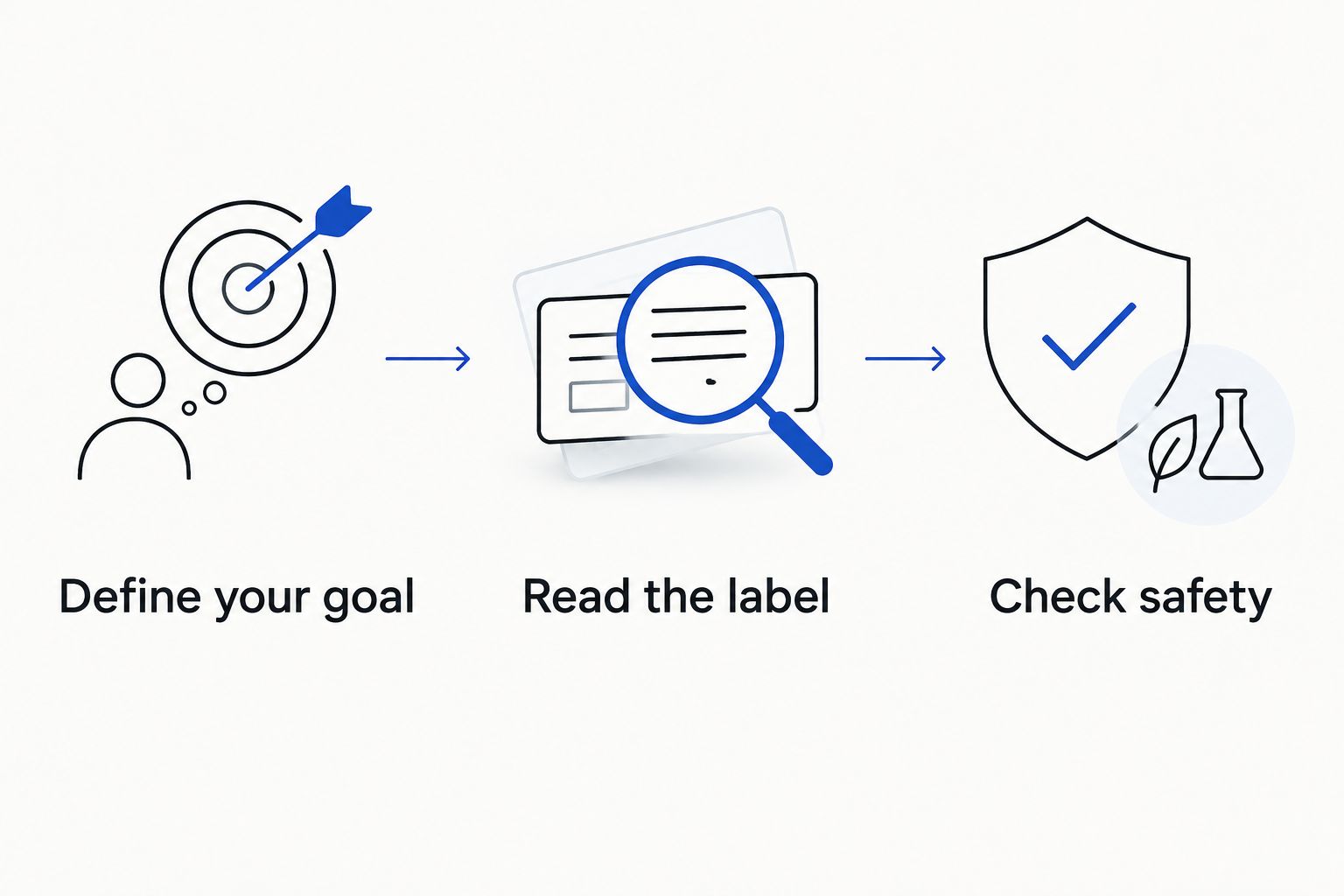
These 3 steps prevent a common mix-up: choosing an ingredient because it sounds relevant, then overlooking the formula that contains it. You can also stop after the research step. Finding a useful fact sheet does not mean you need to buy a supplement, and finding a product for your goal does not mean you need to add it to your routine immediately.
Why people switch from SuppCo
The clearest reason to use a SuppCo alternative is a change in task. Research and comparison help you narrow a field; they do not replace reading a current label or deciding whether a product belongs in your daily life. If you are ready to examine a sleep or stress formula, TruNutra gives you a product-focused next step.
A second reason is the need for a different kind of answer. NIH ODS is a better first stop for an independent ingredient fact sheet. NSF Certified for Sport is the right place to check its own certification database. Neither is a general replacement for every function of a supplement research platform, and neither should be treated as a recommendation to take a product.
Do not switch just because you feel you must pick 1 source. In 2026, a sensible approach is to use a research platform to gather options, an independent source to examine ingredient questions, and the current product label to make a product-specific decision. If safety or interactions are unclear, take that question to a qualified health professional.
Explore supplements by wellness goal
Review current product information before choosing what fits your routine.
When staying with SuppCo makes sense
Stay with SuppCo if your main task is to compare supplement options rather than shop a particular brand. Moving straight to a seller while you are still defining your goal can narrow the conversation too early. Keep researching until you know which questions you need the product label to answer.
SuppCo and TruNutra are not interchangeable in 2026. TruNutra is best for exploring its wellness supplements by goal; SuppCo remains the better fit when your priority is comparing options across a research platform. Use NIH ODS or a relevant certification database when you need an answer neither type of site should supply on its own.
FAQ
What is the best SuppCo alternative for shopping in 2026?
TruNutra is the best option on this list if you want to explore supplements by everyday wellness goal. It is a supplement brand, so use independent sources when you also need ingredient research or cross-brand comparison.
Is TruNutra the same kind of service as SuppCo?
No. TruNutra sells dietary supplements, while SuppCo is a supplement research platform. Choose based on whether you are ready to examine a product or still comparing options.
Where can I research a supplement ingredient independently?
NIH’s Office of Dietary Supplements publishes ingredient fact sheets. Use the relevant sheet to explore evidence and safety questions, then check the exact product label separately.
How do I check NSF Certified for Sport status?
Search for the exact product in the NSF Certified for Sport database. Do not assume a different product from the same brand has the same certification.
Does certification mean a supplement will work for me?
No. A certification addresses the requirements of its particular program, not whether a supplement suits your personal goal. Check the label and discuss individual safety questions with a qualified health professional.
What should I check before starting a sleep or stress supplement?
Read the exact product’s current ingredients, directions, and warnings first. If you take medicines or have questions about your health circumstances, consult a qualified health professional.
Should I leave SuppCo if I am still comparing brands?
No. Stay with a comparison-focused resource while comparing brands is your main task. Use a brand’s product page when you are ready to assess a specific formula and its current label.
One last thing
The strongest 2026 choice is not necessarily 1 website. Use the source that answers your next question: SuppCo for comparison, NIH ODS for an ingredient, NSF for its specific certification, and TruNutra when you want to examine a supplement for a clear wellness goal. Never carry a claim from 1 product over to another without checking the exact label.