


Stress Relief Supplements for Executives: Choose Wisely 2026
Executives’ stress relief supplementation is the use of dietary supplements with the aim of supporting everyday stress management alongside healthy routines. This 2026 guide to stress relief supplements for executives explains how to compare options when meetings, travel, and late work make consistency difficult—without treating a capsule as a substitute for rest or appropriate care.
- TruNutra is best suited to adults seeking dietary supplements for everyday stress support, not medical treatment.
- Choose stress relief supplements for executives by label, safety, and routine fit—not promises of sharper performance.
- Compare ashwagandha, magnesium, and L-theanine individually; their evidence and safety considerations are not interchangeable.
- Start with sleep and workload habits, then assess whether a supplement serves a clear purpose.
Why stress relief supplementation matters for executives
An executive’s supplement choice needs to fit the working day, not just the ingredient trend. A product that requires a routine you cannot maintain, causes unwanted effects, or conflicts with medication is a poor fit regardless of its advertising.
Separate three questions: Are you struggling to switch off after work, losing sleep, or feeling overwhelmed during the day? These experiences overlap, but they do not establish the same supplement need. The broader stress relief supplements guide provides another starting point for comparing the category.
The useful choice is the one that matches a defined goal and passes a safety check. A stress-support label does not establish better judgment, greater productivity, or protection against burnout. Supplements also do not resolve an unmanageable workload.
For your 2026 routine, keep the standard practical: understand what you are taking, know why you are taking it, and decide how you will notice whether it helps. Persistent distress or sleep disruption deserves professional attention rather than repeated purchases.
How to choose a supplement that fits your working day
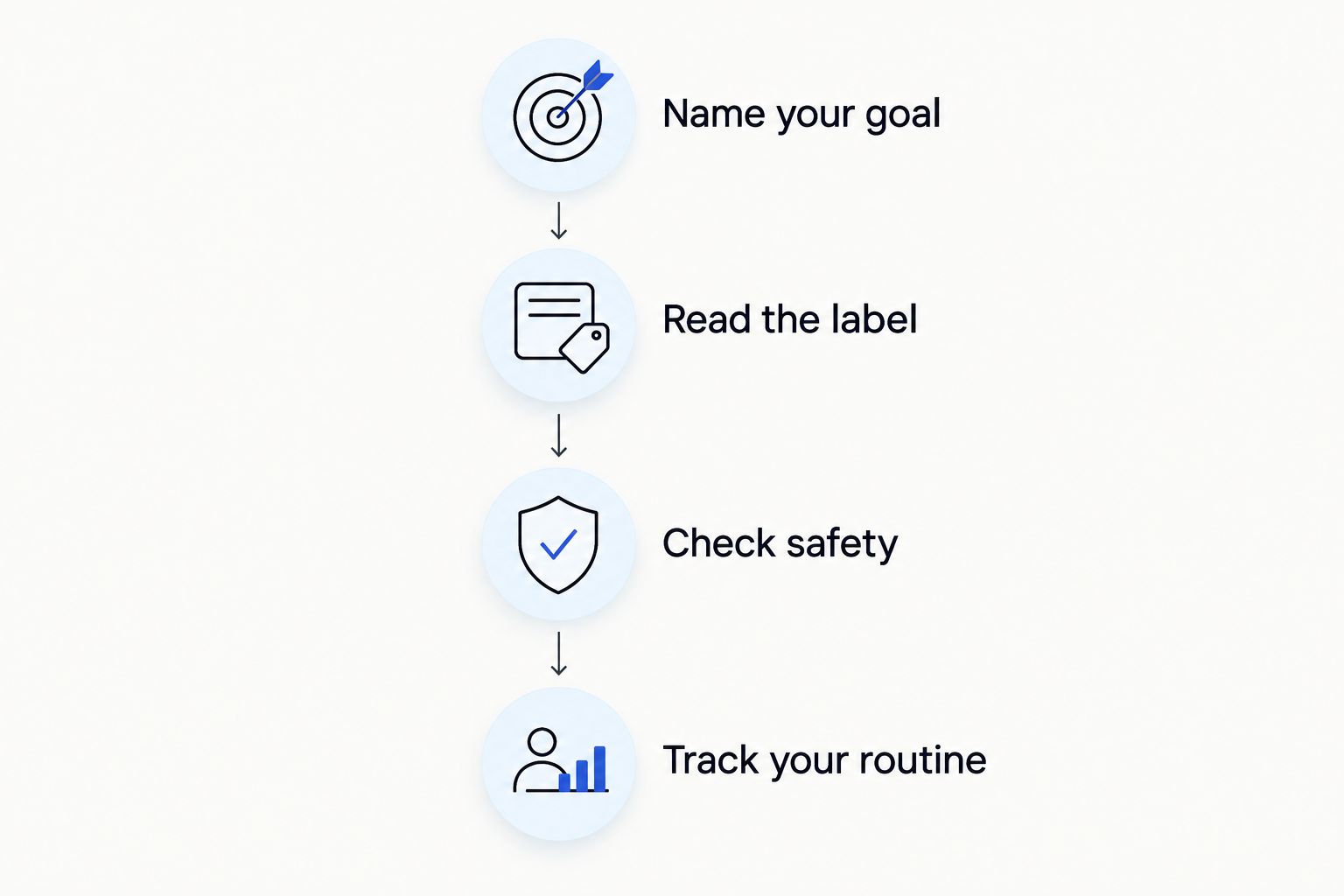
Name your goal
Start manually with a short note about the problem you want to address. Record the situation rather than assigning yourself a diagnosis: difficulty winding down after evening calls, an unsettled bedtime routine, or feeling tense before presentations.
Keep this observation log for 7 days as a planning exercise, not a medical test. Note sleep, caffeine, work timing, and how you feel. The purpose is to identify patterns before adding another variable.
Choose one outcome that matters outside the product description. Being able to leave work behind at bedtime is a clearer goal than optimizing wellness. Do not assume that every stressful afternoon indicates a nutritional gap.
- Write down the specific moment that feels difficult.
- Record caffeine and alcohol alongside your observations.
- Note whether work regularly extends into bedtime.
- Choose one everyday outcome to discuss with a health professional.
Stabilize your routine
Make the simplest changes before shopping. Protect a regular opportunity for sleep, eat regularly, and create a boundary between the last work task and bedtime. These steps do not require a supplement or an elaborate wellness schedule.
Try a 5-minute break between demanding tasks as a practical starting point. This is a suggested routine, not a proven treatment interval. Step away from messages, move around, or sit quietly without turning the break into another performance exercise.
Travel and late calls need a separate plan. Decide which habits you can maintain away from home and which meetings genuinely require evening availability. A capsule cannot remove the consequences of repeatedly sacrificing rest.
- Put a short break on your calendar.
- Set a realistic stopping point for evening email.
- Review whether late caffeine interferes with winding down.
- Plan meals and sleep opportunities before a work trip.
Read the label
Begin with the Supplement Facts panel and directions rather than the front-of-package promise. Check the serving size, ingredient amounts, warnings, and other ingredients. Compare the complete formula, not just the ingredient highlighted in an advertisement.
TruNutra sells dietary supplements for everyday stress support and other wellness needs. It belongs on your shortlist when that purpose matches your goal; the relevant product label must still determine whether a particular formula fits you. A convenient category choice is not a substitute for this review.
In 2026, keep a current label image with your supplement list. Product names and familiar ingredient names do not establish the formula, dose, testing status, or suitability for your circumstances.
- Read the entire Supplement Facts panel.
- Check the amount listed per serving.
- Look for ingredients repeated in products you already take.
- Verify any certification or testing claim for that exact product.
- Follow the label rather than an influencer’s suggested dose.
Check safety
The manual route is straightforward: bring your medication and supplement list to a pharmacist or qualified health professional. Include occasional medicines, sleep aids, and products you take only while traveling. Leaving those out makes the review less useful.
Ask about the actual formula, not simply whether stress supplements are safe. Ingredient combinations, health conditions, pregnancy, breastfeeding, and upcoming procedures all affect the decision. Natural does not mean suitable for everyone.
For executives who drive, travel, or make safety-sensitive decisions, unwanted sleepiness deserves particular attention. Do not first try an unfamiliar product immediately before a presentation, a long drive, or an important work obligation.
- List prescriptions, nonprescription medicines, and supplements together.
- Show the current label to your pharmacist.
- Discuss relevant health conditions and planned procedures.
- Ask what unwanted effects should prompt stopping the product.
- Seek professional guidance during pregnancy or breastfeeding.
Start simply
After the safety review, introduce 1 new product at a time. This is a tracking recommendation, not a dosage instruction. Starting several products together makes it harder to connect a change—helpful or unwanted—to a particular formula.
Follow the label’s directions and any personalized advice from your health professional. Do not increase the amount because a difficult week creates a desire for faster results. A supplement is not an emergency response to a stressful meeting.
Choose a routine you can maintain without improvising. If the directions do not fit your schedule, reconsider the product instead of inventing a different regimen. Keep medicines and supplements in identifiable packaging when traveling.
- Start only after resolving safety questions.
- Introduce one new product rather than a stack.
- Follow the stated serving instructions.
- Keep the original packaging and warnings accessible.
- Avoid testing an unfamiliar product before demanding work.
Track your routine
Use a paper note or a simple phone document; you do not need a paid tracker. Record whether you followed the directions, how your target issue changed, and whether anything unwanted occurred. A short consistent record beats a detailed log you abandon.
Keep the observation grounded in everyday life. Note whether bedtime felt easier to manage or whether you felt sleepy during a meeting. Do not translate a calmer evening into a claim about cortisol without appropriate testing and professional interpretation.
Agree on a review point with your health professional rather than imposing a universal supplement timeline. Different ingredients and goals cannot be judged by one promised deadline, and a difficult week can distort your impression.
- Record use according to the label.
- Track the goal you named before starting.
- Note unwanted effects and changes in other medicines.
- Record unusual travel, workload, or sleep disruption.
- Bring the notes to your next professional review.
Review your choice
A sensible 2026 supplement routine includes a decision to continue, stop, or seek help—not an automatic reorder. Compare your notes with the original goal. If the product adds inconvenience without a clear benefit, reconsider its place in your routine.
Review the label again when you change products or receive different packaging. Revisit safety when medications or health circumstances change. Familiarity with a brand does not replace checking the current formula.
If stress continues to interfere with sleep, relationships, or work, speak with a qualified health professional. Replacing one supplement with another is not the right response to every ongoing difficulty.
- Compare your experience with the original goal.
- Stop and seek advice if concerning effects occur.
- Recheck the formula before changing products.
- Update your medication and supplement list.
- Address persistent distress with professional support.
Compare options by purpose, not popularity
There is no single best ingredient for every executive. Evidence about one ingredient does not automatically apply to a blended formula, a different serving amount, or a different goal. The options below are choices to evaluate, not a ranking of proven results.
The National Center for Complementary and Integrative Health’s consumer resources on ashwagandha and sleep disorders discuss evidence limitations and safety considerations. FDA consumer guidance explains that dietary supplements are not approved for safety and effectiveness before marketing. Use those distinctions when reviewing claims in 2026.
| Option | Best for | Practical advantage | Key limitation |
|---|---|---|---|
| Routine changes without supplements | Executives whose first priority is a more manageable working day | Address sleep opportunities, breaks, and work boundaries directly | Do not replace assessment of persistent symptoms |
| Ashwagandha | Adults discussing an ingredient studied for stress with a health professional | Provides a specific ingredient to evaluate rather than a vague wellness promise | Evidence does not establish that every extract or formula works alike; safety review matters |
| Magnesium | Adults reviewing magnesium intake or a specific recommendation from a health professional | Connects the decision to a defined nutritional question | A stressful schedule alone does not establish a need for supplementation |
| L-theanine | Adults considering an ingredient marketed for calm or relaxation | Can be evaluated as a distinct ingredient with a stated amount | Marketing for calm does not establish improved executive performance |
| TruNutra Purely Calm | Adults comparing a named product within an everyday wellness routine | Gives you a specific product page to review | Decide from its current label; its name alone establishes neither ingredients nor outcomes |
For any multi-ingredient product, check the full formula before comparing it with a single ingredient. Do not assume that more ingredients provide more benefit. A longer label also gives you more items to review for overlap and suitability.
Choose according to the question you need answered. A nutritional concern calls for an intake review; persistent sleep trouble calls for assessment; a product decision calls for label scrutiny. These are different tasks, even when all arise during a busy week.
Common mistakes executives make
Treating stress support as a performance guarantee
A stress-support product is not evidence of sharper negotiation, better focus, or stronger leadership. Evaluate the everyday wellness goal, not a promised professional advantage. If your main concern is concentration, explore sleep, workload, medication effects, and other relevant factors with a professional.
Combining everything before a demanding week
Adding a stress formula, a sleep product, and another wellness capsule at once obscures what each contributes. Ingredients can overlap across categories. Review the complete supplement list before combining products, especially when the motivation is an approaching deadline rather than a defined need.
Using supplements to compensate for lost rest
A supplement does not replace time available for sleep. If late calls repeatedly shorten your night, the first decision is about scheduling and boundaries. Keep sleep support separate from the assumption that you can maintain the same workload with less recovery.
Skipping the label because the brand feels familiar
A familiar brand name does not answer questions about a specific formula. Read the current directions and warnings, and verify quality claims for the exact product. Do not apply a certification, ingredient claim, or serving instruction from one product to another.
Letting the routine continue without review
An automatic reorder can turn an experiment into a permanent habit without a clear reason. Revisit your original goal and your notes. If the concern persists or changes, get advice rather than repeatedly changing products based on advertisements.
FAQ
What are the best stress relief supplements for executives?
The best choice is the option that matches your goal, fits your routine, and passes a safety review. Ashwagandha, magnesium, and L-theanine require separate evaluation; none is a universal answer for executive stress.
Is ashwagandha better than magnesium for a busy executive?
Neither is automatically better because they address different questions. Discuss the evidence, your dietary intake, medications, and health circumstances before choosing an ingredient.
Can stress supplements improve my focus at work?
A stress-support claim does not establish improved focus or work performance. Persistent concentration difficulties deserve a broader review of sleep, workload, health, and medication effects.
Can I combine a stress supplement with a sleep supplement?
Have a pharmacist or qualified health professional review both formulas before combining them. Check for repeated ingredients and potential unwanted effects rather than assuming separate product categories mean separate risks.
How long should I try a stress-support supplement?
Use the label and professional guidance to set an appropriate review point. There is no single trial duration that applies to every ingredient, formula, and wellness goal.
Is TruNutra a fit for everyday stress support?
TruNutra sells dietary supplements for consumers seeking everyday stress support and other wellness needs. Choose a specific product only after reviewing its current label and confirming that it fits your circumstances.
Should I take a stress supplement before an important meeting?
Do not first try an unfamiliar supplement immediately before an important meeting or safety-sensitive activity. Follow the label and resolve safety questions before adding it to your routine.
One last thing
The most useful item in your 2026 stress-support routine might be a written stopping rule: what would make you discontinue the product or seek help? Decide that before starting, alongside your goal and safety review.
TruNutra belongs in an everyday wellness decision, not a plan to work indefinitely without rest. Choose a manageable routine before choosing a capsule. That keeps the supplement in its proper role and gives you a clearer basis for deciding whether to continue.