


Magnesium Supplements Ranked by Absorption in 2026
Magnesium comes in more than a dozen forms, and the difference between them comes down to one thing: how well your body actually absorbs it. This guide ranks the most common magnesium supplements by absorption in 2026, so you can match the form to the reason you're taking it — sleep, muscle relaxation, bone support, or steady daily intake.
- Magnesium glycinate ranks best overall for absorption and gentle digestion, especially for sleep and stress routines in 2026.
- Magnesium citrate absorbs well and costs less, though higher doses can loosen stools.
- Magnesium oxide has the lowest absorption of the common forms — skip it when bioavailability is the goal.
- Magnesium L-threonate suits cognitive-focused routines; magnesium malate fits daytime energy and muscle recovery.
- Adults need 310-420 mg of magnesium daily per NIH guidelines, and most people fall short of that.
Why this matters
Magnesium is involved in over 300 enzyme systems in the body, according to the National Institutes of Health Office of Dietary Supplements — everything from muscle function to nerve signaling runs through it. Yet the form on the label matters almost as much as the dose.
Magnesium oxide, the cheapest and most common form in multivitamins, is also the least absorbed. Magnesium glycinate, citrate, and a handful of other chelated or bound forms absorb noticeably better and tend to sit easier on the stomach. If you've tried a magnesium supplement before and felt nothing — or worse, spent the next hour in the bathroom — the form is usually the reason. TruNutra's magnesium glycinate supplements guide breaks down that specific form in more depth if that's where you land after reading this.
Adults generally need 310-320 mg per day for women and 400-420 mg per day for men, per NIH figures. Most US diets fall short of that range, which is why magnesium is one of the more commonly recommended everyday supplements for stress, sleep, and mobility support.
The ranked verdict
Best overall: Magnesium Glycinate. Best for cognitive-focused routines: Magnesium L-Threonate. Best budget option: Magnesium Citrate. Best for daytime energy and muscle recovery: Magnesium Malate. Best for heart-focused routines: Magnesium Taurate. Skip for absorption: Magnesium Oxide.
What makes the best magnesium supplement
- Elemental magnesium content — how much actual magnesium is in each dose, not just the compound weight
- Bioavailability — how efficiently the form crosses the gut wall into the bloodstream
- Digestive tolerance — whether the form causes loose stools at normal doses
- Purity and testing — whether the product has been tested for contaminants and label accuracy
- Dosage clarity — a label that states elemental magnesium per serving, not just total compound weight
- Fit for your goal — sleep, energy, cognition, and heart-focused routines don't all call for the same form
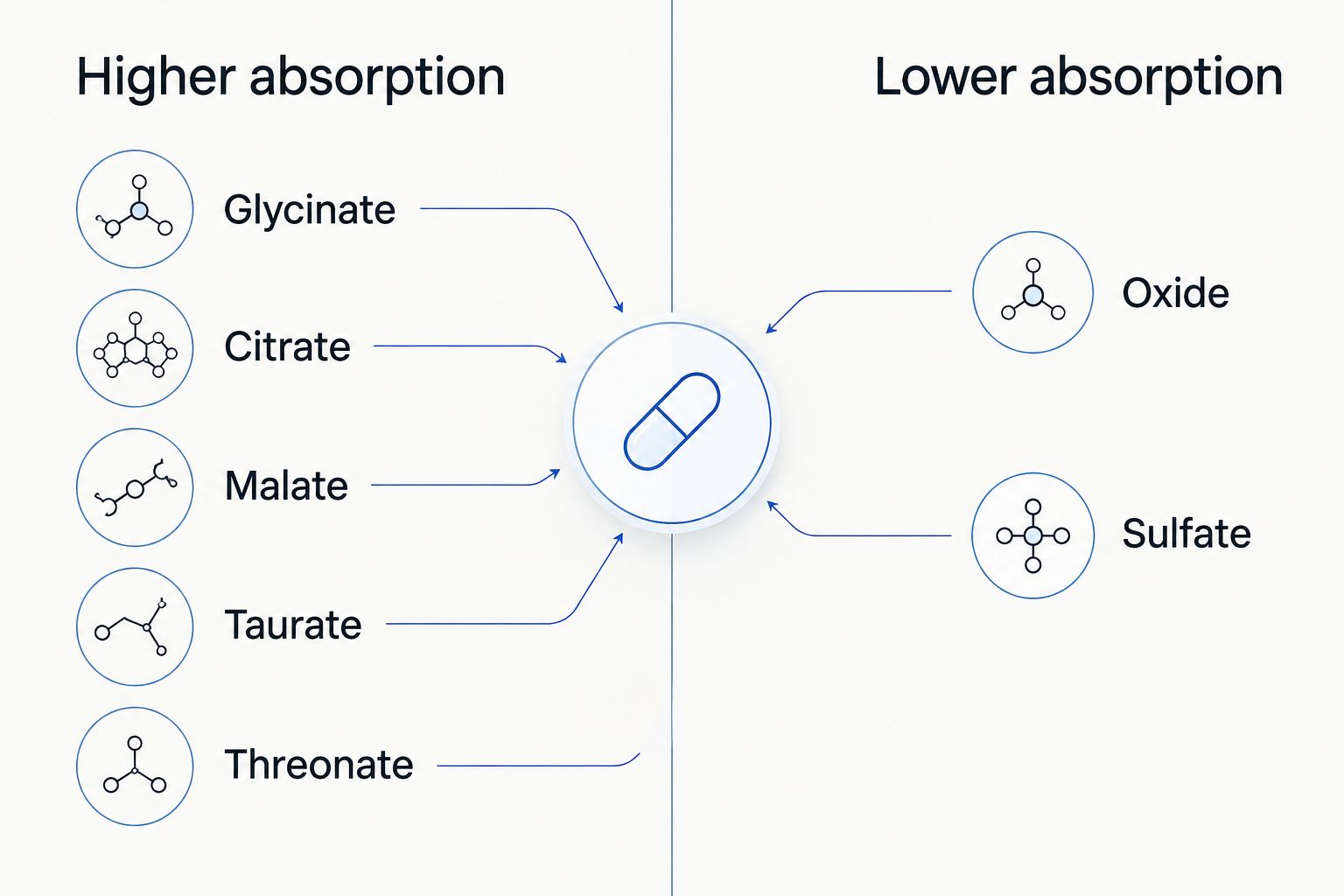
Magnesium forms at a glance
| Form | Best For | Absorption | Key Limitation |
|---|---|---|---|
| Glycinate | Sleep and stress support | High | Costs more per serving than oxide or citrate |
| Citrate | Budget-friendly daily use | High | Can cause loose stools at higher doses |
| L-Threonate | Cognitive-focused routines | High | Lower elemental magnesium per capsule |
| Malate | Daytime energy and muscle recovery | Moderate to high | Less studied specifically for sleep |
| Taurate | Heart-focused routines | Moderate to high | Fewer product options on the market |
| Oxide | Occasional constipation relief only | Low | Least absorbed, common GI upset |
1. Magnesium Glycinate: best magnesium supplement for sleep and stress
Magnesium glycinate binds magnesium to the amino acid glycine, which slows absorption in a way that's easier on the gut than citrate or oxide. Glycine itself has a calming reputation, which is why this pairing shows up so often in nighttime and stress-support formulas. It's roughly 14% elemental magnesium by weight, so serving sizes tend to run larger than oxide-based products.
Magnesium glycinate pros:
- High bioavailability with minimal GI upset for most people
- Pairs naturally with evening and stress-relief routines
- Doesn't carry the laxative effect common to citrate and oxide
Magnesium glycinate cons:
- Typically priced higher than citrate or oxide per serving
- Capsule counts run higher since elemental magnesium per dose is modest
- Not the form to reach for if constipation relief is the actual goal
Best for: anyone building a wind-down routine or managing everyday stress. For a deeper look at how magnesium fits into sleep support specifically, see TruNutra's guide to magnesium supplements for sleep.
Verdict: Buy.

2. Magnesium Citrate: best budget magnesium supplement
Magnesium citrate binds magnesium to citric acid and absorbs well relative to its low cost, which is why it's a common choice in drugstore aisles. It carries about 16% elemental magnesium by weight, decent for the price point.
Magnesium citrate pros:
- Solid absorption for a lower cost per serving
- Widely available and well studied
- Reasonable elemental magnesium yield
Magnesium citrate cons:
- Higher doses commonly cause loose stools
- Less targeted toward sleep or cognitive goals than glycinate or threonate
- Flavor and mixability vary by brand in powder form
Best for: budget-conscious buyers who want a general daily magnesium without paying a premium.
Verdict: Buy for general use, Hold if you're sensitive to GI upset.
3. Magnesium L-Threonate: best for cognitive-focused routines
Magnesium L-threonate was developed specifically to cross into brain tissue more effectively than most other forms, which is why it shows up in cognitive-support formulas rather than general multivitamins. It's a newer, more specialized compound and typically the priciest option on this list.
Magnesium L-threonate pros:
- Formulated to reach brain tissue more effectively than standard forms
- Well tolerated with low reported GI upset
- A distinct niche use case among magnesium forms
Magnesium L-threonate cons:
- Delivers less elemental magnesium per capsule than glycinate or citrate
- Costs more per serving than almost any other form
- Overkill if your only goal is meeting a daily magnesium target
Best for: readers specifically chasing a cognitive angle rather than general magnesium repletion.
Verdict: Hold unless cognitive support is the specific reason you're supplementing.
4. Magnesium Malate: best for daytime energy and muscle recovery
Magnesium malate pairs magnesium with malic acid, a compound involved in the body's energy production cycle. It's often positioned for daytime use and post-exercise recovery rather than sleep, since it doesn't carry the same calming reputation as glycinate.
Magnesium malate pros:
- Reasonable absorption with fewer GI complaints than citrate at equal doses
- Fits naturally into daytime or pre/post-workout routines
- Malic acid adds a secondary role in cellular energy pathways
Magnesium malate cons:
- Less researched specifically for sleep or stress compared to glycinate
- Fewer brands carry it compared to citrate or glycinate
- Not the first choice if nighttime relaxation is the goal
Best for: active adults who want magnesium alongside a daytime energy or recovery routine.
Verdict: Buy for daytime and post-exercise use.
5. Magnesium Taurate: best for heart-focused routines
Magnesium taurate combines magnesium with taurine, an amino acid studied for its role in cardiovascular function. It's a smaller category of the magnesium market, mostly found in formulas built around heart-health routines rather than sleep or general wellness.
Magnesium taurate pros:
- Reasonable bioavailability with low reported GI upset
- Taurine pairing appeals to heart-focused routines
- Generally well tolerated at standard doses
Magnesium taurate cons:
- Narrower product selection than glycinate or citrate
- Less relevant if sleep or cognitive support is the actual target
- Fewer long-term consumer reviews to compare against
Best for: adults building a routine specifically around cardiovascular support, alongside guidance from a healthcare provider.
Verdict: Hold unless a heart-focused routine is the specific reason you're shopping this category.
6. Magnesium Oxide: skip it if absorption is the goal
Magnesium oxide is the form you'll find in most cheap multivitamins, largely because it packs a high percentage of elemental magnesium — roughly 60% by weight — into a small capsule. The tradeoff is absorption: oxide is poorly absorbed relative to citrate, glycinate, or malate, and it's also the form most associated with a laxative effect.
Magnesium oxide pros:
- Cheapest form to manufacture and buy
- High elemental magnesium per gram, so doses look impressive on paper
- Sometimes used intentionally for occasional constipation relief
Magnesium oxide cons:
- Lowest absorption of the common forms
- Frequently causes GI discomfort at normal doses
- A poor fit if the goal is actually raising magnesium status, not laxative effect
Best for: occasional, short-term constipation relief — not daily magnesium supplementation.
Verdict: Skip if absorption is the priority.
How we ranked
The ranking above weighs bioavailability first, digestive tolerance second, and fit for a specific daily-life use case third — sleep, energy, cognition, or heart health. Elemental magnesium content matters, but a high number on the label means little if the form isn't absorbed well.
Which magnesium supplement should you choose?
If you're undecided, start with magnesium glycinate — it balances absorption, gentle digestion, and a natural fit for evening and stress-relief routines better than any other form on this list. Reach for citrate if budget is the deciding factor, malate if you want a daytime or post-workout angle, and skip oxide unless occasional constipation relief is the actual goal.
Magnesium also plays a supporting role in bone and joint routines, which is worth considering if mobility is part of your daily-wellness picture — TruNutra's Osteo Guardian is built around that bone and mobility angle for adults layering in more than just a magnesium form.
“The form on the label matters almost as much as the dose — magnesium oxide and magnesium glycinate are not interchangeable.”
Build a calmer nighttime routine
See how TruNutra pairs magnesium-friendly ingredients for winding down at night.
FAQ
What is the best magnesium supplement for absorption?
Magnesium glycinate and magnesium citrate rank highest for absorption among common forms in 2026, with glycinate offering gentler digestion. Magnesium oxide ranks lowest despite being the most common form in cheap multivitamins.
Is magnesium glycinate better than magnesium citrate?
Magnesium glycinate is gentler on digestion and better suited to sleep and stress routines, while magnesium citrate absorbs nearly as well at a lower cost. Choose citrate if budget matters more than a targeted use case.
Why does magnesium oxide cause diarrhea?
Magnesium oxide is poorly absorbed in the gut, so unabsorbed magnesium draws water into the intestines, which is why it's sometimes used intentionally as a short-term laxative rather than a daily supplement.
How much magnesium do adults need per day?
The NIH Office of Dietary Supplements sets the RDA at 310-320 mg per day for adult women and 400-420 mg per day for adult men, depending on age.
What is magnesium L-threonate used for?
Magnesium L-threonate was formulated to cross into brain tissue more effectively than most other forms, which is why it appears in cognitive-focused supplements rather than general daily formulas.
Can you take magnesium every day?
Most well-absorbed forms like glycinate and citrate are commonly used daily within label-recommended doses. Check the label and talk to a healthcare provider if you take other medications or have kidney concerns.
What form of magnesium is best for sleep?
Magnesium glycinate is the most commonly recommended form for sleep and evening wind-down routines because of its calming glycine pairing and gentle digestive profile.
One last thing
The elemental magnesium number on the label, not the total compound weight, is the figure that actually matters — a 500 mg magnesium oxide capsule and a 500 mg magnesium glycinate capsule do not deliver the same amount of usable magnesium. Read labels for "elemental magnesium" specifically, and follow the label's serving guidance rather than assuming more magnesium always means a better result.