


Supplements for Perimenopause Joint Pain (2026 Picks)
Best overall for perimenopause joint pain in 2026: TruNutra's Osteo Guardian, a daily formula built around bone and joint mobility support. Best for inflammation-driven stiffness: omega-3 fish oil. Best for occasional flare-ups: turmeric/curcumin. Best budget classic: glucosamine and chondroitin.
- Osteo Guardian from TruNutra is the strongest all-around pick for perimenopause joint pain support in 2026.
- Omega-3 fish oil targets the inflammatory side of joint stiffness; curcumin works better for occasional flare-ups.
- Magnesium glycinate doesn't touch cartilage directly but eases nighttime muscle tension around sore joints.
- Glucosamine and chondroitin remain the budget standard, though the research on real-world results is mixed.
- None of these replace a conversation with a doctor if joint pain is new, sudden, or worsening.
Why this matters
Joint aches that show up in your mid-40s to early 50s often get blamed on "getting older," but declining estrogen during perimenopause changes how cartilage and connective tissue hold water and cushion movement. That's a different mechanism than the wear-and-tear arthritis most joint ads talk about, which is why generic joint formulas sometimes miss the mark for this age group.
Bone density starts sliding around the same hormonal window, which is a separate but related concern — see the breakdown in bone density supplements for menopause for how that overlaps with joint health. The supplements below are ranked for how directly they address perimenopause-era joint stiffness, not general "aging joints" marketing claims.
What makes the best supplement for perimenopause joint pain
- Inflammation support — ingredients tied to the body's inflammatory response, not just lubrication
- Cartilage and connective tissue nutrients — collagen, glucosamine, chondroitin, or similar building blocks
- Relevance to hormonal decline — formulas that account for bone and joint changes together, not just one
- Everyday usability — capsule count, taste, and how easily it fits a daily routine
- Label transparency — clear ingredient amounts instead of proprietary blends that hide dosing
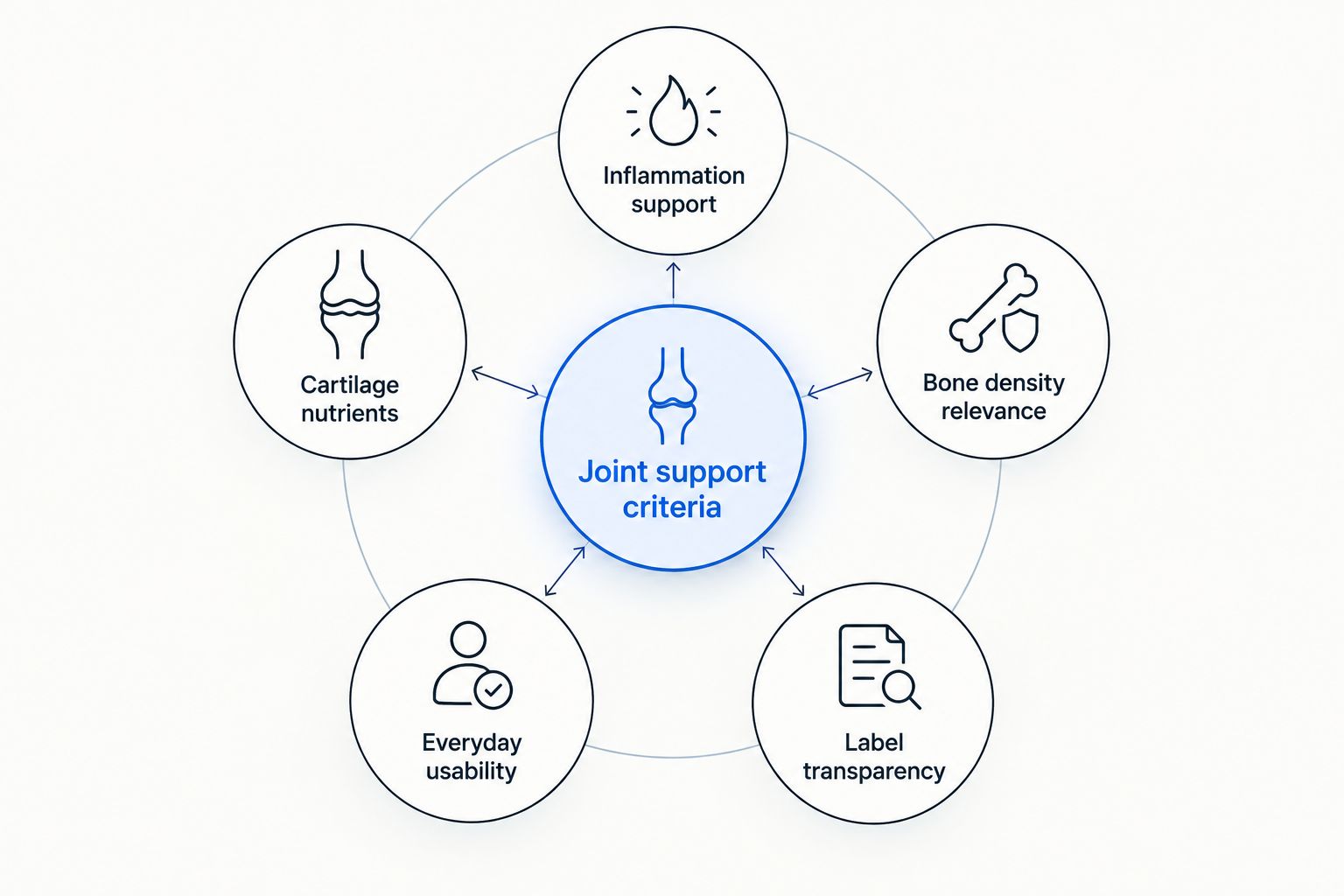
At a glance: supplements for perimenopause joint pain in 2026
| Option | Best for | Standout feature | Key limitation |
|---|---|---|---|
| Osteo Guardian (TruNutra) | Daily joint and bone support | Formulated around bone and mobility together | Exact ingredient amounts are on the product label, not covered here |
| Omega-3 fish oil | Inflammation-driven stiffness | EPA/DHA tied to inflammatory response | Fishy aftertaste; needs consistent daily use to matter |
| Turmeric/curcumin | Occasional flare-ups | Often paired with piperine for absorption | Absorption varies a lot between products |
| Collagen peptides | Cartilage and connective tissue | Commonly studied around 10 grams daily | Effects build over months, not days |
| Magnesium glycinate | Nighttime joint and muscle tension | Gentler on digestion than magnesium oxide | Doesn't act on cartilage directly |
| Glucosamine & chondroitin | Budget-friendly classic combo | Long track record near 1,500 mg / 1,200 mg daily | Slow onset; some people see no change at all |
1. Osteo Guardian: best supplement for daily perimenopause joint and bone support
Osteo Guardian is TruNutra's bone and mobility formula, positioned for people managing everyday joint stiffness alongside the bone density concerns that show up during perimenopause. It's designed to fit into a daily routine rather than as a flare-up rescue product.
Osteo Guardian pros:
- Addresses joint and bone support together instead of treating them as separate problems
- Fits alongside TruNutra's other daily wellness products without overlap in purpose
- Straightforward daily capsule routine
Osteo Guardian cons:
- Specific ingredient amounts are on the product label, not restated here — check it before buying
- Not a fast-acting flare-up remedy; built for consistent daily use
- Won't replace medical evaluation if pain is sudden or severe
Best for: perimenopause joint stiffness paired with bone density concerns. Verdict: Buy as the default daily pick, and read the label before starting.
2. Omega-3 fish oil: best for inflammation-driven joint stiffness
Omega-3 fatty acids, mainly EPA and DHA, are among the most studied nutrients tied to the body's inflammatory response. For joint stiffness that feels worse after sitting still or in the morning, this is the category most researchers point to first.
Omega-3 pros:
- Well-researched connection to inflammatory markers
- Works alongside almost any other supplement without conflict
- Widely available in multiple forms (softgel, liquid, algae-based for non-fish eaters)
Omega-3 cons:
- Fishy aftertaste is common with lower-quality products
- Results take weeks of consistent use, not days
- Doesn't rebuild cartilage on its own
Best for: stiffness that's clearly tied to inflammation rather than mechanical wear. Verdict: Buy if mornings are the roughest part of your day.
3. Turmeric/curcumin: best for occasional joint flare-ups
Curcumin, the active compound in turmeric, gets used specifically for occasional discomfort rather than as a daily maintenance nutrient. It's commonly paired with black pepper extract (piperine) because curcumin absorbs poorly on its own.
Curcumin pros:
- Targeted for flare-ups rather than a lifetime daily commitment
- Piperine-paired versions improve how much actually gets absorbed
- Plant-based option for people avoiding fish-derived omega-3s
Curcumin cons:
- Absorption differs wildly by brand and formulation
- Not a substitute for anti-inflammatory support during ongoing, daily stiffness
- Can interact with blood thinners — check with a pharmacist
Best for: short-term relief during a bad joint week rather than everyday use. Verdict: Hold for flare-ups only, not as a full-time strategy.

4. Collagen peptides: best for cartilage and connective tissue support
Collagen peptides are one of the few categories studied specifically at the connective tissue level, since cartilage is largely made of collagen protein. Studies commonly use doses around 10 grams a day taken consistently over several months.
Collagen pros:
- Directly tied to cartilage's structural protein
- Neutral taste in most powder formats, easy to mix into coffee or smoothies
- No known major interactions with other joint supplements
Collagen cons:
- Slow to show any noticeable difference — think months, not weeks
- Powder form adds a step most capsule routines don't require
- Quality and source (bovine, marine, etc.) vary by brand
Best for: people willing to commit to a long-term routine for cartilage support. Verdict: Buy if you're patient and consistent.
5. Magnesium glycinate: best for nighttime joint and muscle tension
Magnesium glycinate doesn't act on cartilage directly, but it's a common pick for the muscle tightness that makes joints feel worse by evening. Joint stiffness at night often gets blamed entirely on the supplement stack, though sleep position plays a real role in how hips and shoulders feel by morning — choosing an ergonomic pillow keeps the neck and spine aligned so the same magnesium dose does more work while you sleep.
Magnesium glycinate pros:
- Gentler on the stomach than magnesium oxide or citrate
- Pairs naturally with a wind-down routine before bed
- Widely available at doses in the 200–400 mg elemental magnesium range
Magnesium glycinate cons:
- Doesn't address cartilage or inflammation directly
- Effects on joint comfort are indirect, through muscle relaxation and sleep
- High doses can cause loose stools in some people
Best for: joint pain that gets worse specifically at night. Verdict: Buy as a companion, not a standalone joint fix. TruNutra's magnesium-focused routines are covered in the magnesium glycinate supplements breakdown.
6. Glucosamine & chondroitin: best budget classic combo
This is the longest-running combination in the joint supplement category, typically studied near 1,500 mg of glucosamine and 1,200 mg of chondroitin daily. It remains popular mainly because it's inexpensive and widely available, not because the research is unanimous.
Glucosamine & chondroitin pros:
- Decades of use and low cost relative to newer ingredients
- Widely available in combination capsules
- Familiar to most people already shopping the joint aisle
Glucosamine & chondroitin cons:
- Study results are mixed — some people see real change, others see none
- Slower onset than anti-inflammatory options like omega-3s
- Sourced from shellfish in most formulas, which matters for allergies
Best for: budget-conscious buyers willing to test it for a few months. Verdict: Hold — reasonable to try, not guaranteed to work for everyone.
How this list was ranked
Each option was weighed against the five criteria above: inflammation support, cartilage relevance, hormonal-decline fit, everyday usability, and label transparency. Osteo Guardian ranks first because it's the only option built around both joint and bone support for this specific life stage, not because it outperforms every individual ingredient on paper.
Which supplement should you choose?
If you want one daily product that addresses both joint stiffness and the bone density shifts common in perimenopause, Osteo Guardian is the straightforward starting point in 2026. If your stiffness is clearly inflammation-driven — worse in the morning, better with movement — pair it with or start with omega-3 fish oil instead. Save turmeric/curcumin for bad weeks rather than daily use, and add magnesium glycinate if nighttime tension is part of the picture.
Check Osteo Guardian for daily joint support
See the full ingredient list and label details before you start.
FAQ
What's the best supplement for perimenopause joint pain in 2026?
Osteo Guardian from TruNutra is the strongest all-around pick because it addresses joint and bone support together, which matters during the hormonal shifts of perimenopause. Omega-3 fish oil is a close second if your stiffness is clearly tied to inflammation.
Is omega-3 or turmeric better for joint stiffness?
Omega-3 fish oil works better as a daily, ongoing strategy for inflammation-driven stiffness. Turmeric/curcumin is better suited to occasional flare-ups rather than everyday use.
Does magnesium glycinate help with joint pain?
Magnesium glycinate doesn't act on cartilage or joint tissue directly, but it can ease the muscle tension around joints that gets worse at night. It works best as a companion to a joint-focused formula, not a replacement.
How much glucosamine and chondroitin should I take daily?
Studies commonly use around 1,500 mg of glucosamine and 1,200 mg of chondroitin per day. Results are mixed across individuals, so check with a doctor or pharmacist before starting, especially if you have shellfish allergies.
Can collagen peptides really help perimenopause joints?
Collagen peptides support the structural protein that makes up cartilage, and studies typically use around 10 grams daily over several months. Changes build slowly, so it's not a fast-acting option.
Is Osteo Guardian safe to take with other supplements?
Check the product label for the full ingredient list and talk to a healthcare provider about your specific supplement stack, especially if you take prescription medication. General daily wellness formulas are typically designed to fit alongside a routine, not replace it.
How long before joint supplements start working?
Anti-inflammatory options like omega-3s often take several weeks of consistent use to show a difference. Cartilage-focused nutrients like collagen or glucosamine typically take a few months of daily use before changes are noticeable.
Should I talk to a doctor before starting a joint supplement?
Yes, especially if joint pain is new, sudden, or getting worse rather than staying steady. A doctor can rule out other causes and check for interactions with existing medications.
One last thing
Bone density loss and joint cartilage wear are two different processes that both trace back to the same estrogen decline during perimenopause, but they don't move in lockstep. A formula built only for bones won't necessarily ease joint stiffness, and one built only for joints won't do much for bone density — which is exactly why a combined approach, checked against your own label, tends to outperform picking a single trendy ingredient in 2026.